

Has radioactivity risk from oil and gas activity been underrated?
Reviewing a Pennsylvania TENORM Study
By Juliana Henao, Communications Intern
Technologically-enhanced, naturally-occurring radioactive materials, also known as TENORM, are produced when radionuclides deep in the earth are brought to the surface by human activity such as oil and gas drilling. The radioactive materials, which include uranium (U), thorium (th), potassium-40 (K-40) and their decay products, occur naturally in the environment. These materials are known to dissolve in produced water, or brine, from the hydraulic fracturing process (e.g. fracking), can be found in drilling muds, and can accumulate in drilling equipment over time.
According to the EPA, ~30% of domestic oil and gas wells produce TENORM. Surveys have shown that 90% of the wells show some TENORM concentrations, while others have nothing at all. However, with increasing natural gas exploration and production in Pennsylvania’s Marcellus Shale, there is a parallel increase in TENORM. According to Dr. Marvin Resnikoff, an international expert on radiation, drilling companies and geologists locate the Marcellus Shale layer by way of its higher level of radiation.
Bringing more of this TENORM to the surface has the potential to greatly impact public health and the environment. Since 2013, the Pennsylvania Department of Environmental Protection (PA DEP) has been gathering raw data on TENORM associated with oil and gas activity in the state. The study was initiated due to the volume of waste containing high TENORM concentrations in the state’s landfills, something that is largely unregulated at the state and federal level. In January 2015, the PA DEP released a report that outlined their findings and conclusions, including potential exposures, TENORM disposal practices, and possible environmental impacts.
Radioactivity Study Overview

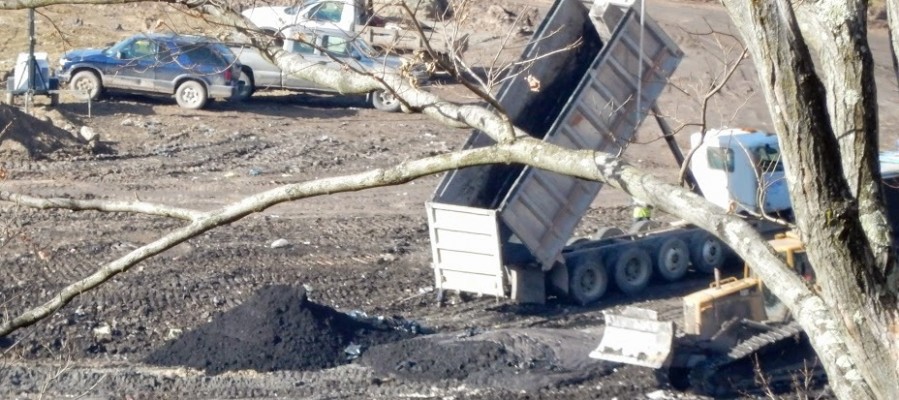
Drilling mud being collected on the well pad
This review touches on the samples tested, the findings, and the conclusions drawn after analysis. The main areas of concern included potential exposure to workers, members of the public, and the environment.
The samples gathered by the DEP came from 38 well sites, conventional and unconventional, by testing solids, liquids, ambient air, soils, and natural gas near oil and gas activity in Pennsylvania. All samples contained TENORM or were in some way impacted by TENORM due to oil and gas operations. The samples were mainly tested for radioactive isotopes, specifically radium, through radiological surveys.
The PA DEP concluded in the cases of well sites, wastewater treatment plants (POTW), centralized wastewater treatment plants, zero liquid discharge plants, landfills, natural gas in underground storage, natural gas fired power plants, compressor stations, natural gas processing plants, radon dosimetry (the calculation and assessment of the radiation dose received by the human body), and oil and gas brine-treated roads that there is little potential for internal radiation exposure to workers and members of the public. In spite of this, each section of the report typically concluded with: however, there is a potential for radiological environmental impacts…
Examples of these findings include:
- There is little potential for radiological exposure to workers and members of the public from handling and temporary storage of produced water on natural gas well sites. However, there is a potential for radiological environmental impacts from spills of produced water from unconventional natural gas well sites and from spills that could occur from the transportation of this fluid.
- There is little potential for radiological exposure to workers and members of the public from sediment-impacted soil at landfills that accepted O&G waste for disposal. However, there may be a radiological environmental impact to soil from the sediments from landfill leachate treatment facilities that treat leachate from landfills that accept O&G waste for disposal.
- Radium 226 was detected within the hydraulic fracturing fluid ranging from 64.0-21,000 pCi/L. Radium-228 was also detected ranging from 4.5-1,640 pCi/L. The hydraulic fracturing fluid was made up of a combination of fresh water, produced water, and reuse flowback fluid. There is little potential impact for radiological exposure to workers and members of the public from handling and temporary storage of flowback fluid on natural gas well sites. However, there is a potential for radiological environmental impacts from spills of flowback fluid on natural gas well sites and from spills that could occur from the transport of this fluid.
- Nine influent and seven effluent leachate samples were collected at the nine selected landfills. Radium was detected in all of the leachate samples. Radium-226 concentrations were detected in produced water samples ranging from 40.5 – 26,600 pCi/L. Radium-228 concentrations were also detected ranging from 26.0 – 1,900 pCi/L. The Ra-226 activity in unconventional well site produced water is approximately 20 times greater than that observed in conventional well site produced water. The ratio of Ra-226 to Ra-228 in unconventional well site produced water is approximately eight times greater than that found in conventional well site produced water. (Sections 3.3.4 and 3.6.3) (PA DEP TENORM study report section 9.0)
According to Melody Fleck from Moshannon Group- Sierra Club Executive Committee:
While the report comprehensively covers the processes from drilling to end users, the number of samples collected and analyzed are very sparse for a state-wide study. Just to give an idea, only 8 well sites were sampled during the flowback phase and of the 8 only 4 had enough volume to analyze. Of 14 drill mud samples collected, only 5 were analyzed as liquids, and alpha & beta analysis was only done on one sample.
Obtaining the proper sample size is often a major barrier for field studies. Additional research needs to be conducted with a larger sample size and more rigorous exposure monitoring to determine specific risk metrics for workers and the public.
Current Handling of TENORM
From drilling to distribution, there are many topics of concern associated with TENORM; however, we will focus on the current treatment of TENORM waste, the release of data, and the transparency of this issue.
On a federal level, there are no specific regulations governing many aspects of TENORM, such as sludge or solids containing TENORM from water treatment plants. Additionally, if concentrations of U or Th make up less than .05% by weight, they are seen as an “unimportant quantity” and are exempt from NRE regulation. Currently, 13 states regulate TENORM with varying degrees of standards. Hazardous waste facilities in each state can choose to accept TENORM materials as long as they don’t exceed certain concentrations.
Today, about 12 of PA’s 50 landfills accept such radioactive waste from oil and gas activity at a 1:50 dilution ratio (related to their other intake sources). Under RCRA’s Land Disposal Restrictions, “dilution is prohibited as treatment for both listed and characterized wastes.”
According to the DEP report, hydraulic fracturing produces an enormous stream of waste by-products. Safe disposal of this waste has not yet been devised. A few of the conclusions concerning TENORM disposal and treatment in the report listed some areas of concern, identified below:
- Filter cake [1] and its radiological environmental impact if spilled, and
- The amount of radioactive waste entering the landfills in PA, which reached 430,317 tons in the first 10 months of 2014.
In unison with the conclusions were recommendations, where the report “recommends considering limiting radioactive effluent discharge from landfills, and adding radium-226 and radium-228 to annual sample analysis of leachate from landfills.” Additionally, the report states that if something such as filter cake spills, it will bring into question the safety of long-term disposal and suggest a protocol revision.
Public Health Concerns
The report identified two places where there is a higher than average radioactive exposure risk for workers and community members of the public: specifically at centralized wastewater treatment plants and zero liquid discharge plants that treat oil and gas wastewater. An additional unknown is whether there is a potential inhalation or ingestion hazard from fixed alpha and beta surface radioactivity if materials are disturbed. As a general precaution, they recommend the evaluation of worker’s use of protective equipment under certain circumstances.
Although research has not come to a consensus regarding a safe level of radiation exposure, it should not be assumed that any exposure is safe. Past research has evaluated two types of radiation exposure: stochastic and non-stochastic, both of which have their own risks and are known to be harmful to the human body. The EPA has defined stochastic effects as those associated with long-term, low level exposure to radiation, while non-stochastic effects are associated with short-term, high-level exposure. From past scientific research, radiation is known to cause cancer and alter DNA, causing genetic mutations that can occur from both stochastic and non-stochastic exposure. Radiation sickness is also common, which involves nausea, weakness, damage to the central nervous system, and diminished organ function. Exposure levels set by the EPA and other regulatory agencies fall at 100 millirem (mrem) per year to avoid acute health effects. As a point of reference, medical X-rays deliver less than 10 mrem, and yearly background exposure can be about 300 mrem.
In the report, Radiological Dose and Risk Assessment of Landfill Disposal of TENORM in North Dakota, Argonne National Laboratory researchers suggest that the exposure to workers be limited and monitored. In many of their studies, they found the doses exceed the 100 mrem/year level in the workers when the appropriate attire is not worn during working hours, which raised some concern.
The DEP deems certain radiation levels “allowable”, but it should be noted that allowable doses are set by federal agencies and may be arbitrary. Based on the PA DEP’s report, consumers of produced gas can get up to 17.8% of their yearly radiation allowance, while POTW workers could get up to 36.3% of their yearly allowable dose. According to the Nuclear Information and Resource Service, radiation bio-accumulates in ecosystems and in the body, which introduces a serious confounder in understanding the risk posed by a dose of 17.8% per year.
Transparency of Radiation Risk
The DEP has been gathering data for their TENORM report since 2012. In July of 2014, Delaware Riverkeeper Network filed a Right-to Know request to obtain the information that the DEP had collected in order for their expert to analyze the raw data. The department refused to release the information, insisting that “the release of preliminary invalidated data, including sample locations, could likely result in a substantial and demonstrable risk of physical harm, pose a security risk and lead to erroneous and/or misleading characterizations of the levels and effects of the radioactive risks.” Essentially, the DEP was equating the risks of radioactive material to the risks of releasing raw data — two incomparable risks. DRN appealed, claiming that they simply sought the raw information, which is presumed public unless exempt, and would have no risk on the public. PA DEP was ordered to release their records to DRN within 30 days.
Conclusion
One observation that you could take from this report is the lack of regulatory advancement. The study is filled with suggestions, like:
- Radium should be added to the PA spill protocol to ensure cleanups are adequately characterized,
- A limited potential was found for recreationists on roads with oil and gas brine from conventional natural gas wells–further study should be conducted, and
- More testing is needed to identify areas of contamination and any area should be cleaned up.
Intent doesn’t make the changes; action does. Will any regulations change, at least in Pennsylvania where radioactive materials are returning to the surface on a daily basis? There seems to be no urgency when it comes to regulating TENORM and its many issues at the state level. Are workers, citizens, and the environment truly being protected or will we wait for a disaster to spur action?
Footnotes:
[1] This is the residue deposited on a permeable medium when a slurry, such as a drilling fluid, is forced against the medium under pressure. Filtrate is the liquid that passes through the medium, leaving the cake on the medium.
 Ted Auch, FracTracker Alliance, 2024.