
Communal Fracture: Concerned Citizens of Western Pennsylvania React to the Various Impacts of Marcellus Shale Fracking on their Communities
By Nate Natale
The 141 acre farm in rural Washington County was a fixer-upper.
The challenge of clearing the 80 overgrown acres on this property suited Ron Gulla just fine. So did the prospect of renovating the farm’s pond, tenant house and barn- all of which he did.
Gulla loves to work, he also loves to hunt and fish. “When I was hungry, I used to catch fish right out of my pond,” said Gulla. His property was perfect for all of these pursuits.
That was until his 2.5 acre pond turned black, killing everything in it- including the fish.
In 2002, like so many in Hickory, Pa., Gulla signed a lease to allow natural gas drilling on his property. In discussing what has happened since, Gulla speaks with an anger and a passion that is impossible to dismiss.
His story is one of the many in Washington County that is fraught with regret. “There are days that I am so mad, I have tears streaming down my face,” said Gulla.
Gulla was one of the last to sign in Hickory, even though his gut told him it was the wrong decision. “People will say, ‘it’s your fault’ and yes, but it wasn’t for the money…it was for the free gas,” said Gulla.
Promised 300,000 cubic square feet of gas per year, Gulla said he never saw any of it.
“Shale gas is wet, you can’t burn it. It has to be processed. They knew all along, we were never going to see that gas,” said Gulla.
He also said that he was never informed that there would be unconventional horizontal drilling on his property.
Gulla said that the lies and deceit he experienced permeates the industry. “If you sign your mineral rights away, you’re signing your land away,” said Gulla.
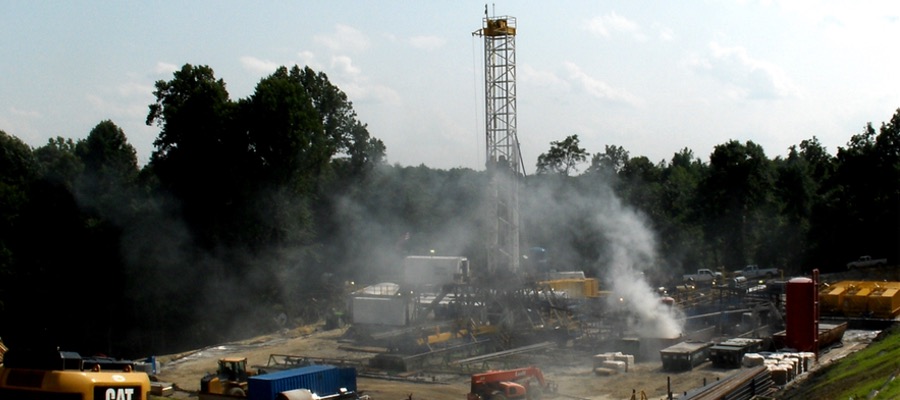
Gulla no longer lives on the farm he said was destroyed by natural gas company Range Resources. It is now owned by the Texas based company, whose Marcellus Division is located in Canonsburg, Pa.
“They treated my farm like a landfill,” said Gulla. He also said that Range Resources never owned up to destroying his land or his pond.
Range Resources did not respond to a request for comment on this story.
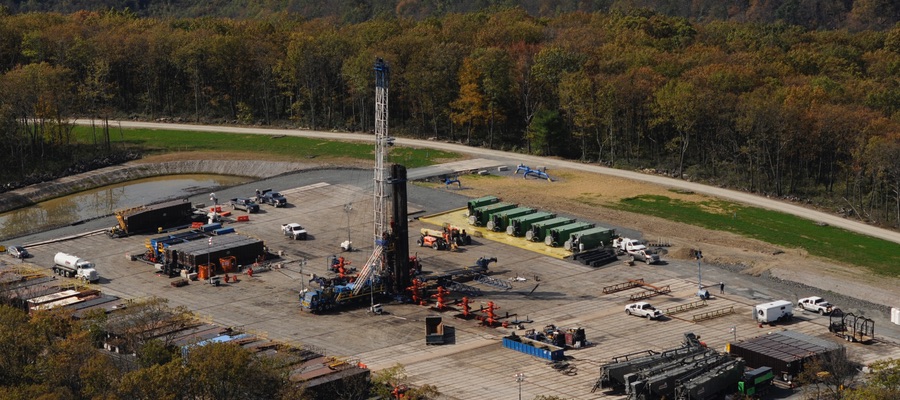
“I know what I know about this industry, I’ve seen the skull and cross bones come onto my property- the black water in my pond, the frack pits. They are destroying the ecosystem,” Gulla said.
The Urban Perspective
Community activists Loretta and Ken Weir, of Pittsburgh, speak with the same passion as Ron Gulla.
After spending their Sunday afternoon at a meeting of the Marcellus Shale Protest organization, the Weirs shared a perspective from an area where drilling is not allowed.
In November 2010, The City of Pittsburgh passed the “Pittsburgh’s Community Protection from Natural Gas Extraction Ordinance”, banning drilling within city limits.
The ordinance alone does not protect the city from pollutants and this is one reason why many residents are still concerned.
“The ordinance is just the beginning- Pittsburgh sits in a bowl, we have to keep moving out- the water sources are all connected,” said Mr. Weir.
Quoting the Pennsylvania Constitution, Article I, Section 27, “The people have a right to clean air, pure water…”, Mr. Weir said that people’s rights are being trampled on by the natural gas industry.
Fourteen waste disposal facilities along the Monongahela River accept and dilute water used in the fracking process, returning it to the river- the source of much of the community’s drinking water.
The chemical solution used in fracking is proprietary, and due to their exemption- known as the Halliburton Loophole- from the 2005 energy bill, the natural gas companies do not have to share its components.
It is the presence of these components in the frack water, some of which are returned to the river, that cause concern.
Due to the Halliburton Loophole, the industry is basically self-reporting. “It’s like the fox watching the henhouse,” said Mr. Weir.
The Weirs said they are frustrated with the lack of oversight and that more was promised. This appears to to be impossible with the budget cuts that the Pennsylvania Department of Environmental Protection (DEP) is experiencing.
“The government has failed to protect the people,” said Mr Weir.
With a lack of trust in the industry and a feeling of dissatisfaction with the government’s efforts, there is a desire to put the topic in front of the people.
Marcellus Shale Protest is exploring the viability of putting a referendum on the 2012 Allegheny County ballot for a moratorium on hydraulic fracturing.
To the Suburbs
In Allegheny County, municipalities like Jefferson Hills are contemplating ordinances that restrict or ban hydraulic fracturing.
In terms of percentage of land under oil and gas lease, Jefferson Hills is ranked tenth in Allegheny County with 18 percent.
“It looks like a new ordinance will go one of two ways: either ban it completely..or allow it in a very small area zoned for industrial activity,” said Anita Barkin, community activist and public health expert.
Ordinances may not be enough. According to the Pennsylvania Oil & Gas Act, the DEP administers the oil and gas well permitting process- superseding municipal ordinances.
However, the courts have not outlined a clear path on what these layers of laws actually mean. At this point, each case is defining the extent of a municipality’s authority to regulate.
Tight Quarters
Suburban fracking creates dangerous scenarios unique to these areas.
“A well blowout or a fire in a densely populated area would make it necessary to evacuate 5,000 people. No one is prepared to do that,” said Conrad (Dan) Volz, director of the Center for Healthy Environments and Communities at the University of Pittsburgh’s Graduate School of Public Health.
“We’ve found that local departments feel inadequately prepared and in situations where there has been an emergency, they’ve played second fiddle to the company. They are also not equipped to do vital air and water testing during an emergency, they have to wait for the DEP to come from a great distance,” said Volz.
Water is also an issue for Jefferson Hills. The Peters Creek Watershed provides source water for the community’s drinking water and functions as a source of recreation. Fracking would put the watershed in a precarious position.
As for Jefferson Hills’ drinking water, “Marcellus drilling does have the potential to affect drinking water quality. The Clairton Municipal Authority is accepting frack fluid at its plant. The effluent of this plant enters Peters Creek just prior to it’s confluence with the Mon River. Drinking water for most watershed residents comes from the Mon River downstream in Hays,” said Tim Schumann of the Peters Creek Watershed Association.
Barkin and Schumann said community education is working, but more needs to be done.
“There are still many residents that have grown up with shallow wells (there are over 40 in Jefferson Hills) and do not realize that the impact of Marcellus wells will be quite different,” said Schumann.
“These are not your grandmother’s wells,” said Volz.
Trouble Ahead, Trouble Behind
More Violations Than Not
Ron Gulla’s pond was destroyed due to a lack of sediment control. “It was pathetic, a joke,” said Gulla.
Studies show that 28 percent of well violations, recorded by the DEP, are due to improper erosion and sediment plans.
On average, 76 percent of wells receive violations.
In Ron Gulla’s case, getting the government to notice was the problem. “No one would help me, the DEP, the county, they all pointed fingers,” said Gulla.
The Great Divide
The natural gas industry has been accused of employing a “divide and conquer” strategy in the communities in which it operates.
Some citizens are happy to accept financial gain for their mineral rights, while others protest.
“What about community members who don’t own the leased land, but live next door? They are exposed to noise, light, air pollution…to waste water, but they get no say,” said University of Pittsburgh’s Volz.
Communities are at risk for divisiveness that comes from some of its members making money, while other members’ health and quality of life are compromised.
Boom and Bust
Research shows that communities involved with energy boom times also experience behavioral health issues.
“These communities have been shown to have an increased need for medical, behavioral and social services. Alcoholism and drug addiction increases, as does the divorce rate and even the number of sexual predators in an area,” said Volz.
Communities have also been promised jobs as part of the boom. “We have been tracking unemployment and haven’t seen an influence,” said Volz.
“Most of the jobs are transient, but even the ones that come from training programs in Pennsylvania, those people won’t stay here. It’s the nature of the field, workers move on to the next well,” said Volz.
The Big Picture
Above all, this issue is about money and money talks.
The natural gas industry is perceived as greedy. The industry has also been accused of preying on the poor, desperate farmers and the elderly.
But, what is happening in Jefferson Hills- an affluent area- points to something else.
Greed on the part of residents.
“Where is their conscious? Money and gain, it’s the way we’re programmed. It’s a tough sell, asking people not to take the money, but in the long run it will ruin your property value and your health,” said activist Loretta Weir.
Long Term?
Pennsylvania Governor Tom Corbett has proposed slashing the state’s education budget, while refusing to tax natural gas. His contention is that the state’s economy will benefit by being the center of the gas boom and any taxation will drive out the industry- despite the fact that the gas cannot leave the state.
“Forty years ago, there was this great insulator, it was asbestos. Look at what we know now. The shale has been there 300 million years, it’s not going anywhere. Until the industry can extract it in a safe way; what’s the hurry? Why risk it?” said activist Ken Weir.
“One of the biggest problems is that there is little or no effort to consider or measure or account for or control the cumulative effect that this process will have in the long-term on water quality and quality of life and health of residents for local communities,” said Schumann.
The Road Ahead
How important is this issue? “It’s the issue of our time. We will be wrestling with this for the next 100 years,” said Volz.
The U.S Energy Information Administration estimates the Marcellus Shale may have enough supply to meet the needs of the U.S. for the next 15 years.
The next 15 years.
Is it worth it? Worth the health risks? Worth the damage to the environment? Worth the impact on our quality of life?
For so many in our consume all society, the cash at stake makes it an easy “yes”.
Ron Gulla disagrees.
“You can’t put a price on quality of life. I was a multimillionaire before Range Resources came into my life and that was based on the quality of life I had,” Gulla said.