

Toxic Risks, Regulatory Failures: Four Years after Passage of Colorado’s Groundbreaking Oil & Gas Chemical Disclosure Law, Dangerous Regulatory Gaps Remain
Toxic Risks, Regulatory Failures
Four Years after Passage of Colorado’s Groundbreaking Oil & Gas Chemical Disclosure Law, Dangerous Regulatory Gaps Remain


Executive Summary
Coloradans are at risk of exposure to a mix of toxic and secret chemicals used in oil and gas wells, according to this second in a series of reports analyzing data disclosed under a 2022 state law, HB22-1348. The law expanded oil and gas chemical disclosure requirements and banned the use of toxic PFAS in wells with underground operations occurring on or after July 31, 2023. Some chemicals disclosed under the law and found to be widely used in Colorado include acrylamide and ethylene oxide, both linked to cancer. These substances were among those injected into a well in Galeton that sprayed a plume of gas and fluids across neighboring properties in 2025. The event led to evacuations of homes and a nearby elementary school.
However, alongside the troubling findings about disclosed chemical use, our investigation also found that many oil and gas chemicals continue to be used without disclosure, creating risks of unknowing exposure to toxic substances. That’s largely because regulators at the Energy & Carbon Management Commission (ECMC) tasked with implementing the 2022 law are still not fully enforcing the law’s requirement that oil and gas companies disclose all chemicals used underground in “downhole operations.” During oil and gas operations, companies can use chemicals in multiple underground operations including drilling, fracking, and enhanced oil recovery (EOR). But ECMC has required disclosure only of chemicals used in fracking. In addition, our analysis shows unexplained discrepancies in reporting based on a comparison between fracking chemical disclosures from the same well pads to ECMC under the 2022 law and to the FracFocus database under still-applicable 2012 rules. Our investigation also shows that oil and gas companies have disclosed the use of prohibited fracking chemicals which are banned by a separate state rule that took effect in 2021. An interactive map showing which chemicals were disclosed as being used on particular well pads, whether under the 2022 law or 2012 rules, can be found at this link. Finally, ECMC has provided conflicting statements about whether regulators or oil and gas companies are complying with the 2022 law’s provision requiring operators to notify first responders and others of the list of chemicals injected into nearby oil and gas wells. It is unclear whether this provision is being implemented.
Together, our findings show that Coloradans may be exposed to dangerous oil and gas chemicals, often without their knowledge – denying residents the opportunity to take steps to avoid or mitigate harm. This situation is what the law was intended to prevent.
Based on our review of state records and conversations with state regulators, our key findings include:
Key Findings
- Since the law went into effect, oil and gas companies reported using 255 fracking chemicals on 285 well pads, whether these substances were disclosed under the 2022 law, the 2012 rules, or both. At least several of these substances are widely used and associated with significant negative health impacts including 1,2,4-trimethylbenzene, acrylamide, ethylene oxide, formaldehyde, methanol, and propargyl alcohol. An estimated 50,000 Coloradans live within a mile of well pads covered by the 2022 law on which at least one of these six chemicals was used. Toxic chemicals have been used in thousands of older wells, too. See Appendix A for a list of chemicals disclosed under both the 2022 and 2012 disclosure regimes.
- Oil and gas wells covered by the 2022 law have been operating without disclosure of drilling chemicals for at least a collective 843,369 days or well-days between the date when ECMC should have required and reported disclosure of the chemicals and August 27, 2026 when we conducted our analysis.
- On about 80 percent of well pads that could be directly compared (178 of 223), chemicals were 1) disclosed to FracFocus under the 2012 rules, but not to ECMC’s website under the 2022 law or 2) disclosed to ECMC’s website but not to FracFocus. In some cases, the discrepancy could be explained by disclosure to ECMC’s website of chemicals withheld as trade secrets under the 2012 rules. But in other cases, this explanation is not applicable, suggesting errors in the respective disclosure systems.
- Disclosures show that 77 oil and gas wells were injected with fracking chemicals prohibited under a separate state rule that took effect in 2021.
- It is unclear whether ECMC or operators are complying with a portion of the 2022 law that requires operators to notify residents, first responders, water providers, and others of the chemicals used in nearby oil and gas wells covered by the law.
An increasing number of studies, including some focused on Colorado, indicate that populations living near oil and gas wells have a higher risk of disease including cancer, congenital heart defects, and low infant birth weights. This report shows that Coloradans have continued reason to be concerned that exposure to oil and gas chemicals could contribute to these negative health impacts. Coloradans could be exposed to oil and gas chemicals through pathways including migration in groundwater through cracks in oil and gas wells, aboveground spills of chemicals or wastewater that seep into water supplies, air emissions during normal well drilling, production, and completion activities, or blowouts like the one in Galeton.
Last year, our analysis of the implementation of the 2022 law found that as of May 1, 2025, chemical disclosures were available for only 439 of at least 1,114 oil and gas wells subject to the law, a reporting rate of just 39 percent. Well operators could have been liable for at least $37 million in fines, if the well operators were responsible. Since publication, compliance has improved, and there is currently at least some fracking chemical disclosure data available for almost all wells covered by the law. But significant gaps remain.
In light of our findings, FracTracker Alliance, Colorado Sierra Club, and Physicians for Social Responsibility Colorado recommend the following:
Recommendations
- ECMC should immediately implement, 1) the provision of the 2022 law requiring disclosure of all chemicals used “downhole” in oil and gas wells including those used for drilling, fracking, enhanced oil recovery, and other underground operations and, 2) the requirement that oil and gas companies provide a list of chemicals injected into their wells to people and institutions located nearby, including residents, first responders, schools, and water providers by establishing a system of reporting, monitoring and enforcement. The Governor, who effectively controls ECMC, should require the commission to comply with the law if ECMC fails to act.
- ECMC should hold oil and gas companies accountable for any violations of the 2022 law and a 2021 rule prohibiting use of certain fracking chemicals by consistently collecting fines that reflect the severity of the operators’ violations and taking other enforcement actions likely to result in full compliance.
- State agencies should partner with academic institutions to monitor air and water for the chemicals highlighted in this report and assess the health risks of exposure to those chemicals.
- ECMC should work with institutions like the Colorado School of Mines to test for chemical composition of fracking fluid and oil and gas wastewater from a representative sample of wells to ensure that the chemicals being disclosed to the public encompass all of the chemicals injected into the wells.
- ECMC should eliminate and/or explain discrepancies between the chemicals disclosed to FracFocus and the chemicals disclosed to ECMC.
Contents
- Executive Summary
- 1 Health Concerns, Oil and Gas Chemical Secrecy Prompt 2022 Law
- 2 Law Improved Oil & Gas Chemical Disclosure, but Implementation Gaps Leave Public at Risk
- 3 Data Show Chemicals of Concern
- 4 Discrepancies in Chemical Disclosures Under 2022 Law, 2012 Rules
- 5 Use of Prohibited Chemicals
- 6 Testing Could Help Verify Accuracy of Disclosure
- 7 Recommendations
- Notes
Chapter 1Health Concerns, Oil and Gas Chemical Secrecy Prompt 2022 Law
This chapter discusses both the impetus behind HB22-1348, a Colorado law enacted in 2022, and how it offers important protections to Coloradans from chemicals used in oil and gas production. This first-in-the-nation law, codified at C.R.S. 34-60-132, bans the use of intentionally added per- and polyfluoroalkyl substances (PFAS) in oil and gas wells and requires full disclosure of chemicals used in the wells during underground “downhole operations.” PFAS are a class of highly toxic chemicals1 known for their negative health impacts2 and their persistence in the environment, hence their nickname, “forever chemicals.”3 A separate law enacted the same year, HB22-1345, codified at C.R.S. § 25-15-604, bans the sale and distribution in Colorado of drilling fluid, fracking fluid, and proppants (a component of fracking fluid) if these products contain intentionally added PFAS. HB22-1348 aimed to increase disclosure of individual oil and gas chemicals compared to disclosure under the existing – and still applicable – regulations enacted in 20124 by the Colorado Oil and Gas Conservation Commission, since renamed the Energy & Carbon Management Commission (ECMC). ECMC regulates oil and gas extraction in Colorado, among other responsibilities, and is led by five commissioners appointed by the Governor.5 The 2012 regulations require operators to publicly disclose chemicals used in Colorado’s oil and gas wells for hydraulic fracturing or “fracking,” a process that typically involves the underground injection of water, sand, and chemicals at high pressure to fracture underground formations and access trapped oil and gas.
Last year, in a prior report, Oil and Gas Chemicals Still Secret in Colorado, we examined whether oil and gas companies and/or ECMC had publicly disclosed any chemicals under the 2022 law and found significant non-compliance. Now, for the first time, this report examines the chemicals that have been disclosed under the 2022 law and shows that at least several of them are both toxic and widely used. Here, we also highlight ECMC’s ongoing failure to fully implement the law, leaving the public at risk of unknowing exposures to toxic substances. As a byproduct of our analysis, we found that in 77 oil and gas wells, oil and gas companies disclosed the use of fracking chemicals prohibited by a separate state rule that took effect in 2021. In total, our findings raise serious concerns about ECMC’s commitment to protecting the public from toxic exposures related to oil and gas production.
The 2022 law was prompted in large part by release of Fracking with ‘Forever Chemicals’ in Colorado, a report published that year by Physicians for Social Responsibility (PSR) showing that PFAS had been used in almost 300 oil and gas wells in Colorado and that secret oil and gas chemical use was pervasive. PSR found that the extent of PFAS use and the use of other toxic chemicals in Colorado’s oil and gas wells was unknown due to lax reporting standards under the 2012 rules and widespread concealment of chemical identities. According to PSR’s report, between 2011 and 2021, companies used trade secret claims to hide the identity of at least one fracking chemical in more than 12,000 oil and gas wells, a practice allowed under the 2012 rules. These secret chemicals totaled almost 414 million pounds.6 PSR reported that there were no requirements under the rules for public disclosure of chemicals used in drilling, which precedes fracking, or in other stages and methods of oil and gas production such as enhanced oil recovery.7 PSR also reported that the 2012 rules required chemical disclosure from companies further down the supply chain but not from chemical manufacturers which are best positioned to know what chemicals are being used in oil and gas wells.8 Evidence suggested that the chemical manufacturers did not always share chemical ingredients with downstream users of their products, making it impossible for those downstream users to fully disclose chemical ingredients to the public.9
Documented Health Risks and Impacts from Exposure to Oil and Gas Chemicals
The lack of disclosure was unsettling because many of the substances used in oil and gas production have negative health impacts, raising the potential that Colorado residents and oil and gas workers were being unknowingly exposed to harmful chemicals. In 2016, the United States Environmental Protection Agency (EPA) published a study that identified 1,606 chemicals used in fracking fluid and/or found in fracking wastewater. The agency found high-quality information on health effects for only 173 of these chemicals, a significant gap in knowledge that could leave the public unknowingly exposed to harmful chemicals. As for the chemicals with high-quality information, the data were troubling. EPA found that “health effects associated with chronic oral exposure to these chemicals include carcinogenicity, neurotoxicity, immune system effects, changes in body weight, changes in blood chemistry, liver and kidney toxicity, and reproductive and developmental toxicity.”10
As PSR’s 2022 report showed, chemicals used during drilling, which precedes fracking and involves its own mixture of substances, can also pose health risks. As early as 2006, EPA regulators expressed concern that drilling chemicals could be associated with developmental toxicity and the formation of tumors.11 A disclosure form filed with the state of Ohio, showed that the neurotoxic chemical xylene has been used in drilling, along with other chemicals linked to negative health impacts.12 Xylene can cause effects ranging from headaches, dizziness and confusion to impaired reaction time, memory, and vision.13 A scientific paper published in 2020 shows that PFAS had at least been proposed for use in drilling.14
Since the publication of PSR’s report, two peer-reviewed studies, both focused on Broomfield, Colorado, have shown that the drilling phase of oil and gas development can be associated with negative health impacts.15 The two papers were published after an epidemiological study was conducted in Broomfield during the development of multiple oil and gas wells and found that adults living within one mile of six, large-scale unconventional oil and gas pads reported higher frequencies of upper respiratory, lower respiratory, gastrointestinal and acute symptoms (e.g. nosebleeds, nausea, shortness of breath) than respondents living more than two miles from these well pads.16 Subsequently, a study of air pollution in Broomfield published in 2025 found that during the drilling phase, there were elevated risks for immunological harms at sites located near unconventional oil and gas wells. Unconventional wells involve methods such as hydraulic fracturing and horizontal drilling.17 The 2025 study further found that “When looking at the [air] concentrations of these chemicals and chemical groupings (BTEX, n-nonane, and aliphatic low hydro-carbons), the highest median concentrations were observed in conjunction with drilling operations….”
The chemicals listed above as being associated with drilling include volatile organic compounds, and several of these chemicals are associated with serious health harms. For example, BTEX stands for benzene, toluene, ethylbenzene, and xylenes. Long-term exposure to benzene can result in bone marrow cancers including acute myelogenous leukemia.18 Toluene,19 ethylbenzene,20 and xylenes21 are associated with their own set of negative health impacts. Benzene, ethylbenzene, and xylene are on Colorado’s list of chemicals which since 2021 have been banned for use during hydraulic fracturing, but not during drilling.22
A separate study of air pollution in Broomfield published in 2024 found that “Emissions of C8-C10 n-alkanes during drilling operations highlighted the importance of [volatile organic compound] emissions from synthetic drilling mud chosen to reduce odor impacts.” Drilling fluid is a key component of drilling mud23 which helps lubricate the drill bit and facilitates the return of rock cuttings to the surface. The authors were concerned that emissions of C8-C10 n-alkanes from the drilling mud, prepared using a drilling fluid known as “Neoflo,” could increase the production of ozone in the atmosphere.24 Ozone can aggravate lung diseases such as asthma and can damage the respiratory system.25 Data from the study also showed that both Neoflo and, especially, another petroleum-based drilling fluid that has been used in Colorado, Gibson D822, contained benzene.26
Health hazards could also be associated with chemicals used for enhanced oil recovery (EOR), which involves a range of techniques including flooding underground formations with chemicals.27 EPA regulators have expressed concern that chemicals used for EOR could cause developmental toxicity and liver and kidney effects28 among other hazards. As PSR noted in its 2022 report, a scientific paper published in 2020 stated that PFAS, in the form of fluorinated surfactants, had at least been proposed for use in EOR.29 PSR also cited a 2008 paper published in an oil and gas industry journal which reported that a fluorinated surfactant had been used for EOR in a well in Moffat County.30 The authors did not use the term PFAS, but described fluorinated surfactants in ways that are commonly used to describe PFAS including being oil- and water-repellent and having a strong carbon-fluorine bond. Since publication of PSR’s report, the authors of the current analysis of Colorado’s HB22-1348 have identified publications from the governments of Canada31 and Norway32 stating that PFAS have been used for a variety of applications in oil and gas production including enhanced oil recovery, drilling and, according to the Canadian government, fracking.
As of 2022, studies showed that people living near oil and gas wells suffer disproportionate health impacts compared to those living farther away, raising questions about whether exposure to oil and gas chemicals was contributing to these harms. A 2017 study of Coloradans with ages from birth to 24 years old diagnosed with blood cancer between 2000 and 2013 found that those between the ages of five and 24 were more than four times more likely to live in areas of heavy oil and gas drilling, compared to controls. Heavy drilling was generally defined as more than 33 oil and gas wells per mile within a 10-mile (16.1 km) radius of a child’s home. The number of wells was weighted so that wells closer to a child’s home were assigned more weight. “For example,” the authors wrote, “[a weighted] well count of 78.1 wells per kilometer could be computed from 125 wells each located 1.6 kilometers from the maternal residence or 25 wells each located 0.32 kilometers from the child’s residence.”33 A 2019 study examined 3,324 babies born in Colorado between 2005 and 2011 and found that, compared with control groups, congenital heart defects were 1.4 and 1.7 times more likely in babies born to mothers in areas of medium and high unconventional gas drilling, respectively.34 Medium intensity drilling was generally defined as between 1 and 403 oil and gas wells per square mile within a 10-mile radius of the baby’s mother’s home while high drilling intensity was defined as greater than 403 oil and gas wells per square mile within the 10-mile distance. As in the previous study, wells located closer to a baby’s mother’s home received greater weight in calculating the intensity of drilling.
On a national scale, PSR, Concerned Health Professionals of New York, and the Science & Environmental Health Network collaborated to compile and summarize the substantial and growing number of scientific studies that have found serious health effects associated with oil and gas drilling. In the ninth edition of their Compendium (2023), they wrote,
With more than 17.6 million U.S. residents living within one mile of at least one active oil and gas well, the result is a public health crisis. As documented in more than 120 studies, public health harms now linked with drilling, fracking, and associated infrastructure are well established. They include cancers, asthma, respiratory diseases, skin rashes, heart problems, and mental health problems. Multiple corroborating studies of pregnant women residing near fracking operations across the nation show impairments to infant health, including birth defects, preterm birth, and low birth weight [associated with inhibited growth and cognitive development35 and a leading contributor to infant death in the U.S.36]. Emerging evidence shows harm to maternal health— including elevated risks for eclampsia during pregnancy—and shortened lifespans among older residents living in proximity to oil and gas wells.37
Studies published after release of PSR’s 2022 report have continued to find health risks and health impacts associated with oil and gas operations including those in Colorado.38
Full disclosure of chemicals used underground in oil and gas wells would help Coloradans address these negative health impacts. Scientists and health professionals could review full chemical disclosures to determine if there were links between the use of particular oil and gas chemicals and illnesses. First responders, residents, and others could analyze the disclosures to better advocate for protections such as prohibitions on the use of certain chemicals or set-back areas where oil and gas operations would be prohibited. But if some chemicals used underground in oil and gas production remain undisclosed, Coloradans face continued risk of unknowing exposure to toxic chemicals with limited ability to act to prevent health and environmental harms.
Chapter 2Law Improved Oil & Gas Chemical Disclosure, but Implementation Gaps Leave Public at Risk
HB22-1348 was enacted to ensure complete disclosure of chemicals used underground in oil and gas wells by closing gaps in the 2012 oil and gas chemical disclosure rules without replacing those rules. But our analysis shows that four years after enactment, ECMC is not fully enforcing the law, and thereby leaving the public at risk of unknowing exposure to toxic chemicals.
The 2022 law made several improvements on the 2012 rules. The 2022 law requires public disclosure of all individual chemicals used “downhole” in oil and gas wells with no exceptions for trade secrets. The law also requires disclosure from all companies in the oil and gas chemical supply chain including chemical manufacturers who are in the best position to know the composition of chemical products being used in oil and gas wells. The law prohibited the use of intentionally added PFAS in oil and gas wells, and it requires oil and gas well operators to provide the public list of chemicals used underground in oil and gas wells to people and entities located nearby including residents, first responders, schools, and water providers. Full chemical disclosure under the law is important not just to inform the public about toxic risks, but also to show whether oil and gas companies are complying with the ban on PFAS use.
The 2022 law lays out a three-part process to facilitate chemical disclosures. First, companies that provide or manufacture chemical products used in oil and gas wells are required to disclose the products, which often contain multiple ingredients, and the ingredients themselves, to ECMC. Second, well operators are required to disclose to ECMC which of the products were used in underground operations at each oil and gas well site. Finally, ECMC must match the products used at the well site with the list of products and ingredients on file and post on its website the list of chemical ingredients used in underground operations at each well site. In most cases, ECMC must make these disclosures within 150 days after an underground operation begins. The law covers oil and gas wells in which underground operations were occurring on or after July 31, 2023.
The law was slow to roll out, and has gradually taken effect, but only for fracking chemicals. The law required ECMC to disclose underground oil and gas chemicals beginning on December 28, 2023. But disclosures did not appear on ECMC’s website until September 2024 following a Colorado Open Records Act request submitted to ECMC by PSR Colorado. In May 2025, the same coalition of environmental groups publishing this report, published, Oil & Gas Chemicals Still Secret in Colorado, showing that ECMC had posted fracking chemical disclosures for only about 40 percent of the oil and gas wells covered by the law.39 Subsequently, disclosures increased significantly. By Nov. 1, 2025, ECMC had posted fracking chemical disclosures for almost all of the 1,750 wells covered by the 2022 law, and ECMC has continued to post fracking chemical disclosures for almost all covered oil and gas wells. Separately, under the 2012 rules, well operators have continued to disclose fracking chemicals for the same wells to the FracFocus database.

2.1Failure to Require Disclosure of Chemicals Used for Drilling, Other Production Techniques
Some alarming gaps in chemical disclosure remain under the 2022 law. One of the most significant is that ECMC has failed to enforce disclosure of all chemicals required to be reported under the law. The 2022 law requires disclosure of chemicals used in “downhole operations,” defined as “oil and gas production operations that are conducted underground.” Multiple such operations are conducted underground including drilling, fracking, enhanced oil recovery, and the use of tracers that are used to assess both the efficiency of fracking and other objectives.40 But ECMC has told state legislators and environmental advocates that the phrase “oil and gas production” limits the disclosure of oil and gas chemicals to those used in fracking,41 suggesting that the terms “oil and gas production” and “fracking” are synonymous.
Yet the term “oil and gas production,” while not defined in the law or in ECMC’s regulations, has been used by prominent institutions, including ECMC, itself, to encompass a variety of underground activities. In honor of its 75th Anniversary this year, ECMC itself poses the question “Which technologies advanced oil and gas production in Colorado?” The ECMC answers with several technologies that are used underground including “Vertical cable-tool drilling tool,” “Horizontal directional drilling,” “Massive hydraulic fracturing (MHF),” and “Multi-stage horizontal directional drilling.”42 The ECMC all but says that oil and gas production operations include not just fracking, but also at least drilling. Therefore, based on the ECMC’s use of the phrase, “oil and gas production,” chemicals used in at least drilling and fracking should be disclosed under the 2022 law.
Other institutions including the oil and gas industry’s leading trade association, the American Petroleum Institute (API), provide additional evidence that the phrase “oil and gas production operations” extends beyond fracking, and that the 2022 law requires disclosure of more than fracking chemicals. In a presentation posted on API’s website, the institute writes that “Oil production includes drilling, extraction, and recovery of oil from underground,” suggesting that oil production includes at least drilling and enhanced oil recovery, if not fracking.43 The Library of Congress echoes this broad understanding. In a research guide to the oil and gas industry entitled “Upstream: Production and Exploration,” the library includes a heading entitled “production.” Under this heading, the library includes discussions of both drilling and fracking.44
In some cases, the use of the phrase “oil and gas production” is used very narrowly to mean 1) only the stage after drilling and fracking during which oil, gas and other substances move up the well and are collected for commercial use or disposal45 or, similarly, 2) a post-drilling and post-fracking phase that might include enhanced oil recovery.46 But these uses of the term “production” would make no sense if applied to the 2022 law because they exclude fracking while the law explicitly requires disclosure of “hydraulic fracturing fluids.”
In addition, the language of the 2022 law shows that disclosure extends beyond fracking. The law’s preamble states that “[t]he general assembly hereby finds and declares that…Many different types of products that contain chemical additives are used by operators during the drilling and stimulation of these wells to break up the subsurface and extract oil and gas from the ground…Even though exposure to these chemical additives poses a danger to public health and the environment, scientists, state and local regulators, and the public lack full access to information about the chemical additives used in oil and gas production in the state.” The use of the terms “drilling” and “stimulation” (stimulation encompasses at least fracking and “matrix treatments” according to ECMC’s rules47) indicate that the law covers at least fracking chemicals and those used in drilling, too. In the body of the law, substances that must be disclosed include “additives” which can be used in drilling,48 fracking,49 or enhanced oil recovery;50 “base fluids,” which can be used in drilling51 and fracking;52 and “chemicals” which “means any element, chemical, compound, or mixture of elements or chemical compounds that has a specific name or identity, including a chemical abstracts service number [a unique numeric identifier for chemicals].” Chemicals could be used in any phase of underground operations. This broad language further demonstrates that the law is intended to apply to disclosure of all chemicals used underground in oil and gas wells, whether in drilling, fracking, enhanced oil recovery, or otherwise.
In November 2025, after environmental advocates and legislators expressed concerns to ECMC that the agency’s interpretation of the law was too limited and inaccurate, the Director of ECMC and the Chair of the Commission agreed to expand disclosure requirements by including chemicals used in the first stage of drilling and the first stage of installing cement in oil and gas wells.53
This proposal, while a step forward, would not cover all chemicals required to be disclosed under the law. Drilling typically involves multiple stages. In each stage, oil and gas companies drill deeper into the earth, insert hollow, cylindrical steel casing, and inject a layer of cement to fill the empty space between the outside of the steel casing and the borehole. The companies repeat the process until they reach the target formation where oil and/or gas is located.54 Different chemicals can be used in different stages.55 But under the ECMC’s latest interpretation of the 2022 law, only chemicals used in the first stage would be disclosed. Nor does the ECMC’s interpretation cover chemicals used for enhanced oil recovery or other techniques. Furthermore, to date, no chemicals other than fracking chemicals have been disclosed, and ECMC has issued no timetable for their disclosure.
This delay is troubling and inexplicable not only because the 2022 law requires ECMC to require disclosure of all chemicals under the 2022 law but also because another law, SB19-181, also empowers the ECMC to require disclosure of chemicals used underground. Enacted in 2019, SB19-181 was designed largely to shift the ECMC’s mission away from simply promoting oil and gas production. The law requires ECMC, among other things, to “[e]nhance safety and environmental protections during operations such as drilling and hydraulic fracturing.”56 It also provides that ECMC “shall regulate oil and gas operations in a reasonable manner to protect and minimize adverse impacts to public health, safety, and welfare, the environment, and wildlife resources and shall protect against adverse environmental impacts on any air, water, soil, or biological resource resulting from oil and gas operations.”57 This measure gives ECMC broad authority to require disclosure of all chemicals used in oil and gas wells.58
Ultimately, the governor is responsible for the ECMC’s lack of enforcement of HB22-1348 because he directly or indirectly appoints all of the agency’s leaders. The governor appoints the executive director of the department of natural resources59 who, in turn, selects the director of ECMC.60 The executive director or the executive director’s designee also serves as a non-voting member of the ECMC as does another gubernatorial appointee, the executive director of the department of public health and environment, or this executive director’s designee.61 In addition, the governor appoints each of the five voting commissioners of ECMC who he can remove at any time.62 If the governor wanted to ensure proper enforcement of HB22-1348, he could demand it or replace ECMC’s current leadership with people who would enforce the law.
The stakes for the public are high because of the potential that toxic chemicals are being used in Colorado’s oil and gas wells without disclosure, preventing the public and regulators from taking steps to protect health and the environment. To understand the scale of the effect that lack of disclosure of chemicals used for drilling and other non-fracking techniques has had on Coloradans, we calculated the total number of days that wells covered by the 2022 law have been out of compliance with the law’s requirement for disclosure of drilling chemicals. We used the “spud dates” (the first day of a drilling process) from the Colorado state well database63 to determine which wells were covered by the law: those that had underground operations occurring on or after July 31, 2023. A total of 2,130 wells in the state data set met those criteria, and 1,644 were subsequently fracked. To be conservative, we used only the fracked wells in our calculation of total non-compliance well-days for drilling chemical disclosure. Non-fracked wells could include some wells that are not developed for oil and gas.
The 2022 law requires that public disclosure of chemicals for oil and gas wells must occur within 150 days of July 31, 2023 for underground operations ongoing as of that date or within 150 days of the start of underground operations for underground operations that began later. For those oil and gas wells with drilling operations that had reached the 150-day reporting deadline, we calculated the number of days without public disclosure of drilling chemicals between the reporting deadline and the date of our analysis, August 27, 2026. Because the law has been effective since July 2023, many wells have drilling operations hundreds of days out of compliance with the law. In total, there were 843,369 well-days of non-compliance, that is, the number of days that Coloradans have lacked the drilling chemical disclosure information promised by the 2022 law.64
843,369well-days without the drilling-chemical disclosure HB22-1348 requires, across 1,644 covered wells that were later fracked (as of Aug. 27, 2026).
2.2Uncertain Implementation of Community Notification
Another important provision of the 2022 law requires operators to provide a list of chemicals used in oil and gas wells directly to people or entities located near the wells. It is unclear whether ECMC or the operators have implemented this provision. In November 2025, ECMC’s then-director Julie Murphy told a group of legislators and environmental advocates that ECMC had not yet implemented this portion of the law.65 The law requires ECMC to provide well operators with a list of chemicals disclosed as being used in each well, and then the operators must disclose the list to nearby residents, first responders, water providers, schools, and others. However, in October 2026, the chair of ECMC’s Commission, Jeff Robbins, told a group of legislators and environmental advocates that ECMC has heard that operators were complying with the community notification requirement. The ECMC did not provide written evidence to support this claim.66
Compliance is important because, unless Coloradans are regularly checking the ECMC’s website – which, as described in this report, is incomplete – those entitled by law to notification of oil and gas chemicals use might be completely uninformed about chemical risks at nearby wells and might have to scramble for information in the event of an emergency.
The April 2025 Bishop Well blowout near Galeton illustrates why advance access to chemical information matters. The uncontrolled release forced residents within a half-mile radius to evacuate67 and closed nearby Galeton Elementary School for nearly two weeks68 while responders monitored air and water, sampled soil, and cleaned homes, roads, vehicles, and the school.69 The well released oil, gas, and other wellbore fluids,70 making timely information about chemicals used in the well potentially important to emergency responders and nearby residents.
Having chemical information on-hand can help protect communities and first responders according to a letter about oil and gas chemicals sent to EPA in 2019 by a group of advocates including a fire department battalion chief. “[H]azardous materials teams and other responders depend on knowing what chemicals are present, especially during the first 30 minutes after an incident when they can best contain a spill and effectively evacuate people at risk,” the authors wrote. “But if the responders do not know which, if any, chemicals are present, they may be initially and unknowingly exposed to dangerous substances. Once they determine that unknown chemicals are present, they may have no choice but to back out to protect themselves, evacuate large areas that may or may not be impacted, and watch as a spill worsens and contamination spreads.”71 Enforcing the 2022 law’s community notification provision is important to ensure safety for first responders and others.
Chapter 3Data Show Chemicals of Concern
In the meantime, disclosure of fracking chemicals under both the 2022 law and the 2012 rules, creates an opportunity to assess these chemicals and to compare the two disclosure regimes. Because the same fracking operations are subject to both disclosure regimes, the chemicals reported in each database for the same well pads should largely agree; however, they often do not as discussed further in Chapter 4. Comparing the disclosures therefore provides a way to assess the completeness and reliability of both disclosure regimes. A comparison of the fracking chemicals disclosed to ECMC for 223 well pads with the fracking chemicals disclosed to FracFocus for the same well pads shows that oil and gas companies operating in Colorado have reported using a total of 255 fracking chemicals on these well pads since 2023, at least several of them known to be toxic.
For ECMC, oil and gas well operators disclose fracking chemicals used on each well pad, which can contain multiple individual oil and gas wells. For FracFocus, operators disclose fracking chemicals used in each individual oil and gas well. Using documents on ECMC’s website, we were able to match each individual oil and gas well in FracFocus with its corresponding well pad on ECMC’s website.
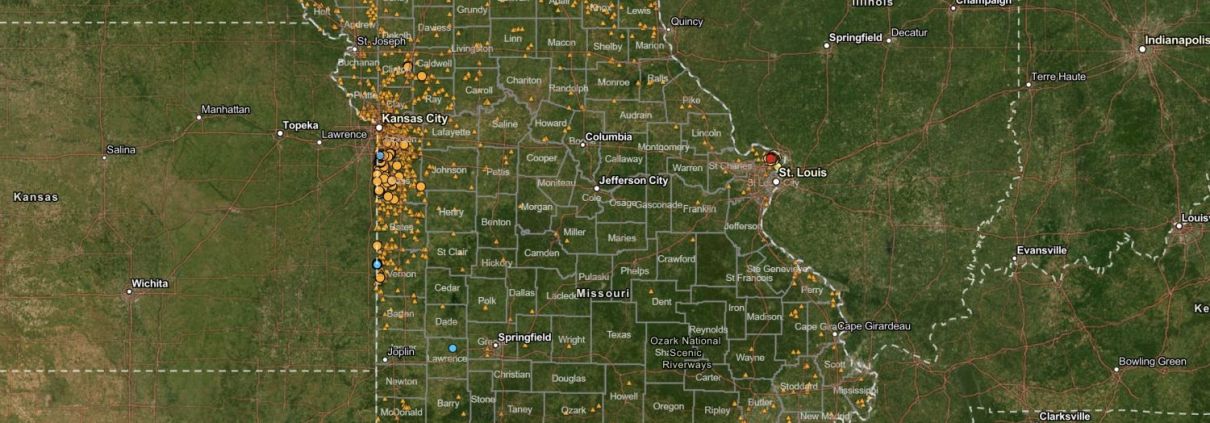
The map below allows users to see the locations of well pads where the chemicals have been used, represented by green circles. An interactive version of the map allows users to zoom in on each well pad to see its precise location. Clicking on the green circles displays information showing to which database the chemicals used on that particular well pad were disclosed (ECMC, FracFocus, or both), a link to information about each chemical’s health hazards, if available, and other related information such as the oil and gas company operating the well pad. See Appendix A for a complete list of chemicals disclosed under both the 2022 and 2012 disclosure regimes. In some cases, companies disclosed the use in fracking of chemicals prohibited by a separate state rule that took effect in 2021. These well pads are represented by red triangles, and the prohibited chemicals and associated rule are discussed in more detail in Chapter 5. Clicking on the red triangles shows which prohibited chemical(s) was used on a particular well pad and related information such as the oil and gas company operating the well pad.
Figure 2. Colorado oil and gas well pads covered by HB22-1348, and well pads with disclosed prohibited chemicals.
Figure 2. Green circles: well pads covered by HB22-1348. Red triangles: well pads where at least one fracking chemical prohibited by a 2021 state rule was disclosed. Well pads can include more than one oil or gas well. Where the green circle and red triangle appear together, the same well pad was covered by the 2022 law and was injected with a fracking chemical prohibited by the 2021 rule. Zoom in on any well pad and click it to see which chemicals were disclosed there, to which database, with links to each chemical’s health hazards. Open the map full screen. Source: ECMC; FracFocus; Open-FF. Map: FracTracker Alliance.
On average, under the 2022 law, oil and gas companies disclosed to ECMC nine additional chemicals used on each well pad compared to the number of chemicals disclosed to FracFocus for the same well pad. The number of additional chemicals disclosed per well pad to ECMC’s website ranged from zero to 42. This record shows that the 2022 law is, to some degree, working as intended by increasing public disclosure of fracking chemicals injected into oil and gas wells. However, multiple shortcomings remain.
At least 30 percent of the 255 total fracking chemicals disclosed had little or no health information associated with them based on reviews of several EPA databases on chemical toxicity,72 making it difficult for residents or health professionals to know what health impacts might result from exposure. This lack of health information is a long-standing problem with fracking chemicals.73 But many other fracking chemicals had health information available on reputable government websites including some substances known to pose significant health risks.
Our analysis identified six fracking chemicals disclosed under the 2022 law which may be of greatest concern based on their reported toxicity, well-documented toxicity data, and frequency of use. These substances include 1,2,4-trimethylbenzene, acrylamide, ethylene oxide, formaldehyde, methanol, and propargyl alcohol. These substances are not among the chemicals prohibited by the state’s 2021 rule. Of the oil and gas wells covered by the 2022 law, we found that more than 88 percent were injected with at least one of these chemicals.
The six substances are discussed below, and are listed along with their Chemical Abstracts Service (CAS) numbers. CAS numbers are unique numeric identifiers assigned to each chemical by the American Chemical Society and enable scientists and others to locate information about the chemicals in scientific literature. The chemicals, their frequency of use, health risks, and likely pathways through which people might be exposed are summarized below in Table 1.
Table 1. Summary of Colorado Fracking Chemicals of Concern Disclosed Under HB22-1348 Which Applies to Wells with Underground Operations Occurring On Or After July 31, 2023.
| Chemical | Well pads | Health hazards (partial list) | Likely exposure pathways |
|---|---|---|---|
| 1,2,4-Trimethylbenzene CAS 95-63-6 | 31 | Decreased pain sensitivity, shortness of breath | Likely air pollutant, potential water pollutant |
| Acrylamide CAS 79-06-1 | 199 | Likely to cause cancer, organ damage | Likely water pollutant |
| Ethylene Oxide CAS 75-21-8 | 73 | May cause cancer, may cause genetic defects | Potential water pollutant, identified as a Priority Toxic Air Contaminant by the State of Colorado |
| Formaldehyde CAS 50-00-0 | 44 | Causes cancer | Identified as a Priority Toxic Air Contaminant by the State of Colorado |
| Methanol CAS 67-56-1 | 220 | Organ damage, birth defects | Likely water pollutant but degrades into formaldehyde, a likely air pollutant |
| Propargyl Alcohol CAS 107-19-7 | 108 | Kidney and liver toxicity | Likely water pollutant |
We also estimated the number of people living within a mile of oil and gas wells where each of the six chemicals of concern was used. We conducted this analysis by consulting well data from Colorado’s Energy & Carbon Management Commission showing oil and gas well locations74 and using a tool developed by FracTracker that uses US Census block data from the 2024 American Community Survey to estimate the number of people within a certain radius from a given set of points. Overall, we found that an estimated 50,000 Coloradans live within a mile of well pads covered by the law on which at least one of the six chemicals were used. The total number of Coloradans living within a mile of any oil or gas well using at least one of the chemicals of concern is likely far higher. We analyzed ECMC data on active production wells, updated as of April 30, 2026,75 and estimated that 454,000 Coloradans live within a mile of an active production well. A mile is a conservative distance from an oil or gas well in which there could be negative health impacts due to exposure to oil and gas-related chemicals. Two Colorado studies cited in Chapter one found negative health impacts among people living within a 10-mile radius of medium or heavy oil and gas production activity. The blowout in Galeton emitted oil, sand, and water over seven square miles.76 Based on these examples, health impacts could be experienced even farther away than one mile.
Analysis of each chemical of concern
For each fracking chemical of concern, we include four sections. Section 1 contains the frequency of the chemical’s disclosed use in Colorado’s oil and gas wells covered by HB22-1348; the number of Coloradans living within a mile of wells in which the fracking chemical was disclosed as being used; the average mass and highest mass, measured in pounds, of the chemical reported as used in the oil and gas wells; and whether disclosure of the chemical is consistent for the same well pads under the 2022 law and the older rules involving disclosure to FracFocus. Section 2 discusses why the chemical is used according to the scientific or regulatory literature. Section 3 reviews the chemical’s health risks. Section 4 identifies likely exposure pathways.
In section 1 for each chemical, we were able to report the average and maximum mass numbers only for cases in which the chemicals were disclosed to FracFocus because Colorado requires disclosure of a chemical’s mass in reporting to FracFocus under older fracking chemical disclosure rules but not in reporting to the ECMC under HB22-1348.77 In some cases, the six chemicals were disclosed only to the ECMC as being used on oil and gas well pads. In these cases, no mass figures are available.
In section 2, regarding why each chemical is used, we list a variety of reasons including some that are the same for multiple chemicals. This mini-glossary explains each use referenced below so that definitions will not have to be repeated for multiple chemicals.
Why these chemicals are used: a mini-glossary
Corrosion inhibitor: protects from corrosive fluids the iron and steel components in the wellbore and equipment used for fracking.78
Friction reducer: “makes it easier for the fluid to be pumped down the oil and gas production well at high rates,” according to EPA.79
Inhibitor: This term is not precise. It could refer to “corrosion inhibitor” defined above or it could refer to another type of inhibitor in fracking known as a “scale inhibitor.” A scale inhibitor “controls or prevents scale deposition” inside pipes used in the well.80 Scale is a deposit or coating on the surface of metal, rock, or other material. Among other problems, scale can significantly narrow or even block the production tubing through which oil and gas flow from underground to the surface.81
Non-emulsifier: “[b]reaks up or separates oil-and-water mixtures that can clog the borehole,” according to FracFocus. “The majority of non-emulsifiers are returned with produced water, but some formations cause it to enter the gas stream and return in the produced natural gas.”82
Proppant: typically used in fracking to prop open fractures deep underground so that oil and gas can be liberated and produced.83
Surfactants: “may act as detergents, soaps, wetting agents, degreasers, emulsifiers, foaming agents and dispersants, according to EPA.”84
In section 3 regarding health risks, we examined among other sources EPA’s 2016 report on fracking and drinking water in which the agency identified the “total hazard potential” among fracking chemicals and chemicals found in fracking wastewater that had been assessed for cancer and non-cancer health hazards. Non-cancer health hazards include kidney toxicity, liver toxicity, neurotoxicity, and reproductive and developmental toxicity.85 A higher total hazard potential score means that a chemical “may be more likely to affect drinking water resources.”86 EPA said, however, that “[t]his analysis is not intended to define whether or not a chemical will present a human health hazard or indicate that one chemical is safer than another, and should not be used in place of site-specific data on chemical exposures.”87 The agency added that the analysis was “preliminary.”88 EPA limited its analysis of fracking chemicals to 42 that had been assessed for non-cancer risk and 10 that had been assessed for cancer risk out of a total of 1,084 chemicals the agency identified as being used in fracking fluid because only the selected chemicals had significant or reliable data on cancer/non-cancer risk, frequency of use in fracking, and physicochemical properties (e.g. mobility in water) useful to evaluate hazards related to drinking water.89 EPA also limited its analysis of chemicals found in fracking wastewater to 29 that had been assessed for non-cancer risk and 7 that had been assessed for cancer risk out of 599 chemicals the agency identified as being present in fracking wastewater because only the selected chemicals had significant or reliable data on health risks, measured concentrations in wastewater, and physicochemical properties (e.g. mobility in water) useful to evaluate hazards related to drinking water.90
For likely exposure pathways, we consulted each chemical’s Henry’s Law Constant, a ratio of two measures: a chemical’s concentration in air, divided by its concentration in water. This number reflects an estimate of the extent to which a chemical in a solution such as oil and gas wastewater or surface water is likely to volatilize and escape into the air.91 A higher number means that the chemical is more likely to become airborne while a lower number suggests that the chemical is more likely to remain in solution and be a water pollutant.
However, David Brown, a toxicologist who has examined health impacts related to oil and gas production for the Environmental Health Project in southwest Pennsylvania said that even if a chemical used at an oil or gas well is unlikely to become airborne through volatilization because of a low Henry’s Law Constant, the chemical could become an air pollutant if fluid from the oil or gas well were sprayed into the air.92 This scenario could occur during a blowout, a situation in which there is an uncontrolled flow of fluids from the underground formation coming up and out of an oil or gas well.93 In this scenario, Brown said, chemicals in the fluid could bind to particulates in the air and people could inhale the particulates into their lungs. Particulates may be present at oil and gas sites, he said, from the operation of diesel engines or from other sources. A large blowout occurred in April 2025 in Galeton, Colorado, that could have caused chemicals used in the well to become air pollutants. The blowout sent a plume of fluid and gas into the air for almost five days. Air monitors detected methane and carcinogenic benzene from the well as far as two miles away.94 The blowout caused the evacuation of homes and a nearby elementary school.95 Records show that three of our six chemicals of concern were used in fracking the well: acrylamide, ethylene oxide, and methanol.96 It is possible, according to Brown’s analysis, that these chemicals, and others, became airborne during the blowout.
3.11,2,4-Trimethylbenzene CAS No. 95-63-6

31well pads where reported
220wells, at least
6,000people within a mile (est.)
133 lbaverage per well pad (max. 939 lb)*
Volatility: Volatile from water. *Mass is reported only to FracFocus.
Disclosed use in Colorado: 1,2,4-Trimethylbenzene was reported to ECMC and/or FracFocus as being used on 31 well pads located across Weld and Arapahoe counties. These well pads encompass at least 220 individual oil and gas wells using 1,2,4-trimethylbenzene. An estimated 6,000 people live within one mile of oil and gas wells in which 1,2,4-Trimethylbenzene was used. The average mass of 1,2,4-Trimethylbenzene disclosed as being used on well pads was about 133 pounds while the highest mass disclosed on a well pad was an estimated 939 pounds.
Some discrepancies appeared in the records. 1,2,4,-Trimethylbenzene was disclosed in FracFocus as being used on two well pads but was not disclosed to ECMC as being used on the same well pads. This omission from ECMC data is inexplicable because ECMC’s disclosures are supposed to be more comprehensive and should include all chemicals used on a particular well pad that are disclosed to FracFocus and, perhaps, additional chemicals.
Why is it used? According to the EPA’s 2016 report on fracking and drinking water, 1,2,4-Trimethylbenzene has been used for several purposes in fracking including as a corrosion inhibitor, inhibitor, surfactant, and non-emulsifier.97
Health risks: The National Institutes of Health PubChem database lists six different health hazards for 1,2,4-trimethylbenzene including “Causes serious eye irritation,” “Harmful if inhaled,” and “May cause respiratory irritation.”98 The New Jersey Department of Health lists several of the same health effects. The department states that acute exposure from inhaling 1,2,4-Trimethylbenzene “can irritate the nose, throat, and lungs causing coughing, wheezing and/or shortness of breath.” The department also reported that exposure can lead to “headache, nausea, and vomiting,” and that high exposure “can cause fatigue, dizziness, lack of coordination, anxiety, and confusion.” The department adds that “there is limited evidence that [1,2,4-Trimethylbenzene] causes cancer in animals. It may cause head cancers.” EPA states that there is “inadequate information” to determine whether the chemical causes cancer.99
The EPA in its 2016 report on fracking and drinking water, gave 1,2,4-Trimethylbenzene one of its highest scores for “total hazard potential” among 42 fracking chemicals assessed for health hazards other than cancer apparently because negative health effects can appear at low concentrations.100 EPA reported that exposure to 1,2,4-Trimethylbenzene was associated with decreased pain sensitivity.101 EPA also gave 1,2,4-Trimethylbenzene one of its highest scores for “total hazard potential” among 29 chemicals out of a total of 599 chemicals that the agency identified as being present in fracking wastewater. EPA commented that 1,2,4-Trimethylbenzene received a high toxicity score but a relatively moderate total hazard potential score because it was “detected at lower concentrations compared to other chemicals considered in this analysis” and was “expected to have moderate transport in water.”102
Likely exposure pathways: If 1,2,4-Trimethylbenzene were to leak from oil and gas wells or spill on the surface at well sites either in its pure form or in wastewater, there is at least a moderate risk that it could contaminate water supplies according to EPA’s 2016 report on fracking and drinking water discussed above. 1,2,4-Trimethylbenzene is also likely to become an air pollutant because its Henry’s Law Constant is 0.00620397,103 which is classified as “volatile from water” according to EPA.104 The chemical could also become an air pollutant if it were sprayed in the air.
3.2Acrylamide CAS No. 79-06-1
199well pads where reported
865wells, at least
43,000people within a mile (est.)
90 lbaverage per well pad (max. 1,446 lb)*
Volatility: Nonvolatile. *Mass is reported only to FracFocus.
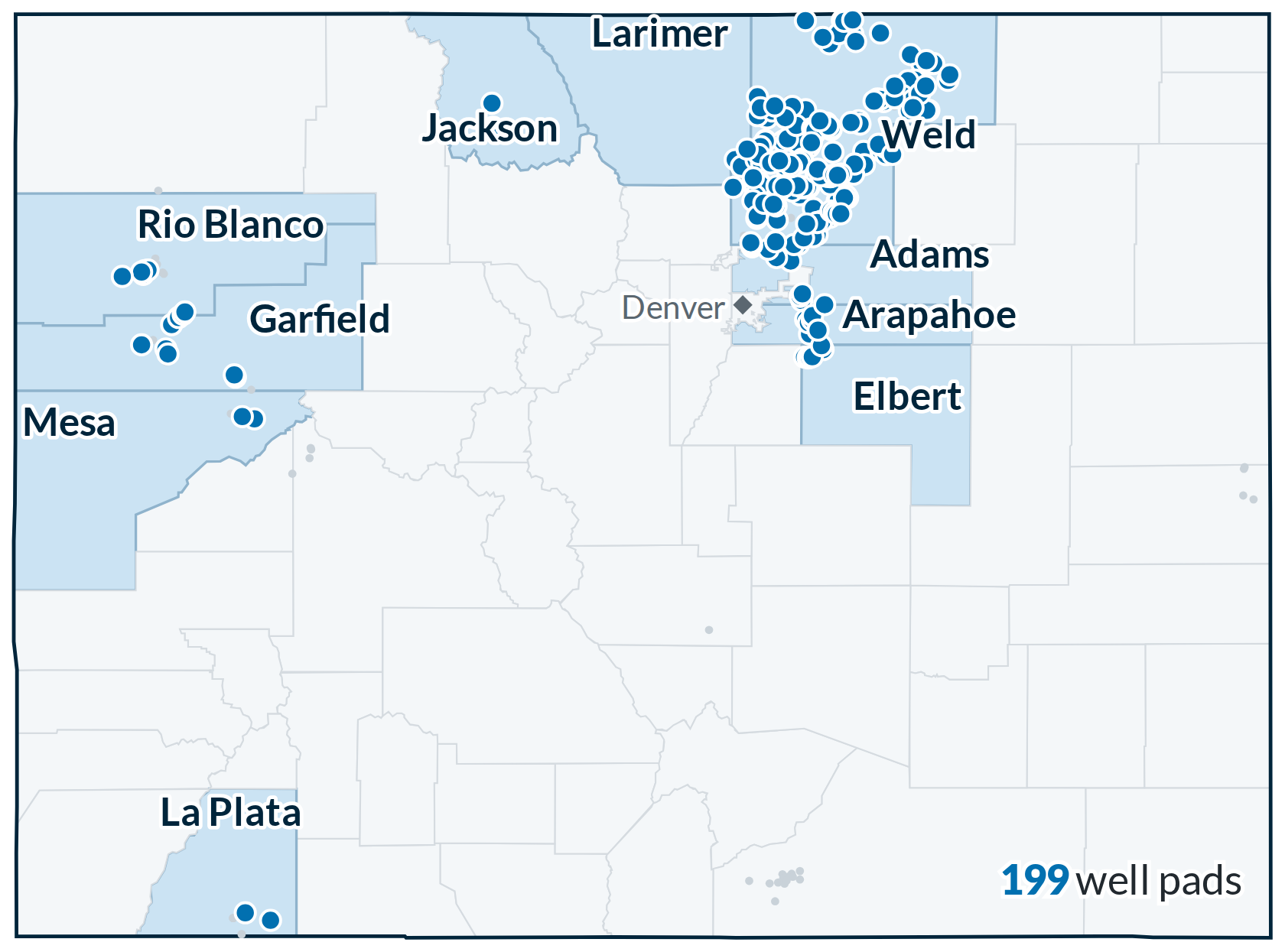
Disclosed use in Colorado: Acrylamide was reported to ECMC and/or FracFocus as being used on 199 well pads located across Adams, Arapahoe, Elbert, Garfield, Jackson, La Plata, Larimer, Mesa, Rio Blanco, and Weld counties. These well pads encompass at least 865 individual oil and gas wells using acrylamide. An estimated 43,000 people live within one mile of oil and gas wells in which acrylamide was used. The average mass of acrylamide disclosed as being used on well pads was about 90 pounds while the highest mass disclosed on a well pad was an estimated 1,446 pounds.
Some discrepancies appeared in the records. On 109 of the well pads, acrylamide was disclosed as being used in ECMC’s database but not in FracFocus. These omissions could have occurred because acrylamide was withheld from disclosure as a trade secret in the FracFocus data, or there could be another explanation. On four of the well pads, acrylamide was disclosed as being used in FracFocus but not on ECMC’s website. This omission from ECMC’s website is inexplicable because ECMC’s disclosures are supposed to be more comprehensive and should include all chemicals used on a particular well pad that are disclosed to FracFocus and, perhaps, additional chemicals.
Why is it used? Two peer-reviewed papers suggest that acrylamide is a chemical building block used to construct several types of polyacrylamide that can be used as a friction reducer.105
Health risks: The National Institutes of Health PubChem database lists ten different health hazards for acrylamide including “May cause cancer,” “May cause genetic defects,” and “Causes damage to organs through prolonged or repeated exposure.”106 The U.S. Department of Health’s Agency for Toxic Substances & Disease Registry reports that “The Department of Health and Human Services (DHHS), the International Agency for Research on Cancer (IARC), and the EPA have concluded that acrylamide is likely to be carcinogenic to humans, based on sufficient evidence of cancer in animals.”107
In its 2016 report on fracking and drinking water, the EPA gave acrylamide the highest total hazard potential score among 10 fracking-fluid chemicals assessed for cancer-related health hazards.108 Acrylamide received its score because oral exposure to it is associated with a relatively high increased cancer risk and the chemical has “properties that are highly conducive to transport in water.”109 In the same report, EPA found that for health hazards not related to cancer such as kidney toxicity, liver toxicity, and reproductive and developmental toxicity, acrylamide “received one of the highest overall Total Hazard Potential Scores” of 42 chemicals studied.110
One of the papers suggesting that acrylamide is used as a friction reducer, published in 2020, noted that polyacrylamide degrades during hydraulic fracturing and that such degraded material can “enhance the likelihood of releasing hazardous acrylamide monomer into the environment.”111 The other paper, published in 2018, similarly found that polyacrylamide degraded during fracking and stated that “it is possible that the degraded [polyacrylamide] could potentially lead to the generation of acrylamide (a neurotoxin) and other unknown toxic degraded products.”112
Likely exposure pathways: If acrylamide were to leak from oil and gas wells or spill on the surface at well sites in its pure form or mixed in with wastewater, it would likely infiltrate water supplies according to EPA’s 2016 report on fracking and drinking water discussed above. Acrylamide is less likely to become an air pollutant because its Henry’s Law Constant is 2.48431 e-8,113 which is classified as “nonvolatile” according to EPA.114 However, the chemical could become an air pollutant if it were sprayed in the air.
3.3Ethylene Oxide CAS No. 75-21-8
73well pads where reported
499wells, at least
20,000people within a mile (est.)
33 lbaverage per well pad (max. 316 lb)*
Volatility: Moderately volatile. *Mass is reported only to FracFocus.
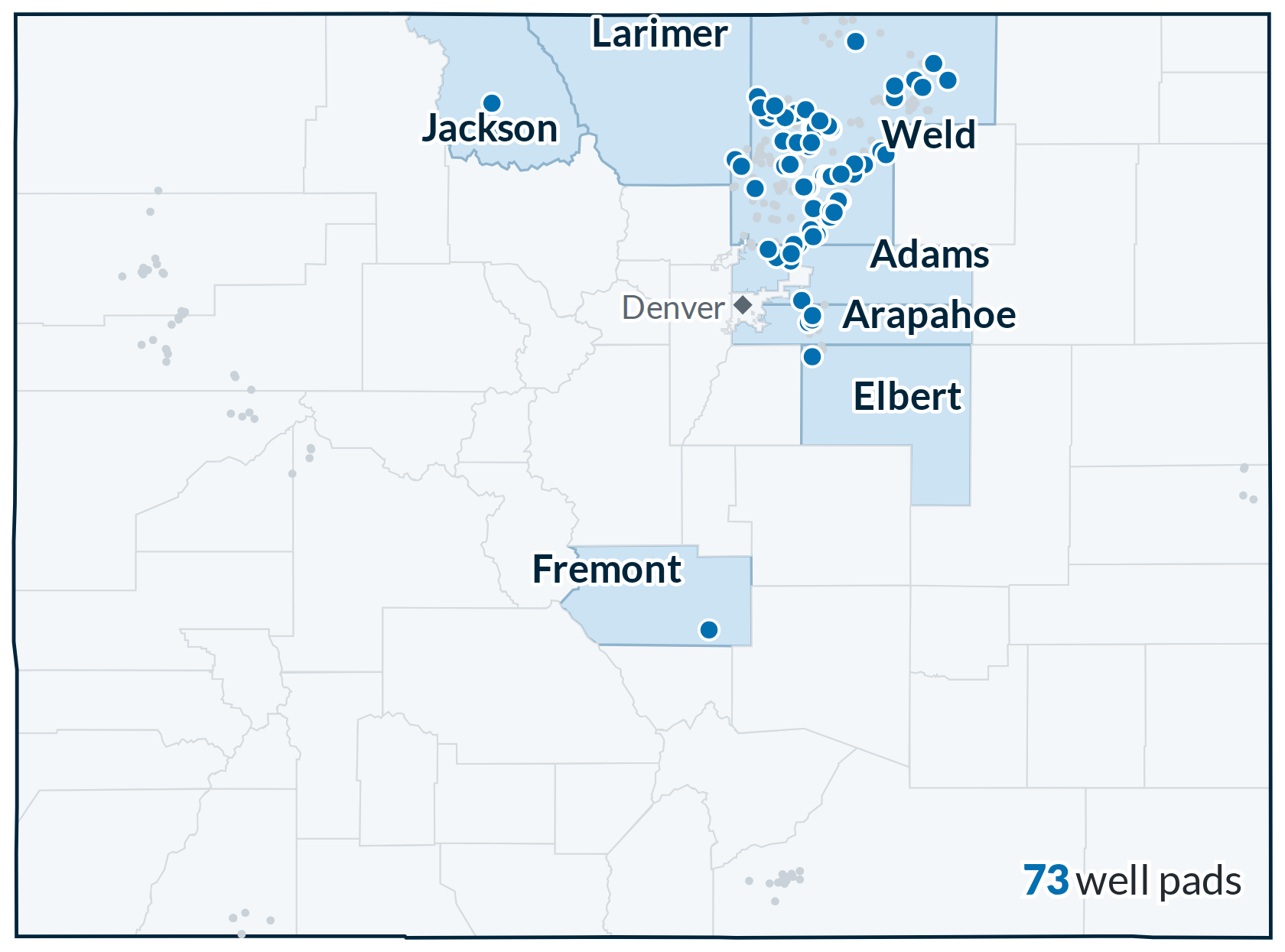
Disclosed use in Colorado: This chemical was reported to ECMC and/or FracFocus as being used on 73 well pads located across Adams, Arapahoe, Elbert, Fremont, Jackson, Larimer, and Weld counties. These well pads encompass at least 499 individual oil and gas wells using ethylene oxide. An estimated 20,000 people live within one mile of oil and gas wells in which ethylene oxide was used. The average mass of ethylene oxide disclosed as being used on well pads was about 33 pounds while the highest mass disclosed on a well pad was an estimated 316 pounds.
Some discrepancies appeared in the records. On seven well pads, ethylene oxide was disclosed as being used in ECMC’s database but not in FracFocus. These omissions could have occurred because ethylene oxide was withheld from disclosure as a trade secret in the FracFocus data, or there could be another explanation. On one well pad, ethylene oxide was disclosed as being used in FracFocus but not on ECMC’s website. This omission from ECMC’s website is inexplicable because ECMC’s disclosures are supposed to be more comprehensive and should include all chemicals used on a particular well pad that are disclosed to FracFocus and, perhaps, additional chemicals.
Why is it used? According to the American Chemistry Council, “Using ethylene oxide-based compounds allows for faster drilling and completion of oil and gas wells.”115 It is unclear exactly what role the chemical plays, but one patent for a fracking fluid containing ethylene oxide stated that ethylene oxide polymers were used as friction reducers. The patent states that “Without friction reduction, the enormous flow rates needed to suspend proppant and fracture a shale formation cannot be achieved safely nor economically.”116 Proppant refers to materials – usually sand – that are used to prop open microscopic fractures in rock formations that liberate trapped gas and oil.117
Health risks: The U.S. Environmental Protection Agency lists ethylene oxide as a known human carcinogen through inhalation.118 Other agencies listing ethylene oxide as a known human carcinogen include The National Institutes of Health through both its National Toxicology Program119 and Agency for Toxic Substances and Disease Registry,120 California’s Office of Environmental Health Hazard Assessment,121 and the International Agency for Research on Cancer.122 The National Institutes of Health PubChem database lists 10 health hazards for ethylene oxide including that it “may cause cancer,” “may cause genetic defects,” “may damage fertility,” and “causes damage to organs through prolonged or repeated exposure.”123 In 2025, Colorado’s Department of Public Health & Environment identified ethylene oxide as one of five priority air contaminants.124 The department stated that “Reducing the amount and time spent exposed to ethylene oxide can lower overall cancer risk.”125 The Trump administration announced in March 2026 that it planned to weaken rules implemented during the Biden administration to protect people from ethylene oxide emissions.126
Likely exposure pathways: It is unclear whether ethylene oxide is more likely to be an air or water pollutant when it is used in fracking. If ethylene oxide were present at oil and gas well sites, it could potentially pollute air if it volatilized from wastewater or surface water or were emitted from oil and gas wells through flaring or a blowout. The chemical could potentially contaminate water if it spilled, leaked, or migrated underground. The Agency for Toxic Substances and Disease Registry reports that “[e]thylene oxide is a man-made flammable gas with a somewhat sweet odor when it is at very high levels. It dissolves easily in water.”127 This statement suggests that the chemical could be a water pollutant. The National Institutes of Health reports that ethylene oxide is a colorless gas at ordinary room temperature and pressure, but is a liquid at temperatures lower than about 51-54 fahrenheit.128 If ethylene oxide were used in its liquid form at oil and gas wells, such use would raise concerns about water contamination. Colorado’s records do not indicate whether ethylene oxide is used as a gas or a liquid in fracking. Ethylene oxide could be an air pollutant at fracking sites because its Henry’s Law Constant has an experimental range of 1.15e-4 to 1.97e-4 and a predicted range of 1.48e-4,129 all of which are classified as “moderately volatile from water” according to EPA.130 The chemical could also become an air pollutant if it were sprayed in the air.
3.4Methanol CAS No. 67-56-1

220well pads where reported
1,245wells, at least
47,000people within a mile (est.)
41,167 lbaverage per well pad (max. 407,434 lb)*
Volatility: Slightly to moderately volatile. *Mass is reported only to FracFocus.
Disclosed use in Colorado: This chemical, otherwise known as methyl alcohol or wood alcohol,131 was reported to ECMC and/or FracFocus as being used on 220 well pads located across Adams, Arapahoe, Delta, Elbert, Garfield, Gunnison, Jackson, La Plata, Larimer, Mesa, Moffat, Rio Blanco, and Weld counties. These well pads encompass at least 1,245 wells where methanol was used. An estimated 47,000 people live within one mile of oil and gas wells in which methanol was used. The average mass of methanol disclosed as being used on well pads was about 41,167 pounds while the highest mass disclosed on a well pad was an estimated 407,434 pounds.
Some discrepancies appeared in the records. On 53 of the well pads, methanol was disclosed as being used in ECMC’s database but not in FracFocus. These omissions could have occurred because methanol was withheld from disclosure as a trade secret in the FracFocus data, or there could be another explanation. On 12 of the well pads, methanol was disclosed as being used in FracFocus but not on ECMC’s website. This omission from ECMC’s website is inexplicable because ECMC’s disclosures are supposed to be more comprehensive and should include all chemicals used on a particular well pad that are disclosed to FracFocus and, perhaps, additional chemicals. From the FracFocus data, we know that methanol can be used in large quantities in Colorado’s oil and gas wells: FracFocus records show that methanol was used in 56 individual wells at quantities greater than 20,000 pounds. All FracFocus records spanning more than 20 states show that methanol was used in more than 10,000 wells at quantities greater than 20,000 pounds.
Why is it used? According to the EPA’s 2016 report on fracking and drinking water, methanol has been used for several purposes in fracking including as a corrosion inhibitor, surfactant, non-emulsifier, and for scale control.132
Health risks: Though methanol is a type of alcohol, it is distinct from ethanol, which is the type of alcohol people typically drink in alcoholic beverages.133 According to the Pan American Health Organization (PAHO), a Washington, DC-based international health agency for the Americas, “it is very difficult to differentiate methanol from ethanol by its smell or taste. However, methanol is much more toxic than ethanol because the human body is less efficient at metabolizing methanol than ethanol and [methanol] generates toxic metabolites. After ingestion, liver enzymes transform the methanol by-products into formic acid and affect several organs, producing tissue hypoxia and lactic acidosis.”134 Tissue hypoxia is lack of oxygen in tissues and can lead to organ damage.135 Lactic acidosis occurs when lactic acid builds up in the bloodstream and the body’s pH becomes acidic. This condition can cause the heart to pump less blood and can lead to organ failure and death.136
In addition to the effects highlighted by PAHO, California’s Office of Health Hazard Assessment includes methanol on California’s Proposition 65 list of chemicals that cause cancer or reproductive harm. Specifically, methanol is listed as causing reproductive harm because it has been found to cause birth defects in animals.137 The New Jersey Department of Health lists multiple health hazards associated with methanol including that it can “damage the liver, kidneys, and nervous system.”138 Echoing California’s warning, the New Jersey Health Department notes that methanol may be a teratogen, a scientific name for “a substance that interferes with normal fetal development and causes congenital disabilities.”139
In EPA’s 2016 report on fracking and drinking water, EPA found that methanol had a moderate hazard potential. EPA explained that it ranked methanol as less hazardous than some of the 42 fracking chemicals it assessed because it takes a relatively high level of exposure to methanol for negative health effects to occur.140 At the same time, EPA noted that methanol was widely used, so exposure to methanol was more likely than to other chemicals used in fracking.141 EPA also reported that methanol breaks down into formaldehyde142 which earned one of the highest hazard potentials.143 Formaldehyde carries its own health risks discussed below. In addition, EPA reported that methanol enhances the solubility of toxic chemicals benzene, toluene, ethylbenzene, and xylene (BTEX), and reduces their rate of biodegradation, making it more likely that BTEX will travel farther in water if methanol mixes with BTEX in oil and gas production.144
Likely exposure pathways: If methanol were to leak from oil and gas wells or spill on the surface at well sites in its pure form or in wastewater, it would be likely to infiltrate water supplies because it is “relatively mobile in water” according to EPA’s 2016 report on fracking and drinking water discussed above.145 Methanol may be less likely to become an air pollutant because its Henry’s Law Constant is relatively low. Its Henry’s Law Constant experimental range is 7.59e-7 to 2.74e-4 and its predicted range is 4.57e-6,146 ranging from “slightly volatile from water” to “moderately volatile from water” according to EPA.147 However, the chemical could become an air pollutant if it were sprayed in the air.
3.5Formaldehyde CAS No. 50-00-0

44well pads where reported
50wells, at least
13,000people within a mile (est.)
337 lbaverage per well pad (max. 604 lb)*
Volatility: Nonvolatile to slightly volatile. *Mass is reported only to FracFocus.
Disclosed use in Colorado: Formaldehyde was reported to ECMC and/or FracFocus as being used on 44 well pads located across Adams, Elbert, Garfield, Larimer, Moffat, Rio Blanco, and Weld counties. These well pads encompass at least 50 wells where formaldehyde was used. An estimated 13,000 people live within one mile of oil and gas wells in which formaldehyde was used. The average mass of formaldehyde disclosed as being used on well pads was about 337 pounds while the highest mass disclosed on a well pad was an estimated 604 pounds.
Some discrepancies appeared in the records. On 41 of the 44 well pads, formaldehyde was disclosed as being used in ECMC’s database but not in FracFocus. These omissions could have occurred because formaldehyde was withheld from disclosure as a trade secret in the FracFocus data, or there could be another explanation. The omissions from FracFocus for almost every well pad where formaldehyde was disclosed on ECMC’s website is a stark example of how FracFocus was leaving Coloradans significantly uninformed about oil and gas chemical use and how Colorado’s 2022 law has led to an increase in disclosure of fracking chemicals. On two well pads, formaldehyde was disclosed as being used in FracFocus, but not in ECMC’s database. This omission from ECMC’s website is inexplicable because ECMC’s disclosures are supposed to be more comprehensive and should include all chemicals used on a particular well pad that are disclosed to FracFocus and, perhaps, additional chemicals. On one well pad, formaldehyde was disclosed as being used in both ECMC’s database and in FracFocus.
Why is it used? According to the American Chemistry Council, which represents the chemical industry, in fracking, formaldehyde is “used as a biocide to prevent microbial growth in fracking fluids, helping provide smooth operations preventing equipment issues.”148 Separately, the organization added that “formaldehyde-based resins and other formaldehyde-derived products are critical to drilling fluids, proppants, and proppant coatings, and mud additives used for improving drilling efficiency and well stability.”149 The mention of drilling fluids highlights the importance of expanding chemical disclosure under Colorado’s 2022 law to include chemicals used in drilling which precedes fracking. Proppants, however, are typically used in fracking to prop open fractures deep underground so that oil and gas can be liberated and produced.150
Health risks: The U.S. Environmental Protection Agency lists formaldehyde as a known human carcinogen through inhalation.151 In a human health risk assessment completed in 2024 under the Toxic Substances Control Act (TSCA), EPA based its formaldehyde cancer assessment on nasopharyngeal cancer,152 a rare type of head and neck cancer,153 while also noting that formaldehyde can cause leukemia.154 Other agencies listing formaldehyde as a known human carcinogen include The National Institutes of Health through both its National Toxicology Program155 and Agency for Toxic Substances and Disease Registry,156 California’s Office of Environmental Health Hazard Assessment,157 and the International Agency for Research on Cancer.158 The National Institutes of Health PubChem database lists six health hazards for formaldehyde including that it “may cause cancer,” and is “suspected of causing genetic defects.”159 In 2025, Colorado’s Department of Public Health & Environment identified formaldehyde as one of five priority air contaminants.160 The department stated that “Prolonged exposure to formaldehyde increases the risk of developing cancers, including leukemia. Long-term exposure to formaldehyde is also associated with an increased risk of nose and throat cancers.”161 EPA, in its 2024 human health risk evaluation under TSCA, based its assessment of acute exposure to formaldehyde on lung and skin irritation and its chronic exposure assessment on respiratory effects including reduced lung function, allergy-related conditions, and asthma, as well as negative gastrointestinal effects.162
The EPA has established the health risks of formaldehyde used in oil and gas operations. Potential risks to nearby residents remain less fully assessed. During the Biden administration, the EPA finalized an assessment under the federal Toxic Substances Control Act (TSCA) of formaldehyde’s health risks, including during its use in fracking. The agency’s final regulatory decision163 concluded, based on risk evaluations, that formaldehyde poses an unreasonable risk of harm to health but not to the environment. The EPA stated that the unreasonable risk determination was due to multiple findings including that long-term inhalation exposure could result in cancer in workers, both those handling formaldehyde directly and those who did not use it directly. The agency also found that skin exposure and inhalation on an acute (as opposed to chronic or long-term) basis could result in non-cancer harm to workers and consumers including allergic skin response and irritation to eyes and upper airways.164 Under TSCA, a finding of unreasonable risk requires the EPA to implement regulations to mitigate these risks.165
In its unreasonable risk determination, the EPA estimated health risks caused by exposure to formaldehyde during fracking and found that such risks could be significant but were limited to workers using the chemical directly and would not affect the general public or other workers. Specifically, the agency found that multiple “conditions of use” of formaldehyde contributed to its finding of unreasonable risk to workers, including “as a process aid in oil and gas drilling, extraction, and support activities; process aid specific to petroleum production, hydraulic fracturing.”166 A table in the same unreasonable risk determination shows that for the category “Functional fluid in: Oil and gas drilling, extraction, and support activities,” the EPA concluded that exposure to formaldehyde through inhalation can result in cancer and acute non-cancer harm to oil and gas workers. The agency also concluded that exposure to formaldehyde through skin can result in acute non-cancer harm to oil and gas workers. These conclusions supported the finding of unreasonable risk. The EPA found that exposure to formaldehyde did not result in unreasonable risk to the general public or to workers who did not use formaldehyde directly.167 EPA refers to such workers as “occupational non-users.”168
However, the EPA’s figures suggest that, in fact, the general public and occupational non-users may be at risk from formaldehyde exposures due to fracking. The agency found that cancer risks from exposure to formaldehyde in ambient air exceeded health benchmarks at the following distances from fracking sites: 100 meters (328 feet), 1,000 meters (3,280 feet), and between 100 and 1,000 meters. In addition, the EPA did not model cancer risks beyond 1,000 meters, so there could be health risks at greater distances.169 However, these findings were not reflected in the final finding of unreasonable risk.
In 2025, the Trump EPA, without conducting a separate risk assessment, also found in a draft unreasonable risk determination that multiple “conditions of use” of formaldehyde, including fracking, contributed to a determination of unreasonable risk.170 However, the Trump EPA’s unreasonable risk determination was much less protective than the Biden EPA’s finding due to a proposal to nearly double what is considered safe exposure levels to formaldehyde.171 In a December 2025 memo,172 EPA proposed that only acute, or more concentrated inhalations of formaldehyde could create unreasonable risk and that chronic, or steady exposure to lower levels of formaldehyde would not result in unreasonable risk.173 Some scientists and environmental advocates criticized this approach. “Within the scientific community, the idea that there is a safe threshold for carcinogenic exposures is not widely accepted,” David Michaels, a professor in epidemiology at the Milken Institute School of Public Health at George Washington University told the New York Times, in reference to the Trump administration’s proposal. “But the idea of a threshold is a holy grail for industry, because if you can claim a threshold, then you don’t need to protect people at levels below that threshold.” The EPA office responsible for the new proposed standards for formaldehyde, is being led in part by two former senior directors of the American Chemistry Council.174 The Environmental Defense Fund wrote that the EPA was assuming that “the exposure level that is protective for the acute effects of formaldehyde will also be protective of chronic effects and cancer. These findings are contrary to independent scientific consensus on the risks of formaldehyde.”175
It is likely that both the Biden EPA and Trump EPA underestimated health risks from the use of formaldehyde during fracking because both administrations relied on unrealistic assumptions about how people might be exposed to formaldehyde. For EPA’s 2024176 human health risk assessment of formaldehyde's use in fracking, which informs the unreasonable risk finding, and the 2025 revised draft human health risk assessment, which reflects EPA’s December 2025 memo, EPA relied on a 2022 exposure scenario document. This paper, developed by EPA, provides scenarios under which people are likely to be exposed to water soluble fracking chemicals including formaldehyde.177 The document suggests that EPA is considering apparently benign “environmental releases” in which no mishaps occur such as injection of fracking wastewater underground for permanent disposal. The document also suggests that EPA is considering a limited number of mishap-free “occupational exposures” such as cleaning of chemical containers, which would affect only workers directly handling formaldehyde but not other workers or members of the general public.178
This document does not account for a host of likely exposure pathways including leaks, spills, or underground migration of fracking chemicals, even though in its 2016 report on fracking and drinking water, EPA listed multiple scenarios that “are more likely than others to result in more frequent or more severe impacts” to drinking water including:
- Spills during the management of hydraulic fracturing fluids and chemicals or produced water that result in large volumes or high concentrations of chemicals reaching groundwater resources;
- Injection of hydraulic fracturing fluids into wells with inadequate mechanical integrity, allowing gases or liquids to move to groundwater resources;
- Injection of hydraulic fracturing fluids directly into groundwater resources;
- Discharge of inadequately treated hydraulic fracturing wastewater to surface water resources; and
- Disposal or storage of hydraulic fracturing wastewater in unlined pits, resulting in contamination of groundwater resources.179
Nor does the document consider volatilization of fracking chemicals from oil and gas wastewater. A study of air emissions of volatile organic compounds (VOCs) from oil and gas production sites in Colorado published in 2025, found that “concentrated plumes were captured across a wide range of operations” including during “flowback,” defined as the return to the surface of fracking fluid injected into oil and gas wells and naturally-occurring produced water.180 Air sampling found the highest concentrations of a mix of 49 VOCs and, separately, benzene, a known human carcinogen, during flowback,181 suggesting that some of the chemicals injected during fracking could volatilize when the fracking fluid returns to the surface. The authors noted that “[s]ome potentially important compounds such as formaldehyde, an air toxic and an important ozone precursor, were not measured in this study and should be a focus of future measurements.”182 This study, and a subsequent study of oil and gas wells in Colorado found VOC emissions during various portions of the oil and gas production process, including drilling, suggesting that people near oil and gas sites could be exposed to formaldehyde and other chemicals through multiple pathways simultaneously, an exposure scenario that was apparently not addressed in the 2022 exposure scenario document related to fracking chemicals. Other potential air emissions scenarios not addressed by the document include two pathways suggested by toxicologist David Brown. Brown believes that there is a potential that fracking chemicals could infiltrate a person’s water well and then volatilize inside a home and that fracking chemicals could be released into air when gas is vented or flared at the wellhead.183 It is possible, therefore, that if EPA considered more realistic exposure scenarios for the use of formaldehyde during fracking, the agency would conclude that risks of exposure to formaldehyde were greater.
Likely exposure pathways: As suggested by the section above, likely exposure pathways to formaldehyde used in fracking include skin exposure for workers and inhalation for workers and perhaps those living nearby. The extent of air exposures linked to formaldehyde used in fracking are uncertain. Formaldehyde has a Henry’s Law Constant experimental range of 9.97e-8 to 4.29e-6 and a predicted range of 3.47e-7.184 These figures range from “nonvolatile” to “slightly volatile from water” according to EPA,185 suggesting that formaldehyde could volatilize from fracking wastewater and become airborne, though formaldehyde is less likely to follow this pathway than other chemicals. According to toxicologist David Brown, the chemical could become an air pollutant if it were sprayed in the air, for example, during a blowout. The Agency for Toxic Substances and Disease Registry (ATSDR) says that “[t]he primary way you can be exposed to formaldehyde is by breathing air containing it.”186 At the same time, the agency found that “once formaldehyde is in the air, it is quickly broken down, usually within hours.” Based on formaldehyde’s relatively short half-life in the atmosphere,187 dispersion will tend to move formaldehyde away from its source on shorter timescales than degradation, and the average speed of transport away from a pollution source will be the local wind speed. Sustained local exposures to formaldehyde would require sustained emissions. The ATSDR reported that indoor exposure to formaldehyde is likely to be greater than outdoor exposure, though, as the 2024 paper about air pollution near Colorado’s oil and gas wells suggested, outdoor exposures to formaldehyde related to oil and gas production may not have been studied often. EPA’s risk assessment also suggests that outdoor exposures to formaldehyde used for fracking can pose health risks.
It is also possible that exposure to formaldehyde used in fracking could combine at oil and gas wells with exposure to formaldehyde formed in the atmosphere from a chemical reaction that occurs when volatile organic compounds (VOCs) released from oil and gas wells are exposed to sunlight (photooxidation). A peer-reviewed study published in 2023 found that “analysis of aircraft and satellite data consistently found that formaldehyde over oil and gas production regions during spring and summer is mostly formed by the photooxidation of precursor VOCs” and that “Formaldehyde columns over the Permian Basin, one of the largest oil- and gas-producing regions in the United States, are correlated with the production locations.”188
It is, therefore, likely that there will be exposure to formaldehyde through air at oil and gas wells, whether from use of formaldehyde in fracking or through other pathways. But there is uncertainty about how significant pollution from each of these pathways is likely to be. A study of air pollution conducted near oil and gas infrastructure in five states published in 2014 found cases in Arkansas, Pennsylvania, and Wyoming in which air concentrations of formaldehyde exceeded health standards, but these cases were associated with gas compressors that push methane gas through pipelines rather than oil and gas wells where fracking occurs.189
As for water, government reports suggest that pollution would be unlikely if formaldehyde were to leak from oil and gas wells or spill on the surface at well sites. The Agency for Toxic Substances and Disease Registry reports that “formaldehyde dissolves easily but does not last a long time in water.”190 The EPA found in its 2024 determination of unreasonable risk for formaldehyde that “[f]ormaldehyde is not expected to persist in water or land based on the chemical, fate, and transport properties of formaldehyde. As such, EPA does not expect general population exposure to formaldehyde to occur via either the water or land pathway and therefore did not quantitatively assess exposures via these routes.”191 The Trump EPA maintained the identical statement in its 2025 revised draft determination of unreasonable risk.192
3.6Propargyl Alcohol CAS No. 107-19-7
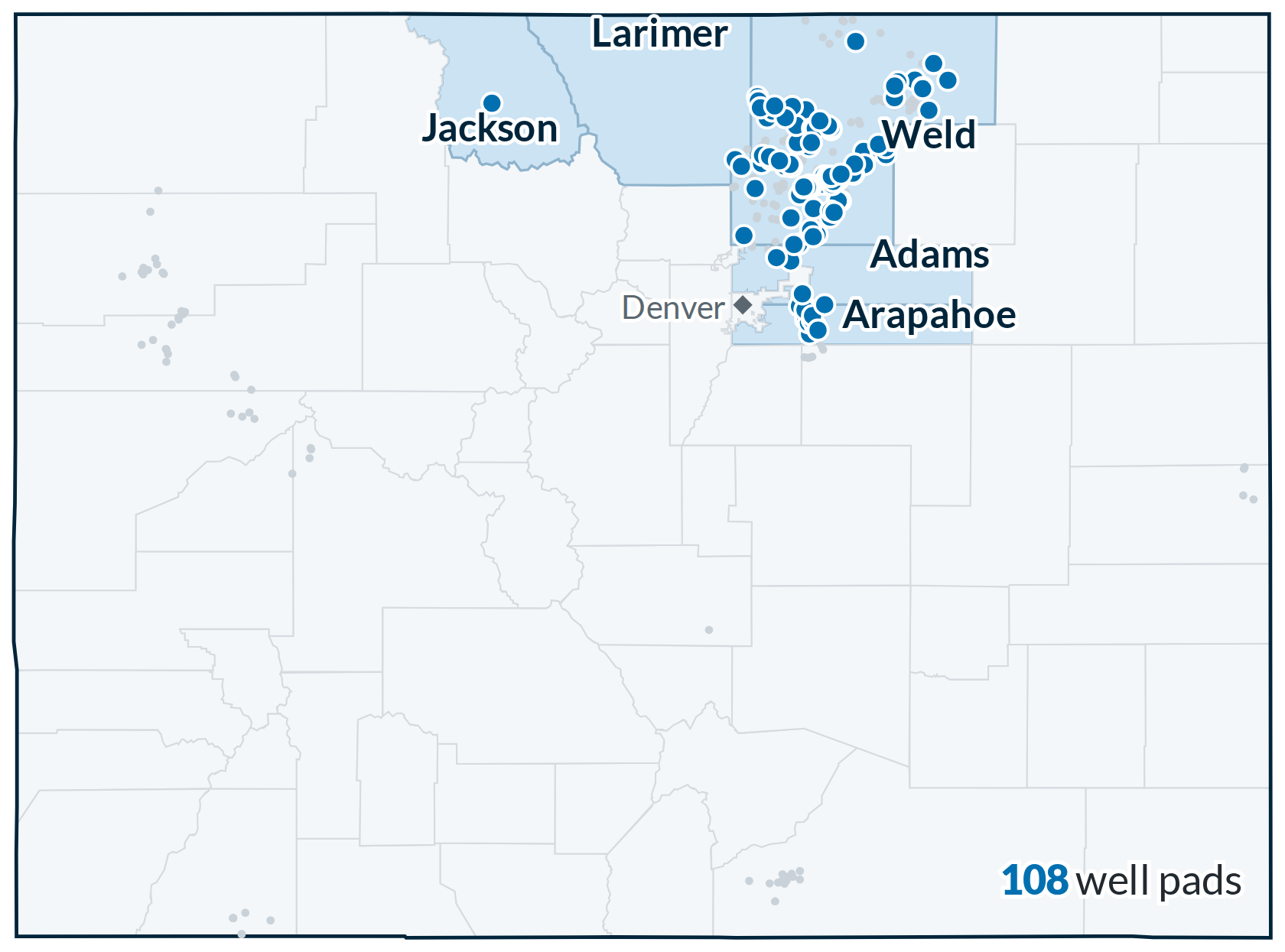
108well pads where reported
864wells, at least
23,000people within a mile (est.)
1,105 lbaverage per well pad (max. 8,870 lb)*
Volatility: Slightly volatile. *Mass is reported only to FracFocus.
Disclosed use in Colorado: Propargyl alcohol was reported to ECMC as being used on 108 well pads located across Adams, Jackson, Arapahoe, Larimer, and Weld counties. These well pads encompass at least 864 wells where propargyl alcohol was used. An estimated 23,000 people live within one mile of oil and gas wells in which propargyl alcohol was used. The average mass of propargyl alcohol disclosed as being used on well pads was about 1,105 pounds while the highest mass disclosed on a well pad was an estimated 8,870 pounds.
Some discrepancies appeared in the records. On three well pads, propargyl alcohol was disclosed as being used in ECMC’s database but not in FracFocus. These omissions could have occurred because propargyl alcohol was withheld from disclosure as a trade secret in the FracFocus data, or there could be another explanation. On another two of the well pads, propargyl alcohol was disclosed as being used in FracFocus but not on the ECMC’s website. This omission from ECMC’s website is inexplicable because ECMC’s disclosures are supposed to be more comprehensive and should include all chemicals used on a particular well pad that are disclosed to FracFocus and, perhaps, additional chemicals.
Why is it used? According to the EPA’s 2016 report on fracking and drinking water, propargyl alcohol is used as a corrosion inhibitor.193
Health risks: The EPA in its 2016 report on fracking and drinking water, gave propargyl alcohol its highest score for “total hazard potential” among 42 fracking chemicals assessed for non-cancer health hazards.194 A higher total hazard potential score means that propargyl alcohol “may be more likely to affect drinking water resources.”195 EPA reported that exposure to propargyl alcohol was associated with kidney toxicity and liver toxicity.196 EPA gave propargyl alcohol its highest score for total hazard potential because chronic exposure to very small amounts can cause negative health impacts, the chemical was widely used, and it “has physicochemical properties that are conducive to transport in water.” EPA reported that propargyl alcohol was disclosed as being used in 33 percent of more than 38,000 well-by-well disclosures of fracking fluid associated with oil and gas wells hydraulically fractured in more than 20 states between January 1, 2011 and February 28, 2013. EPA added that there is significant uncertainty about the level at which propargyl alcohol is toxic.197 The National Institutes of Health PubChem database lists six hazards for propargyl alcohol including that it is “toxic if swallowed” and “toxic if inhaled” on an acute basis, that it “[c]auses severe skin burns and eye damage,” and that it is “[t]oxic to aquatic life with long lasting effects.”198 Like EPA, the New Jersey Department of Health reports, among other risks, that propargyl alcohol “may damage the liver and kidneys.”199
Likely exposure pathways: As the EPA suggests, the likeliest exposure pathway for propargyl alcohol is through water. Propargyl alcohol’s Henry’s Law Constant suggests that the chemical is less likely to act as an air pollutant. Propargyl alcohol has a Henry’s Law Constant experimental range of 1.10e-6 to 2.60e-6 and a predicted range of 5.62e-6,200 all figures showing that the substance is “slightly volatile from water” according to EPA.201 However, according to toxicologist David Brown, the chemical could become an air pollutant if it were sprayed in the air, for example, during a blowout.
We focused on these six chemicals because of their well-documented toxicity and reported frequency of use, but other disclosed chemicals may also pose significant health concerns. Readers can examine the full list of fracking chemicals disclosed as being used in oil and gas wells covered by Colorado’s 2022 law in Appendix A whether these chemicals were disclosed to ECMC, FracFocus, or both.
Chapter 4Discrepancies in Chemical Disclosures Under 2022 Law, 2012 Rules
Despite the increased compliance in disclosure of fracking chemicals under the 2022 law over the past year, it is unclear whether these disclosures are complete due to discrepancies between disclosures available for the same well pads through ECMC and FracFocus. Because the 2022 law requires more comprehensive oil and gas chemical disclosures to the ECMC’s website than 2012 fracking chemical disclosure rules require to FracFocus, the ECMC disclosures should contain all the chemicals that are reported to FracFocus plus additional chemicals. However, in an analysis of 223 well pads that appeared in both data sets, we found disclosures for 178 well pads (about 80 percent), in which chemicals were disclosed to FracFocus, but not to ECMC’s website. For example, on the “Broe Fd” well pad fracked in Weld County in 2024, PDC Energy Inc. disclosed the use of methanol to FracFocus but not to ECMC. This outcome suggests that some chemicals are being omitted from ECMC’s disclosures that oil and gas companies could easily disclose.
Conversely, for 172 well pads, chemicals were disclosed to ECMC’s website under the 2022 law but not to FracFocus under the 2012 rules. In some cases, the discrepancy could be explained by disclosure to ECMC’s website of chemicals withheld as trade secrets under the 2012 rules. But in other cases, this explanation is not applicable. For example, on the “Cascade Creek (cc 0603-23-32)” well pad fracked in Garfield County in 2024, Laramie Energy, LLC disclosed the use of acrylamide to ECMC but not to FracFocus. There were no trade secret claims listed on the FracFocus disclosures for this well pad, suggesting that acrylamide should have been disclosed in the FracFocus database but was not. These inexplicable outcomes suggest that oil and gas firms are making errors or that there is an unstated difference between the two disclosure regimes.
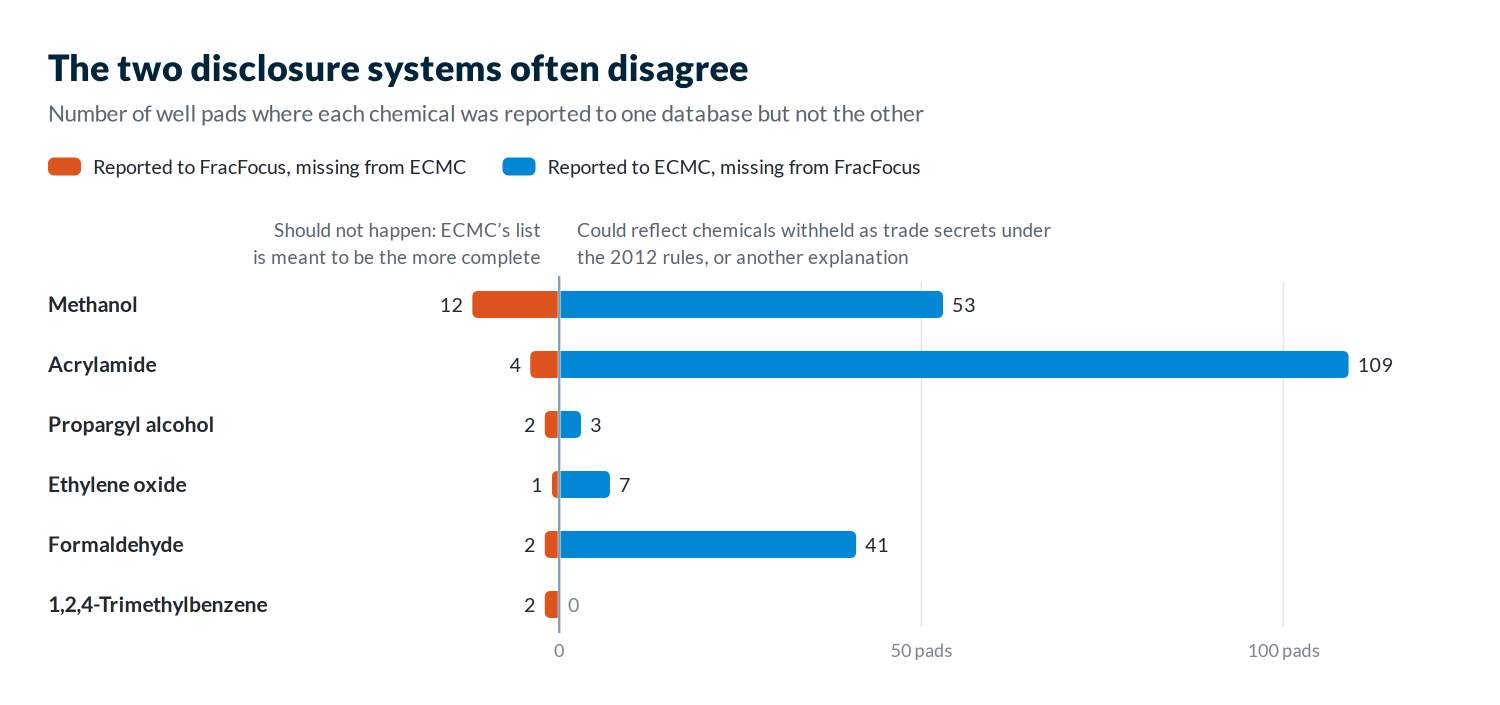
FracFocus’ apparent reliance on safety data sheets (SDS) may help explain the scenario in which chemicals are disclosed to ECMC’s website but not to FracFocus. At the bottom of at least some FracFocus chemical disclosures for wells located in Colorado,202 and in FracFocus’ instructions for completing its form for disclosing fracking chemicals,203 it is apparent that FracFocus envisions that fracking chemical disclosures will rely significantly on SDS. These SDSs, which often accompany chemical products or additives which are mixtures of multiple chemicals, may not include all of the chemical ingredients in the products or additives. FracFocus acknowledges these shortcomings in its instructions to oil and gas companies about how to disclose their chemicals. FracFocus notes that according to federal rules, chemicals will not be listed on an SDS for multiple reasons including if the chemical product does not contain hazardous or carcinogenic chemicals at concentrations above listed thresholds or if individual chemical ingredients are not considered hazardous.204
Federal rules also provide that the chemical companies, themselves, determine what chemicals are hazardous205 and that “[t]here is no requirement for testing chemicals.”206 Therefore, if no data show that a chemical is hazardous, a company need not list it on an SDS or test the chemical even if the chemical would be shown to be hazardous if it were tested.
These exclusions for reporting of chemicals on SDS may explain why fracking chemicals used in Colorado do not appear in FracFocus but do appear on ECMC’s website for the same well pads. ECMC apparently does not rely on SDS. If so, fewer chemicals would likely be excluded from disclosure to ECMC.
Chapter 5Use of Prohibited Chemicals
Our analysis of chemical disclosures under the 2022 law also shows apparent violations of Colorado’s regulations prohibiting the use of certain fracking chemicals. Most of the apparent violations appear in the FracFocus database, and one appears on ECMC’s website. These apparent violations are listed below in Table 2. Some of the uses of fracking chemicals listed below predate implementation of the 2022 law but each of these uses was prohibited in fracking in Colorado by regulations which took effect after January 15, 2021. The regulations prohibit the use for fracking of 22 separate chemicals.207
Table 2. Fracking with Prohibited Chemicals in Colorado, 2021-2026.
| Prohibited chemical | Wells | Companies disclosing it | Counties |
|---|---|---|---|
| 1-butanol CAS 71-36-3 | 1 | Noble Energy, Inc | Weld |
| 1,4-dioxane CAS 123-91-1 | 18 | Noble Energy, Inc. TEP Rocky Mountain LLC | Garfield, Weld |
| 2-butoxyethanol CAS 111-76-2 | 53 | Anadarko Petroleum Corporation Hilcorp Energy Company LOGOS Operating, LLC QB Energy Operating LLC Red Willow Production, LLC SG Interests I Ltd. Wapiti Operating, LLC | Garfield, Gunnison, La Plata, Las Animas, Rio Blanco, Weld |
| BMPA (bis hexamethylene triamine penta methylene phosphonic acid) CAS 35657-77-3 | 5 | Enduring Resources LLC Robert L. Bayless, Producer LLC | La Plata, Rio Blanco |
| N,N-dimethylformamide CAS 68-12-2 | 46 | LOGOS Operating, LLC QB Energy Operating LLC SG Interests I Ltd. | Garfield, Gunnison, La Plata, Rio Blanco |
| Total wells using at least one prohibited fracking chemical | 77 |
Four of the five prohibited chemicals in Table 2 are associated with serious negative health impacts while the available health data for BMPA are less clear. For 1-butanol, the National Institutes of Health PubChem database lists six hazards including that it is “harmful if swallowed,” “causes serious eye damage,” and “[M]ay cause respiratory irritation.”208 The New Jersey Department of Health adds that 1-butanol “can damage the liver, kidneys, hearing, and sense of balance.”209
Regarding 2-butoxyethanol, the PubChem database lists four hazards including “harmful if swallowed,” “causes serious eye irritation,” and “toxic if inhaled.”210 The National Institute for Occupational Safety and Health has reported that symptoms of exposure to 2-butoxyethanol can include irritation to eyes, skin, nose, and throat; hemolysis (destruction of red blood cells which can lead to serious heart conditions), hematuria (blood in the urine), central nervous system depression, headache, and vomiting.211 The PubChem database lists four hazards for N,N-dimethylformamide including that it “causes serious eye irritation,” it is “harmful if inhaled,” and “may damage the unborn child.”212
As for 1,4-dioxane, in 2024, EPA completed a risk assessment of the chemical, and found that “1,4-dioxane presents an unreasonable risk of injury to health under the conditions of use.” One of the identified conditions of use assessed was hydraulic fracturing, though drilling was apparently not assessed.213 EPA found that exposure to workers and occupational non-users associated with hydraulic fracturing contributed to its determination.214 The agency’s determination was “based on cancer and non-cancer risks (from liver toxicity and effects in the olfactory epithelium [the peripheral organ for our sense of smell, located in the nose]215) to workers and occupational non-users from inhalation and dermal exposures, and cancer risks to the general population, including fenceline communities, from exposures to 1,4-dioxane in drinking water sourced from surface water contaminated with industrial discharges of 1,4-dioxane (including when it is generated as a byproduct).”216 The agency added that for fracking and three other workplace scenarios, “EPA did not find reasonably available monitoring data, so inhalation exposures were modeled.”217 EPA stated that “general population exposures to drinking water contaminated with 1,4-dioxane from hydraulic fracturing do not contribute to the unreasonable risk from 1,4-dioxane,”218 nor did the agency find that the effects on fenceline communities of ambient air emissions from fracking contributed to its determination.219
At the same time, the agency suggested that more data are needed to determine whether 1,4-dioxane used in fracking could pose an unreasonable risk to the general population through drinking water pollution or to fenceline communities through ambient air emissions. “Available groundwater monitoring data are not located near hydraulic fracturing operations,” EPA wrote, “and do not provide information about the potential for hydraulic fracturing operations to contribute to groundwater contamination.”220 Similarly, EPA found that “No air monitoring data were reasonably available to determine whether 1,4-dioxane is detected near hydraulic fracturing operations.”221 So, effects on workers from fracking, but not effects on the general public, drove EPA’s concerns about 1,4-dioxane. But gaps in the data suggest that risks to the public cannot be ruled out.
Toxicological information for BMPA is limited. However, the European Chemicals Agency states that BMPA is a skin and eye irritant.222
Use of these prohibited chemicals and other violations of Colorado’s oil and gas rules are punishable with fines ranging from $200-$15,000 per violation per day.223 Residents may petition the Director of ECMC to enforce violations.224 Particularly severe violations including a pattern of violations, gross negligence, or knowing or willful misconduct can result in additional penalties such as a prohibition on the issuance of new drilling permits to an operator.225,226
Chapter 6Testing Could Help Verify Accuracy of Disclosure
ECMC has significant work to do to ensure that the public is protected from dangerous chemicals used in oil and gas wells and that the public has a complete understanding of the chemicals being injected. One action that could help effectively implement both the 2022 law and the 2012 rules is testing of fracking wastewater to verify that the list of chemicals being disclosed by oil and gas companies and chemical manufacturers as used in oil and gas wells is accurate. Otherwise, regulators are depending largely on the word of the chemical disclosers that the list of chemicals is complete because the components of chemical mixtures are not generally visible to the naked eye. In other words, self-reporting cannot effectively serve as a substitute for monitoring and verification.
In June 2023, a group of scientists and environmental advocates wrote to ECMC asking the agency to verify that oil and gas companies were accurately disclosing their chemicals by testing each year a portion of the wastewater sometimes called “flowback” from a random sample of oil and gas wells. Flowback, the authors wrote, “is the wastewater that exits oil and gas wells shortly after fracking is complete and is likely to contain at least some of the chemicals injected during fracking, if not during the drilling process that precedes fracking.” The authors urged ECMC to make the testing results public including the Chemical Abstracts Service Registry numbers of each chemical identified. The authors noted that such tests could be illuminating.
If chemicals appear in the flowback that had not been disclosed in the chemical disclosure list for that particular well, the appearance of these chemicals could indicate a lack of disclosure, particularly if the chemicals were unlikely to be naturally-occurring. Conversely, if all of the chemicals found in the flowback also appeared on the chemical disclosure list, this match would indicate that disclosure had been complete.227
ECMC did not respond to this letter.
Despite the progress in public disclosure of fracking chemicals under the 2022 law, the lack of disclosure to ECMC’s website of chemicals used in drilling or other stages and methods of oil and gas production, the potential lack of disclosure of fracking chemicals directly to people and institutions near oil and gas wells, discrepancies in chemical disclosure between ECMC and FracFocus, the use of prohibited chemicals in fracking, the use of chemicals with unknown health effects, and the lack of chemical testing to verify that disclosure has been accurate show that much more work needs to be done to properly implement the law and protect Coloradans from chemical exposures.
Chapter 7Recommendations
In light of these findings and with an eye toward the next governor's administration, FracTracker Alliance, Colorado Sierra Club, and Physicians for Social Responsibility Colorado recommend the following:
Recommendations
- ECMC should immediately implement, 1) the provision of the 2022 law requiring disclosure of all chemicals used “downhole” in oil and gas wells including those used for drilling, fracking, enhanced oil recovery, and other underground operations and, 2) the requirement that oil and gas companies provide a list of chemicals injected into their wells to people and institutions located nearby, including residents, first responders, schools, and water providers by establishing a system of reporting, monitoring and enforcement. The Governor, who effectively controls ECMC, should require the commission to comply with the law if ECMC fails to act.
- ECMC should hold oil and gas companies accountable for any violations of the 2022 law and a 2021 rule prohibiting use of certain fracking chemicals by consistently collecting fines that reflect the severity of the operators' violations and taking other enforcement actions likely to result in full compliance.
- State agencies should partner with academic institutions to monitor air and water for the chemicals highlighted in this report and assess the health risks of exposure to those chemicals.
- ECMC should work with institutions like the Colorado School of Mines to test for chemical composition of fracking fluid and oil and gas wastewater from a representative sample of wells to ensure that the chemicals being disclosed to the public encompass all of the chemicals injected into the wells.
- ECMC should eliminate and/or explain discrepancies between the chemicals disclosed to FracFocus and the chemicals disclosed to ECMC.
Acknowledgments: Colorado Sierra Club, FracTracker Alliance, and Physicians for Social Responsibility Colorado (PSR Colorado) thank the following for their contributions to this report: Ramesh Bhatt, Chair, Colorado Sierra Club Conservation Committee; David Brown, ScD, public health toxicologist and board member of Environment & Human Health, Inc.; Jeffrey L. Collett, Jr., University Distinguished Professor of Atmospheric Science, Colorado State University; Lauren Swain, Program Director, PSR Colorado; John Spear, Ph.D., professor of environmental engineering specializing in microbiology at the Colorado School of Mines.
Notes
- U.S. Environmental Protection Agency. Technical Fact Sheet: Drinking Water Health Advisories for Four PFAS (PFOA, PFOS, GenX chemicals, and PFBS). June 2022, at 4. Accessed Oct. 7, 2026, at https://www.epa.gov/system/files/documents/2022-06/technical-factsheet-four-PFAS.pdf. ↩
- U.S. Environmental Protection Agency. Our Current Understanding of the Human Health and Environmental Risks of PFAS. Accessed Oct. 7, 2026, at https://www.epa.gov/pfas/our-current-understanding-human-health-and-environmental-risks-pfas. ↩
- Lisa Friedman. E.P.A. to End Some Limits on ‘Forever Chemicals’ in Drinking Water (May 18, 2026). Accessed Oct. 7, 2026, at https://www.nytimes.com/2026/05/18/climate/epa-forever-chemicals-pfas-drinking-water.html. ↩
- 2 CCR 404-1 § 205A (effective Jan. 30, 2012). ↩
- Colorado Energy & Carbon Management Commission. About the Energy & Carbon Management Commission. Accessed October 7, 2026, at https://ecmc.state.co.us/documents/about/About_the_ECMC_FactSheet.pdf. ↩
- Dusty Horwitt and Barbara Gottlieb. Fracking with “Forever Chemicals” in Colorado. Physicians for Social Responsibility (Jan. 2022), at 6-7. Accessed Oct. 7, 2026, at https://psr.org/wp-content/uploads/2022/01/fracking-with-forever-chemicals-in-colorado.pdf. ↩
- Dusty Horwitt and Barbara Gottlieb. Fracking with “Forever Chemicals” in Colorado. Physicians for Social Responsibility (Jan. 2022), at 3. Accessed Oct. 7, 2026, at https://psr.org/wp-content/uploads/2022/01/fracking-with-forever-chemicals-in-colorado.pdf. ↩
- Dusty Horwitt and Barbara Gottlieb. Fracking with “Forever Chemicals” in Colorado. Physicians for Social Responsibility (Jan. 2022), at 14. Accessed Oct. 7, 2026, at https://psr.org/wp-content/uploads/2022/01/fracking-with-forever-chemicals-in-colorado.pdf. ↩
- Dusty Horwitt and Barbara Gottlieb. Fracking with “Forever Chemicals” in Colorado. Physicians for Social Responsibility (Jan. 2022), at 14. Accessed Oct. 7, 2026, at https://psr.org/wp-content/uploads/2022/01/fracking-with-forever-chemicals-in-colorado.pdf. ↩
- U.S. Environmental Protection Agency. Hydraulic fracturing for oil and gas: impacts from the hydraulic fracturing water cycle on drinking water resources in the United States. Washington, DC: Office of Research and Development; 2016, at 9-1. Accessed Oct. 7, 2026, at https://cfpub.epa.gov/ncea/hfstudy/recordisplay.cfm?deid=332990. ↩
- See, e.g., U.S. Environmental Protection Agency. Focus report for chemical with EPA case number P-06-0676 (Sept. 25, 2006) (on file with FracTracker Alliance). ↩
- Ohio Department of Natural Resources, Division of Oil and Gas Resources Management, Oil and Gas Well Locator, Form 8(A) for well API Number 34-111-24285-0100 (Eisenbarth 7-H) (on file with FracTracker Alliance). The well’s records were accessed Oct. 7, 2026, at https://ohiodnr.gov/business-and-industry/energy-resources/well-information/well-locator by searching for the well’s API Number. However, the drilling record was not available. Previously, the record was available, and FracTracker Alliance can provide it upon request. ↩
- Agency for Toxic Substances and Disease Registry. Xylenes - ToxFAQs. Accessed Oct. 7, 2026, at https://www.atsdr.cdc.gov/toxfaqs/tfacts71.pdf. ↩
- Juliane Glϋge et al. An Overview of the Uses of Per- and Polyfluoroalkyl Substances (PFAS) – Electronic Supplementary Information 1. Environmental Science: Processes and Impacts (Oct. 30, 2020) at 50-51. Accessed online Oct. 7, 2026 at https://pubs.rsc.org/en/content/articlelanding/2020/em/d0em00291g#!divAbstract. ↩
- Meagan L. Weisner et al. Cumulative Human Health Risk Assessment of Regional Ozone and Volatile Organic Compounds from Unconventional Oil and Gas Sites in Colorado's Front Range. Environmental Health Perspectives (2025) May;133(5):57025. Accessed Oct. 7, 2026, at https://pubmed.ncbi.nlm.nih.gov/40305737/ and I-Ting Ku et al. Air quality impacts from the development of unconventional oil and gas well pads: Air toxics and other volatile organic compounds. Atmospheric Environment, Vol. 317 (Jan. 15, 2024), 120187. Accessed Oct. 7, 2026, at https://www.sciencedirect.com/science/article/pii/S1352231023006131. ↩
- Meagan L. Weisner et al. Health Symptoms and Proximity to Active Multi-Well Unconventional Oil and Gas Development Sites in the City and County of Broomfield, Colorado. Int. J. Environ. Res. Public Health 2023, 20(3), 2634. Accessed Oct. 7, 2026, at https://www.mdpi.com/1660-4601/20/3/2634. ↩
- Meagan L. Weisner et al. Cumulative Human Health Risk Assessment of Regional Ozone and Volatile Organic Compounds from Unconventional Oil and Gas Sites in Colorado's Front Range. Environmental Health Perspectives (2025) May;133(5):57025. Accessed Oct. 7, 2026, at https://pubmed.ncbi.nlm.nih.gov/40305737/. ↩
- Agency for Toxic Substances and Disease Registry. Benzene – ToxFAQs (October 2024). Accessed Oct. 7, 2026, at https://www.atsdr.cdc.gov/toxfaqs/tfacts3.pdf. ↩
- Agency for Toxic Substances and Disease Registry. Toluene – ToxFAQs. Accessed Oct. 7, 2026, at https://www.atsdr.cdc.gov/toxfaqs/tfacts56.pdf. ↩
- Agency for Toxic Substances and Disease Registry. Ethylbenzene – ToxFAQs. Accessed Oct. 7, 2026, at https://www.atsdr.cdc.gov/toxfaqs/tfacts110.pdf. ↩
- Agency for Toxic Substances and Disease Registry. Xylenes – ToxFAQs. Accessed Oct. 7, 2026, at https://www.atsdr.cdc.gov/toxfaqs/tfacts71.pdf. ↩
- 2 CCR 437. ↩
- Schlumberger Oilfield Glossary. Drilling Mud. Accessed May 13, 2026, at https://glossary.slb.com/en/terms/m/mud. ↩
- I-Ting Ku et al. Air quality impacts from the development of unconventional oil and gas well pads: Air toxics and other volatile organic compounds. Atmospheric Environment, Vol. 317 (Jan. 15, 2024), 120187. Accessed Oct. 7, 2026, at https://www.sciencedirect.com/science/article/pii/S1352231023006131. ↩
- U.S. Environmental Protection Agency. Health Effects of Ozone Pollution. Accessed Oct. 7, 2026, at https://www.epa.gov/ground-level-ozone-pollution/health-effects-ozone-pollution. ↩
- I-Ting Ku et al. Air quality impacts from the development of unconventional oil and gas well pads: Air toxics and other volatile organic compounds. Atmospheric Environment Vol. 317 (Jan. 15, 2024) 120187. Supplements, Figure S4. Accessed Oct. 7, 2026, at https://www.sciencedirect.com/science/article/pii/S1352231023006131. ↩
- Schlumberger. Oilfield Glossary. Enhanced Oil Recovery. Accessed Oct. 7, 2026, at https://glossary.slb.com/en/terms/e/enhanced_oil_recovery. ↩
- See, e.g., U.S. Environmental Protection Agency. Focus Report for chemical with EPA case number P-06-0806 (Oct. 5, 2006) (on file with FracTracker Alliance). ↩
- Juliane Glϋge et al. An Overview of the Uses of Per- and Polyfluoroalkyl Substances (PFAS) – Electronic Supplementary Information 1. Environmental Science: Processes and Impacts (Oct. 30, 2020) at 53. Accessed online Oct. 7, 2026 at https://pubs.rsc.org/en/content/articlelanding/2020/em/d0em00291g#!divAbstract. ↩
- Peter M. Murphy and Tracy Hewat. Fluorosurfactants in Enhanced Oil Recovery. The Open Petroleum Engineering Journal, 1. 58-61, 58 (2008). Accessed Oct. 28, 2026 at https://benthamopen.com/contents/pdf/TOPEJ/TOPEJ-1-58.pdf. ↩
- Environment and Climate Change Canada. PFAS guidance for reporting to the National Pollutant Release Inventory (2026). Accessed Oct. 7, 2026, at https://www.canada.ca/en/environment-climate-change/services/national-pollutant-release-inventory/report/pfas.html#toc11. ↩
- Norwegian Environment Agency. PFAS in mining and petroleum industry – use, emissions and alternatives (July 2021). Accessed Oct. 7, 2026, at https://www.miljodirektoratet.no/sharepoint/downloaditem?id=01FM3LD2R3K5XU7HZ275GJ7NKF3DGGZ576. ↩
- Lisa M. McKenzie et al. Childhood hematologic cancer and residential proximity to oil and gas development. PLOS One, 12(2): e0170423. https://doi.org/10.1371/journal.pone.0170423 (2017). Accessed Oct. 7, 2026, at https://journals.plos.org/plosone/article?id=10.1371/journal.pone.0170423. ↩
- Lisa M. McKenzie et al. Congenital heart defects and intensity of oil and gas well site activities in early pregnancy. Environment International (2019) 132, 104949. Accessed Oct. 7, 2026, at https://doi.org/10.1016/j.envint.2019.104949. ↩
- World Health Organization. Low Birth Weight. Accessed Oct. 7, 2026, at https://www.who.int/data/nutrition/nlis/info/low-birth-weight. ↩
- U.S. Centers for Disease Control. Infant Mortality. Accessed Oct. 7, 2026, at https://www.cdc.gov/maternal-infant-health/infant-mortality/index.html. ↩
- Concerned Health Professionals of New York et al. Compendium of Scientific, Medical, and Media Findings Demonstrating Risks and Harms of Fracking (Unconventional Gas and Oil Extraction), Ninth Edition (2023). Accessed Oct. 7, 2026, at https://psr.org/wp-content/uploads/2023/10/fracking-compendium-9.pdf. ↩
- See, e.g., Meagan L. Weisner et al. Health Symptoms and Proximity to Active Multi-Well Unconventional Oil and Gas Development Sites in the City and County of Broomfield, Colorado. International Journal of Environmental Research and Public Health (2023), 20, 2634. Accessed Oct. 7, 2026, at https://www.mdpi.com/1660-4601/20/3/2634. ↩
- Dusty Horwitt. Oil & Gas Chemicals Still Secret in Colorado. Physicians for Social Responsibility et al. (May 2025). Accessed Oct. 7, 2026, at https://psr.org/resources/oil-gas-chemicals-still-secret-in-colorado/. ↩
- U.S. Environmental Protection Agency. Hydraulic fracturing for oil and gas: impacts from the hydraulic fracturing water cycle on drinking water resources in the United States. Washington, DC: Office of Research and Development; 2016, at 5-15 to 5-16. Accessed Oct. 7, 2026, at https://cfpub.epa.gov/ncea/hfstudy/recordisplay.cfm?deid=332990. ↩
- Video calls between ECMC Director Julie Murphy and other ECMC representatives and supporters of HB22-1348 including State Senator Faith Winter; State Representative Meg Froelich; Chair Colorado Sierra Club Conservation Committee Ramesh Bhatt; FracTracker Alliance Senior Research & Policy Counsel Dusty Horwitt; and Open-FF Founder and FracTracker Alliance Consultant Gary Allison (Oct. 31, 2025 and Nov. 24, 2025). ↩
- 75th Anniversary Feature: A Brief History of Drilling Technology. Colorado Energy & Carbon Management Commission (2026). Accessed Oct. 7, 2026, at https://ecmc.colorado.gov/blog-post/75th-anniversary-feature-a-brief-history-of-drilling-technology. ↩
- American Petroleum Institute. Energy: Understanding Our Supply Chain. Accessed Oct. 7, 2026, at https://www.api.org/-/media/files/policy/safety/api-oil-supply-chain.pdf. ↩
- Library of Congress. Oil and Gas Industry: A Research Guide. Upstream: Production and Exploration. Accessed Oct. 7, 2026, at https://guides.loc.gov/oil-and-gas-industry/upstream. ↩
- U.S. Environmental Protection Agency. Technical Development Document for the Effluent Limitations Guidelines and Standards for the Oil and Gas Extraction Point Source Category, at 32. Accessed Oct. 7, 2026, at https://www.epa.gov/sites/default/files/2016-06/documents/uog_oil-and-gas-extraction_tdd_2016.pdf. ↩
- Stanford University. Drilling, Completing, and Producing from Oil and Natural Gas Wells (Dec. 2025). Accessed Oct. 7, 2026, at https://understand-energy.stanford.edu/energy-resources/fossil-fuel-energy/drilling-completing-and-producing-oil-and-natural-gas-wells. ↩
- 2 CCR 404-1 § 100. ↩
- Schlumberger. Drilling Fluid Additives (2026). Accessed Oct. 7, 2026, at https://www.slb.com/products-and-services/innovating-in-oil-and-gas/well-construction/drilling-fluids/drilling-fluid-additives. ↩
- U.S. Environmental Protection Agency. Hydraulic fracturing for oil and gas: impacts from the hydraulic fracturing water cycle on drinking water resources in the United States. Washington, DC: Office of Research and Development; 2016, at ES-9. Accessed Oct. 7, 2026, at https://cfpub.epa.gov/ncea/hfstudy/recordisplay.cfm?deid=332990. ↩
- Dow. Enhanced Oil Recovery (2026). Accessed Oct. 7, 2026, at https://www.dow.com/en-us/market/mkt-energy/sub-energy-eor.html. ↩
- Oklahoma State University Water Research and Extension Center (2026). Accessed Oct. 7, 2026, at https://extension.okstate.edu/fact-sheets/print-publications/wrec/an-introduction-to-the-land-application-of-drilling-mud-in-oklahoma-wrec-102.pdf. ↩
- U.S. Environmental Protection Agency. Hydraulic fracturing for oil and gas: impacts from the hydraulic fracturing water cycle on drinking water resources in the United States. Washington, DC: Office of Research and Development; 2016, at ES-9. Accessed Oct. 7, 2026, at https://cfpub.epa.gov/ncea/hfstudy/recordisplay.cfm?deid=332990. ↩
- Video call between ECMC Director Julie Murphy and other ECMC representatives and supporters of HB22-1348 including State Senator Faith Winter; State Representative Meg Froelich, Chair; Colorado Sierra Club Conservation Committee Ramesh Bhatt; FracTracker Alliance Senior Research & Policy Counsel Dusty Horwitt; and Open-FF Founder and FracTracker Alliance Consultant Gary Allison (Nov. 24, 2025). ↩
- U.S. Environmental Protection Agency. Hydraulic fracturing for oil and gas: impacts from the hydraulic fracturing water cycle on drinking water resources in the United States. Washington, DC: Office of Research and Development; 2016, at 3-14 to 3-16. Accessed Sept. 3, 2026, at https://cfpub.epa.gov/ncea/hfstudy/recordisplay.cfm?deid=332990. ↩
- Schlumberger. The Defining Series: Drilling Fluid Basics. Mar. 1, 2013). Accessed Oct. 8, 2026, at https://www.slb.com/resource-library/oilfield-review/defining-series/defining-drilling-fluids. ↩
- SB19-181 (modifying C.R.S. 34-60-106 by adding § (18)(c). Accessed Oct. 8, 2026, at https://leg.colorado.gov/bills/sb19-181. ↩
- SB19-181 (modifying C.R.S. 34-60-106 by adding § 2.5(a). Accessed Oct. 8, 2026, at https://leg.colorado.gov/bills/sb19-181. ↩
- SB19-181 (modifying C.R.S. 34-60-106 by adding § (2.5)(a), (18)(c). Accessed Oct. 8, 2026, at https://leg.colorado.gov/bills/sb19-181. ↩
- C.R.S. § 24-1-124. ↩
- C.R.S. § 34-60-104.5. ↩
- C.R.S. § 25-1-102. ↩
- C.R.S. § 34-60-104.3 ↩
- Colorado Energy & Carbon Management Commission. Downloadable Data & Documents. Field Operations. GIS Data. Shapefiles. Well Spots. Accessed May 27, 2026, at https://ecmc.colorado.gov/data-maps-reports/downloadable-data-documents. ↩
- HB22-1348 requires that public disclosure of chemicals for oil and gas wells must occur within 150 days of July 31, 2023 for underground operations ongoing as of that date or within 150 days of the start of underground operations for underground operations that began later. For those oil and gas wells with drilling operations that had reached the 150-day reporting date, we calculated the number of days without public disclosure of drilling chemicals between the reporting date and the date of our analysis, August 27, 2026. ↩
- Video call between ECMC Director Julie Murphy and other ECMC representatives and supporters of HB22-1348 including State Senator Faith Winter; State Representative Meg Froelich; Chair, Colorado Sierra Club Conservation Committee Ramesh Bhatt; FracTracker Alliance Senior Research & Policy Counsel Dusty Horwitt; and Open-FF Founder and FracTracker Alliance Consultant Gary Allison (Nov. 24, 2025). ↩
- Video call between ECMC Director Jennifer Walker Graf, ECMC Chair Jeff Robbins and other ECMC representatives and supporters of HB22-1348 including State Representative Meg Froelich; Chair, Colorado Sierra Club Conservation Committee Ramesh Bhatt; FracTracker Alliance Senior Research & Policy Counsel Dusty Horwitt; and Open-FF Founder and FracTracker Alliance Consultant Gary Allison (Oct. 9, 2026). ↩
- Jennifer McRae and Dillon Thomas. Residents in Northern Colorado neighborhood asked to leave homes after oil and gas “containment loss” incident. CBS News (April 7, 2025). Accessed Oct. 8, 2026, at https://www.cbsnews.com/colorado/news/residents-northern-colorado-neighborhood-leave-homes-oil-gas-incident/. ↩
- Katie Parkins. Galeton Elementary School returns to campus after 2-week closure following well site incident. Denver 7 KMGH-TV (April 22, 2025). Accessed Oct. 8, 2026, at https://www.denver7.com/news/front-range/weld-county/galeton-elementary-school-returns-to-campus-tuesday-after-two-weeks. ↩
- Galeton Fire Protection District. 4/12/25 Bishop Well Incident Update. Accessed Oct. 8, 2026, at https://www.galetonfireprotectiondistrict.org/4-12-25-bishop-well-incident-update-click-here. ↩
- Rae Solomon. Scenes from the 'Galeton Geyser': a community responds to the Bishop Well blowout. KUNC (April 11, 2025). Accessed Oct. 8, 2026, at https://www.kunc.org/news/2025-04-11/scenes-from-the-galeton-geyser-a-community-responds-to-the-bishop-well-blowout. ↩
- Letter from Silverio Caggiano et al. to Charlotte Bertrand, Deputy Assistant Administrator for Programs, U.S. Environmental Protection Agency (May 2, 2019). Accessed Oct. 8, 2026, at https://www.pfpi.net/wp-content/uploads/2019/05/EPACharlotteBertrandLetterResponse5.2.2019.pdf. ↩
- We use several resources to gauge the depth of health information across the list of chemicals disclosed as used in Colorado’s oil and gas wells under HB22-1348 or the older disclosure rules. First, we consider a chemical’s inclusion in EPA's Integrated Risk Information System (IRIS) or Provisional Peer-Reviewed Toxicity Values (PPRTV) programs to be an indication of extensive chemical understanding. IRIS supports EPA’s mission of protecting human health and the environment “by identifying and characterizing the health hazards of chemicals found in the environment. Each IRIS assessment can cover a chemical, a group of related chemicals, or a complex mixture. IRIS assessments are an important source of toxicity information used by EPA, state and local health agencies, other federal agencies, and international health organizations.” See U.S. Environmental Protection Agency. Basic Information about the Integrated Risk Information System. Accessed May 27, 2026, at https://www.epa.gov/iris/basic-information-about-integrated-risk-information-system. A PPRTV “is a toxicity value primarily derived for use in EPA's Superfund Program. PPRTVs are derived from a review of the relevant scientific literature using EPA methods, sources of data and guidance for value derivation.” See U.S. Environmental Protection Agency. Provisional Peer-Reviewed Toxicity Values (PPRTVs). Accessed May 27, 2026, at https://www.epa.gov/pprtv. In addition, EPA's Toxicity Value Database (ToxValDB) compiles toxicology data and risk assessment values from many sources for tens of thousands of chemicals. See U.S. Environmental Protection Agency. Downloadable Computational Toxicology Data. Accessed May 27, 2026, at https://www.epa.gov/comptox-tools/downloadable-computational-toxicology-data. Also, EPA tracks chemical toxicological evaluations performed by researchers inside and outside EPA. Chemicals listed in the IRIS and PPRTV programs typically have dozens of such evaluations recorded in ToxValDB and EPA’s CompTox system. We deem chemicals as having little or no information if they are included in neither the IRIS nor PPRTV programs and have few if any records in ToxValDB or EPA's screening databases which register rapid lab tests on living cells, tissues or isolated proteins and evaluate chemicals' effects. Further, it is typical for research databases such as the Chemical Abstract Services's "SciFinder" to index few if any research articles on these "low information" chemicals. ↩
- U.S. Environmental Protection Agency. Hydraulic fracturing for oil and gas: impacts from the hydraulic fracturing water cycle on drinking water resources in the United States. Washington, DC: Office of Research and Development; 2016, at 9-1. Accessed Oct. 8, 2026, at https://cfpub.epa.gov/ncea/hfstudy/recordisplay.cfm?deid=332990. ↩
- Colorado Energy & Carbon Management Commission. Downloadable Data & Documents. Field Operations. GIS Data. Shapefiles. Well Spots (accessed April 30, 2026). Accessed May 27, 2026, at https://ecmc.colorado.gov/data-maps-reports/downloadable-data-documents. ↩
- Colorado Energy & Carbon Management Commission. Downloadable Data & Documents. Accessed April 30, 2026, at https://ecmc.colorado.gov/data-maps-reports/downloadable-data-documents. We included only active production wells in the analysis. ↩
- Michael Booth. Colorado fines Chevron subsidiary $1.7 million over 2025 well blowout in Weld County. Colorado Sun (Feb. 24, 2026). Accessed Oct. 8, 2026, at https://coloradosun.com/2026/02/24/colorado-noble-energy-chevron-fine-well-blowout/. ↩
- FracFocus publishes the maximum concentration in the fracking fluid of each component of the fluid in percent by mass. FracFocus also publishes the total gallons of water used in the fracking fluid. By converting the gallons of water into pounds, users can estimate the total weight of the fracking fluid and the weight in pounds of each chemical in the fluid, including the six chemicals of concern. This calculation allowed us to estimate the total weight of the six chemicals of concern used on each well pad. ↩
- U.S. Environmental Protection Agency. Hydraulic fracturing for oil and gas: impacts from the hydraulic fracturing water cycle on drinking water resources in the United States. Washington, DC: Office of Research and Development; 2016, at 5-11. EPA Report # 600/R-16/236F. Accessed Oct. 8, 2026, at https://cfpub.epa.gov/ncea/hfstudy/recordisplay.cfm?deid=332990. ↩
- U.S. Environmental Protection Agency. Hydraulic fracturing for oil and gas: impacts from the hydraulic fracturing water cycle on drinking water resources in the United States. Washington, DC: Office of Research and Development; 2016, at ES-19. EPA Report # 600/R-16/236F. Accessed Oct. 8, 2026, at https://cfpub.epa.gov/ncea/hfstudy/recordisplay.cfm?deid=332990. ↩
- U.S. Environmental Protection Agency. Hydraulic fracturing for oil and gas: impacts from the hydraulic fracturing water cycle on drinking water resources in the United States. Washington, DC: Office of Research and Development; 2016, at 5-12. EPA Report # 600/R-16/236F. Accessed Oct. 8, 2026, at https://cfpub.epa.gov/ncea/hfstudy/recordisplay.cfm?deid=332990. ↩
- Schlumberger. Energy Glossary. Scale. Accessed October 8, 2026, at https://glossary.slb.com/en/terms/s/scale. U.S. Environmental Protection Agency. Hydraulic fracturing for oil and gas: impacts from the hydraulic fracturing water cycle on drinking water resources in the United States. Washington, DC: Office of Research and Development; 2016, at 6-7. EPA Report # 600/R-16/236F. Accessed Oct. 8, 2026, at https://cfpub.epa.gov/ncea/hfstudy/recordisplay.cfm?deid=332990. ↩
- FracFocus. What is Fracturing Fluid Made Of? Non-emulsifier. Accessed October 8, 2026, at https://www.fracfocus.org/learn/what-is-fracturing-fluid-made-of. ↩
- U.S. Environmental Protection Agency. Hydraulic fracturing for oil and gas: impacts from the hydraulic fracturing water cycle on drinking water resources in the United States. Washington, DC: Office of Research and Development; 2016, at 3-3. EPA Report # 600/R-16/236F. Accessed Oct. 8, 2026, at https://cfpub.epa.gov/ncea/hfstudy/recordisplay.cfm?deid=332990. ↩
- U.S. Environmental Protection Agency. Criteria for Biodegradability Claims on Products Registered under FIFRA. Accessed Oct. 8, 2026 at https://www.epa.gov/pesticide-labels/criteria-biodegradability-claims-products-registered-under-fifra. ↩
- U.S. Environmental Protection Agency. Hydraulic fracturing for oil and gas: impacts from the hydraulic fracturing water cycle on drinking water resources in the United States. Washington, DC: Office of Research and Development; 2016, at 9-60 through 9-71. EPA Report # 600/R-16/236F. Accessed Oct. 8, 2026, at https://cfpub.epa.gov/ncea/hfstudy/recordisplay.cfm?deid=332990. ↩
- U.S. Environmental Protection Agency. Hydraulic fracturing for oil and gas: impacts from the hydraulic fracturing water cycle on drinking water resources in the United States. Washington, DC: Office of Research and Development; 2016, at 9-58 to 9-59. EPA Report # 600/R-16/236F. Accessed Oct. 8, 2026, at https://cfpub.epa.gov/ncea/hfstudy/recordisplay.cfm?deid=332990. ↩
- U.S. Environmental Protection Agency. Hydraulic fracturing for oil and gas: impacts from the hydraulic fracturing water cycle on drinking water resources in the United States. Washington, DC: Office of Research and Development; 2016, at 9-52 to 9-53. EPA Report # 600/R-16/236F. Accessed Oct. 8, 2026, at https://cfpub.epa.gov/ncea/hfstudy/recordisplay.cfm?deid=332990. ↩
- U.S. Environmental Protection Agency. Hydraulic fracturing for oil and gas: impacts from the hydraulic fracturing water cycle on drinking water resources in the United States. Washington, DC: Office of Research and Development; 2016, at 9-59. EPA Report # 600/R-16/236F. Accessed Oct. 8, 2026, at https://cfpub.epa.gov/ncea/hfstudy/recordisplay.cfm?deid=332990. ↩
- U.S. Environmental Protection Agency. Hydraulic fracturing for oil and gas: impacts from the hydraulic fracturing water cycle on drinking water resources in the United States. Washington, DC: Office of Research and Development; 2016, at 9-53 to 9-56. EPA Report # 600/R-16/236F. Accessed Oct. 8, 2026, at https://cfpub.epa.gov/ncea/hfstudy/recordisplay.cfm?deid=332990. ↩
- U.S. Environmental Protection Agency. Hydraulic fracturing for oil and gas: impacts from the hydraulic fracturing water cycle on drinking water resources in the United States. Washington, DC: Office of Research and Development; 2016, at 9-53 to 9-56. EPA Report # 600/R-16/236F. Accessed Oct. 8, 2026, at https://cfpub.epa.gov/ncea/hfstudy/recordisplay.cfm?deid=332990. ↩
- U.S. Environmental Protection Agency. Chemistry Assistance Manual for Premanufacture Notification Submitters (March 1997), at 63. Accessed Oct. 8, 2026, at https://www.epa.gov/sites/default/files/2014-05/documents/chemistry_assistance_manual_for_premanufacture_notification_submitters_0.pdf. ↩
- David Brown. Personal communications with Dusty Horwitt (May 21, 2026 and June 10, 2026). ↩
- Schlumberger. Oilfield Glossary. Blowout. Accessed Oct. 8, 2026, at https://glossary.slb.com/en/terms/b/blowout. ↩
- Mark Jaffe. Weld County oil well blowout exposed people miles away to high levels of benzene, researchers say. The Colorado Sun (May 12, 2025). Accessed Oct. 8, 2026, at https://coloradosun.com/2025/05/12/oil-well-blowout-galeton-weld-county-bishop-chevron/. ↩
- Mark Jaffe. Chevron’s $1.5M fine for Weld County blowout will finance improvements to monitoring programs. Colorado Sun (March 19, 2026). Accessed Oct. 8, 2026, at https://coloradosun.com/2026/03/19/chevron-well-blowout-galeton-fine-monitoring/. ↩
- FracFocus record for well with API number 05-123-52071-01-00. Accessed Oct. 8, 2026, at https://www.fracfocus.org/wells/05123520710100. ↩
- U.S. Environmental Protection Agency. Hydraulic fracturing for oil and gas: impacts from the hydraulic fracturing water cycle on drinking water resources in the United States. Washington, DC: Office of Research and Development; 2016, at 5-22. EPA Report # 600/R-16/236F. Accessed Oct. 8, 2026, at https://cfpub.epa.gov/ncea/hfstudy/recordisplay.cfm?deid=332990. ↩
- National Institutes of Health. National Library of Medicine. PubChem. 1,2,4-Trimethylbenzene. Accessed Oct. 8, 2026, at https://pubchem.ncbi.nlm.nih.gov/compound/7247#section=Safety-and-Hazards. ↩
- U.S. Environmental Protection Agency. Integrated Risk Information System. 1,2,4-Timethylbenzene. Accessed Oct. 8, 2026, at https://iris.epa.gov/ChemicalLanding/&substance_nmbr=1037. ↩
- U.S. Environmental Protection Agency. Hydraulic fracturing for oil and gas: impacts from the hydraulic fracturing water cycle on drinking water resources in the United States. Washington, DC: Office of Research and Development; 2016, at 9-60 through 9-68. EPA Report # 600/R-16/236F. Accessed Oct. 8, 2026, at https://cfpub.epa.gov/ncea/hfstudy/recordisplay.cfm?deid=332990. ↩
- U.S. Environmental Protection Agency. Hydraulic fracturing for oil and gas: impacts from the hydraulic fracturing water cycle on drinking water resources in the United States. Washington, DC: Office of Research and Development; 2016, at 9-49. EPA Report # 600/R-16/236F. Accessed Oct. 8, 2026, at https://cfpub.epa.gov/ncea/hfstudy/recordisplay.cfm?deid=332990. ↩
- U.S. Environmental Protection Agency. Hydraulic fracturing for oil and gas: impacts from the hydraulic fracturing water cycle on drinking water resources in the United States. Washington, DC: Office of Research and Development; 2016, at 9-75. EPA Report # 600/R-16/236F. Accessed Oct. 8, 2026, at https://cfpub.epa.gov/ncea/hfstudy/recordisplay.cfm?deid=332990. ↩
- U.S. Environmental Protection Agency. CompTox Chemicals Dashboard. Acrylamide. Accessed Oct. 8, 2026, at https://comptox.epa.gov/dashboard/chemical/properties/DTXSID5020027. ↩
- U.S. Environmental Protection Agency. Interpretive Assistance Document for Assessment of Discrete Organic Chemicals. Sustainable Futures Summary Assessment (June 2013). Accessed Oct. 8, 2026, at https://www.epa.gov/sites/default/files/2015-05/documents/05-iad_discretes_june2013.pdf. ↩
- Boya Xiong et al. Mechanical degradation of polyacrylamide at ultra high deformation rates during hydraulic fracturing. Environmental Science: Water Research & Technology 6, 1 (January 2020): 166-172. Accessed Oct 8, 2026, at https://pubs.rsc.org/en/content/articlelanding/2020/ew/c9ew00530g and Boya Xiong et al. Chemical Degradation of Polyacrylamide During Hydraulic Fracturing. Environmental Science & Technology (2018) 52, 327-336. Accessed Oct. 8, 2026, at https://pubs.acs.org/doi/10.1021/acs.est.7b00792. ↩
- National Institutes of Health. National Library of Medicine. PubChem. Acrylamide. Accessed Oct. 8, 2026, at https://pubchem.ncbi.nlm.nih.gov/compound/acrylamide. ↩
- See, e.g. Agency for Toxic Substances and Disease Registry. Acrylamide ToxFAQs. Accessed Oct. 9, 2026, at https://www.atsdr.cdc.gov/toxfaqs/tfacts203.pdf. ↩
- U.S. Environmental Protection Agency. Hydraulic fracturing for oil and gas: impacts from the hydraulic fracturing water cycle on drinking water resources in the United States. Washington, DC: Office of Research and Development; 2016, at 9-60. EPA Report # 600/R-16/236F. Accessed Oct. 9, 2026, at https://cfpub.epa.gov/ncea/hfstudy/recordisplay.cfm?deid=332990. ↩
- U.S. Environmental Protection Agency. Hydraulic fracturing for oil and gas: impacts from the hydraulic fracturing water cycle on drinking water resources in the United States. Washington, DC: Office of Research and Development; 2016, at 9-69. EPA Report # 600/R-16/236F. Accessed Oct. 9, 2026, at https://cfpub.epa.gov/ncea/hfstudy/recordisplay.cfm?deid=332990. ↩
- U.S. Environmental Protection Agency. Hydraulic fracturing for oil and gas: impacts from the hydraulic fracturing water cycle on drinking water resources in the United States. Washington, DC: Office of Research and Development; 2016, at 9-58 to 9-59. EPA Report # 600/R-16/236F. Accessed Oct. 9, 2026, at https://cfpub.epa.gov/ncea/hfstudy/recordisplay.cfm?deid=332990. ↩
- Boya Xiong et al. Mechanical degradation of polyacrylamide at ultra high deformation rates during hydraulic fracturing. Environmental Science: Water Research & Technology 6, 1 (January 2020): 166-172. Accessed Oct. 9, 2026, at https://pubs.rsc.org/en/content/articlelanding/2020/ew/c9ew00530g. ↩
- Boya Xiong et al. Chemical Degradation of Polyacrylamide During Hydraulic Fracturing. Environmental Science & Technology (2018) 52, 327-336. Accessed Oct. 9, 2026, at https://pubs.acs.org/doi/10.1021/acs.est.7b00792. ↩
- U.S. Environmental Protection Agency. CompTox Chemicals Dashboard. Acrylamide. Accessed Oct. 9, 2026, at https://comptox.epa.gov/dashboard/chemical/properties/DTXSID5020027. ↩
- U.S. Environmental Protection Agency. Interpretive Assistance Document for Assessment of Discrete Organic Chemicals. Sustainable Futures Summary Assessment (June 2013). Accessed Oct. 8, 2026, at https://www.epa.gov/sites/default/files/2015-05/documents/05-iad_discretes_june2013.pdf. ↩
- American Chemistry Council. Ethylene Oxide – A Critical Building Block for the Oil and Gas Industry (March 12, 2024). Accessed Oct. 9, 2026, at https://www.americanchemistry.com/industry-groups/ethylene-oxide/resources/ethylene-oxide-a-critical-building-block-for-the-oil-and-gas-industry. ↩
- United States Patent No. US-9957439-B2 (May 1, 2018). Fracturing Fluid for Prevention of Shale Fracture Hydration During Well Stimulation by Hydraulic Fracturing. Accessed Oct 9, 2026, at https://ppubs.uspto.gov/basic/. ↩
- U.S. Environmental Protection Agency. Hydraulic fracturing for oil and gas: impacts from the hydraulic fracturing water cycle on drinking water resources in the United States. Washington, DC: Office of Research and Development; 2016, at 3-3. EPA Report # 600/R-16/236F. Accessed Oct. 9, 2026, at https://cfpub.epa.gov/ncea/hfstudy/recordisplay.cfm?deid=332990. ↩
- U.S. Environmental Protection Agency. Integrated Risk Information System. Ethylene Oxide. Accessed Oct. 9, 2026, at https://cfpub.epa.gov/ncea/iris2/chemicalLanding.cfm?substance_nmbr=1025. ↩
- National Institutes of Health. 15th Report on Carcinogens (Dec. 21, 2021). Substances Listed in the Fifteenth Report on Carcinogens. Accessed Oct. 9, 2026, at https://ntp.niehs.nih.gov/sites/default/files/ntp/roc/content/listed_substances_508.pdf. ↩
- National Institutes of Health. Agency for Toxic Substances and Disease Registry. Ethylene Oxide – ToxFAQs (August 2022). Accessed Oct. 9, 2026, at https://www.atsdr.cdc.gov/toxfaqs/tfacts137.pdf. ↩
- California Office of Environmental Health Hazard Assessment. Chemicals considered or listed under Proposition 65. Ethylene Oxide (2026). Accessed Oct. 9, 2026, at https://oehha.ca.gov/proposition-65/chemicals/ethylene-oxide. ↩
- International Agency for Research on Cancer. List of Classifications. Ethylene Oxide. Accessed Oct. 9, 2026, at https://monographs.iarc.who.int/list-of-classifications/ (showing that Ethylene Oxide is classified as “Group 1.” International Agency for Research on Cancer. Agents Classified by the IARC Monographs, Volumes 1–140. Group 1, Carcinogenic to Humans, 135 agents (Feb. 11, 2026). Accessed Oct. 9, 2026, at https://monographs.iarc.who.int/agents-classified-by-the-iarc/. ↩
- National Institutes of Health. Pub Chem. Ethylene Oxide. Accessed Oct. 9, 2026, at https://pubchem.ncbi.nlm.nih.gov/compound/6354#section=GHS-Classification. ↩
- Colorado Department of Public Health & Environment. Priority Toxic Air Contaminants (2026). Accessed Oct. 9, 2026, at https://cdphe.colorado.gov/air-toxics/priority-toxic-air-contaminants. ↩
- Colorado Department of Public Health & Environment. Ethylene Oxide and Your Health (2026). Accessed Oct. 9, 2026, at https://cdphe.colorado.gov/dehs/teeo/ethylene-oxide-health. ↩
- Maxine Joselow. EPA Moves to Weaken Limits on a Cancer-Causing Gas. New York Times (March 13, 2026). Accessed Oct. 9, 2026, at https://www.nytimes.com/2026/03/13/climate/epa-ethylene-oxide-cancer.html?searchResultPosition=1. ↩
- Agency for Toxic Substances and Disease Registry. Ethylene Oxide – ToxFAQs. Accessed Oct. 9, 2026, at https://www.atsdr.cdc.gov/toxfaqs/tfacts137.pdf. ↩
- National Institutes of Health. National Library of Medicine. PubChem. Accessed Oct. 9, 2026, at https://pubchem.ncbi.nlm.nih.gov/compound/ethylene-oxide. ↩
- U.S. Environmental Protection Agency. CompTox Chemicals Dashboard. Ethylene Oxide. Accessed Oct. 9, 2026, at https://comptox.epa.gov/dashboard/chemical/properties/DTXSID0020600. ↩
- U.S. Environmental Protection Agency. Interpretive Assistance Document for Assessment of Discrete Organic Chemicals. Sustainable Futures Summary Assessment (June 2013). Accessed Oct. 9, 2026, at https://www.epa.gov/sites/default/files/2015-05/documents/05-iad_discretes_june2013.pdf. ↩
- New Jersey Department of Health. Hazardous Substance Fact Sheet. Methanol (April 2016). Accessed Oct. 9, 2026, at https://www.nj.gov/health/eoh/rtkweb/documents/fs/1222.pdf. ↩
- U.S. Environmental Protection Agency. Hydraulic fracturing for oil and gas: impacts from the hydraulic fracturing water cycle on drinking water resources in the United States. Washington, DC: Office of Research and Development; 2016, at 5-21. EPA Report # 600/R-16/236F. Accessed Oct. 9, 2026, at https://cfpub.epa.gov/ncea/hfstudy/recordisplay.cfm?deid=332990. ↩
- World Health Organization. Alcohol (June 28, 2024). Accessed Oct. 9, 2026, at https://www.who.int/news-room/fact-sheets/detail/alcohol. ↩
- Pan American Health Organization. Epidemiological Alert: Methanol poisoning risk (Oct. 7, 2025). Accessed Oct. 9, 2026, at https://www.paho.org/sites/default/files/2025-10/2025-oct-07-phe-methanol-poisoning-alert-final.pdf. ↩
- Cleveland Clinic. Hypoxia (May 12, 2022). Accessed Oct. 9, 2026, at https://my.clevelandclinic.org/health/diseases/23063-hypoxia. ↩
- Cleveland Clinic. Lactic Acidosis. Accessed Oct. 9, 2026, at https://my.clevelandclinic.org/health/diseases/25066-lactic-acidosis. ↩
- California Office of Health Hazard Assessment. Methanol. Accessed Oct. 9, 2026, at https://oehha.ca.gov/sites/default/files/media/downloads/faqs/methanol2012_0.pdf. ↩
- New Jersey Department of Health. Hazardous Substance Fact Sheet. Methanol (April 2016). Accessed Oct. 9, 2026, at https://www.nj.gov/health/eoh/rtkweb/documents/fs/1222.pdf. ↩
- Cleveland Clinic. Teratogens (Oct. 21, 2022). Accessed Oct. 9, 2026, at https://my.clevelandclinic.org/health/articles/24325-teratogens. ↩
- U.S. Environmental Protection Agency. Hydraulic fracturing for oil and gas: impacts from the hydraulic fracturing water cycle on drinking water resources in the United States. Washington, DC: Office of Research and Development; 2016, at 9-60. EPA Report # 600/R-16/236F. Accessed Oct. 9, 2026, at https://cfpub.epa.gov/ncea/hfstudy/recordisplay.cfm?deid=332990. ↩
- U.S. Environmental Protection Agency. Hydraulic fracturing for oil and gas: impacts from the hydraulic fracturing water cycle on drinking water resources in the United States. Washington, DC: Office of Research and Development; 2016, at 9-81. EPA Report # 600/R-16/236F. Accessed Oct. 9, 2026, at https://cfpub.epa.gov/ncea/hfstudy/recordisplay.cfm?deid=332990. ↩
- U.S. Environmental Protection Agency. Hydraulic fracturing for oil and gas: impacts from the hydraulic fracturing water cycle on drinking water resources in the United States. Washington, DC: Office of Research and Development; 2016, at 5-56. EPA Report # 600/R-16/236F. Accessed Oct. 9, 2026, at https://cfpub.epa.gov/ncea/hfstudy/recordisplay.cfm?deid=332990. ↩
- U.S. Environmental Protection Agency. Hydraulic fracturing for oil and gas: impacts from the hydraulic fracturing water cycle on drinking water resources in the United States. Washington, DC: Office of Research and Development; 2016, at 9-60. EPA Report # 600/R-16/236F. Accessed Oct. 9, 2026, at https://cfpub.epa.gov/ncea/hfstudy/recordisplay.cfm?deid=332990. ↩
- U.S. Environmental Protection Agency. Hydraulic fracturing for oil and gas: impacts from the hydraulic fracturing water cycle on drinking water resources in the United States. Washington, DC: Office of Research and Development; 2016, at 5-57. EPA Report # 600/R-16/236F. Accessed Oct. 9, 2026, at https://cfpub.epa.gov/ncea/hfstudy/recordisplay.cfm?deid=332990. ↩
- U.S. Environmental Protection Agency. Hydraulic fracturing for oil and gas: impacts from the hydraulic fracturing water cycle on drinking water resources in the United States. Washington, DC: Office of Research and Development; 2016, at 9-81. EPA Report # 600/R-16/236F. Accessed Oct. 9, 2026, at https://cfpub.epa.gov/ncea/hfstudy/recordisplay.cfm?deid=332990. ↩
- U.S. Environmental Protection Agency. CompTox Chemicals Dashboard. Methanol. Accessed Feb. 28, 2026, at https://comptox.epa.gov/dashboard/chemical/properties/DTXSID2021731. ↩
- U.S. Environmental Protection Agency. Interpretive Assistance Document for Assessment of Discrete Organic Chemicals. Sustainable Futures Summary Assessment (June 2013). Accessed Oct. 9, 2026, at https://www.epa.gov/sites/default/files/2015-05/documents/05-iad_discretes_june2013.pdf. ↩
- American Chemistry Council. Formaldehyde. Formaldehyde Plays a Critical Role in Empowering American Energy (2025). Accessed Oct. 9, 2026, at https://www.americanchemistry.com/industry-groups/formaldehyde. ↩
- American Chemistry Council. Formaldehyde. Formaldehyde Plays a Critical Role in Empowering American Energy (2025). Accessed Oct. 9, 2026, at https://www.americanchemistry.com/industry-groups/formaldehyde. ↩
- U.S. Environmental Protection Agency. Hydraulic fracturing for oil and gas: impacts from the hydraulic fracturing water cycle on drinking water resources in the United States. Washington, DC: Office of Research and Development; 2016, at 5-8. EPA Report # 600/R-16/236F. Accessed Oct. 9, 2026, at https://cfpub.epa.gov/ncea/hfstudy/recordisplay.cfm?deid=332990. ↩
- U.S. Environmental Protection Agency. Integrated Risk Information System. Ethylene Oxide. Accessed Oct. 9, 2026, at https://iris.epa.gov/ChemicalLanding/&substance_nmbr=419. ↩
- U.S. Environmental Protection Agency. Human Health Risk Assessment for Formaldehyde. EPA Document #EPA-740-R-24-015 (December 2024), at 91. Accessed Oct. 9, 2026, at https://www.epa.gov/system/files/documents/2025-01/13.-formaldehyde-.-human-health-risk-assessment-.-public-release-.-hero-.-dec-2024.pdf. ↩
- Cleveland Clinic. Nasopharyngeal Cancer (Sept. 7, 2023). Accessed Oct. 9, 2026, at https://my.clevelandclinic.org/health/diseases/21661-nasopharyngeal-cancer. ↩
- U.S. Environmental Protection Agency. Human Health Risk Assessment for Formaldehyde. EPA Document #EPA-740-R-24-015 (December 2024), at 88. Accessed Oct. 9, 2026, at https://www.epa.gov/system/files/documents/2025-01/13.-formaldehyde-.-human-health-risk-assessment-.-public-release-.-hero-.-dec-2024.pdf. ↩
- National Institutes of Health. 15th Report on Carcinogens (Dec. 21, 2021). Substances Listed in the Fifteenth Report on Carcinogens. Accessed Oct. 9, 2026, at https://ntp.niehs.nih.gov/sites/default/files/ntp/roc/content/listed_substances_508.pdf. ↩
- Agency for Toxic Substances and Disease Registry. Formaldehyde – ToxFAQs (May 2015). Accessed Oct. 9, 2026, at https://www.atsdr.cdc.gov/toxfaqs/tfacts111.pdf. ↩
- California Office of Environmental Health Hazard Assessment. Chemicals considered or listed under Proposition 65. Ethylene Oxide (2026). Accessed Oct. 9, 2026, at https://oehha.ca.gov/proposition-65/chemicals/formaldehyde-gas. ↩
- International Agency for Research on Cancer. List of Classifications. Formaldehyde. Accessed Oct. 9, 2026, at https://monographs.iarc.who.int/list-of-classifications/ (showing that formaldehyde is classified as “Group 1.” International Agency for Research on Cancer. Agents Classified by the IARC Monographs, Volumes 1–140. Group 1, Carcinogenic to Humans, 135 agents (Feb. 11, 2026). Accessed Oct. 9, 2026, at https://monographs.iarc.who.int/agents-classified-by-the-iarc/. ↩
- National Institutes of Health. Pub Chem. Formaldehyde. Accessed Oct. 9, 2026, at https://pubchem.ncbi.nlm.nih.gov/compound/712#section=GHS-Classification. ↩
- Colorado Department of Public Health & Environment. Priority Toxic Air Contaminants (2026). Accessed Oct. 9, 2026, at https://cdphe.colorado.gov/air-toxics/priority-toxic-air-contaminants. ↩
- Colorado Department of Public Health & Environment. Formaldehyde and Your Health (2026). Accessed Oct. 9, 2026, at https://cdphe.colorado.gov/dehs/teeo/ethylene-oxide-health. ↩
- U.S. Environmental Protection Agency. Human Health Risk Assessment for Formaldehyde. EPA Document #EPA-740-R-24-015 (December 2024), at 90-91. Accessed Oct. 9, 2026, at https://www.epa.gov/system/files/documents/2025-01/13.-formaldehyde-.-human-health-risk-assessment-.-public-release-.-hero-.-dec-2024.pdf. ↩
- U.S. Environmental Protection Agency. Unreasonable Risk Determination of the Risk Evaluation for Formaldehyde. EPA Document# EPA-740-R24-017 (December 2024), at 4. Accessed Oct. 9, 2026, at https://www.epa.gov/system/files/documents/2025-01/37.-formaldehyde-.-unreasonable-risk-determination-.-public-release-.-hero-.-dec-2024.pdf. ↩
- U.S. Environmental Protection Agency. Unreasonable Risk Determination of the Risk Evaluation for Formaldehyde. EPA Document# EPA-740-R24-017 (December 2024), at 4-5. Accessed Oct. 9, 2026, at https://www.epa.gov/system/files/documents/2025-01/37.-formaldehyde-.-unreasonable-risk-determination-.-public-release-.-hero-.-dec-2024.pdf. ↩
- 15 USC 2605. ↩
- U.S. Environmental Protection Agency. Unreasonable Risk Determination of the Risk Evaluation for Formaldehyde. EPA Document# EPA-740-R24-017 (December 2024), at 5-6. Accessed Oct. 9, 2026, at https://www.epa.gov/system/files/documents/2025-01/37.-formaldehyde-.-unreasonable-risk-determination-.-public-release-.-hero-.-dec-2024.pdf. ↩
- U.S. Environmental Protection Agency. Unreasonable Risk Determination of the Risk Evaluation for Formaldehyde. EPA Document# EPA-740-R24-017 (December 2024), at 19. Accessed Oct. 9, 2026, at https://www.epa.gov/system/files/documents/2025-01/37.-formaldehyde-.-unreasonable-risk-determination-.-public-release-.-hero-.-dec-2024.pdf. ↩
- U.S. Environmental Protection Agency. Exposure of Skilled Trades and Maintenance Workers: Are They ONUs? Accessed Oct. 9, 2026, at https://www.epa.gov/system/files/documents/2023-12/labor-perspectives-on-cous.pdf. ↩
- U.S. Environmental Protection Agency. Formaldehyde; TSCA Review. 26. IIOAC Assessment Results and Risk Calcs for Formaldehyde Supplement B. Accessed Oct. 9, 2026, at https://www.regulations.gov/document/EPA-HQ-OPPT-2018-0438-0179. ↩
- U.S. Environmental Protection Agency. Revised Draft Unreasonable Risk Determination of the Risk Evaluation for Formaldehyde. EPA Document #EPA-740-R24-017 (December 2025), at 5-6. Accessed Oct. 9, 2026, at https://www.epa.gov/system/files/documents/2025-12/9-formaldehyde-revised-draft-unreasonable-risk-determination-for-formaldehyde-public-release-december-2025.pdf. ↩
- Hiroko Tabuchi. Starting With Formaldehyde, Trump Administration Reassesses Chemical Risks. New York Times (Dec. 10, 2025). Accessed Oct. 9, 2025, at https://www.nytimes.com/2025/12/10/climate/starting-with-formaldehyde-trump-administration-reassesses-chemical-risks.html?searchResultPosition=1. ↩
- U.S. Environmental Protection Agency. Updated Draft Risk Calculation Memorandum (December 1, 2025). Accessed Oct. 9, 2026, at https://www.epa.gov/system/files/documents/2025-12/1-formaldehyde-updated-draft-risk-calculation-memorandum-public-release-december-2025.pdf. ↩
- U.S. Environmental Protection Agency. Draft Risk Calculation Memorandum: Formaldehyde (Dec. 3, 2025). Accessed Oct. 9, 2026, https://www.regulations.gov/document/EPA-HQ-OPPT-2018-0438-0240. ↩
- Hiroko Tabuchi. Starting With Formaldehyde, Trump Administration Reassesses Chemical Risks. New York Times (Dec. 10, 2025). Accessed Oct. 9, 2025, at https://www.nytimes.com/2025/12/10/climate/starting-with-formaldehyde-trump-administration-reassesses-chemical-risks.html?searchResultPosition=1. ↩
- Environmental Defense Fund. Comments on Formaldehyde; Updated Draft Risk Calculation Memorandum; Notice of Availability and Request for Comment (Feb. 2, 2026). Accessed Oct. 9, 2026, at https://www.regulations.gov/comment/EPA-HQ-OPPT-2018-0438-0492. ↩
- U.S. Environmental Protection Agency. Human Health Risk Assessment for Formaldehyde. EPA Document #EPA-740-R-24-015 (December 2024), at 24. Accessed Oct. 9, 2026, at https://www.epa.gov/system/files/documents/2025-01/13.-formaldehyde-.-human-health-risk-assessment-.-public-release-.-hero-.-dec-2024.pdf. ↩
- Environment Directorate. Organization for Economic Co-operation and Development. OECD Environmental Health and Safety Publications. Series on Emission Scenario Documents. Emission Scenario Document on Chemicals Used in Hydraulic Fracturing, Prepared by U.S. Environmental Protection Agency (June 2022). Accessed Oct. 9, 2026, at https://hero.epa.gov/reference/10366193/. ↩
- Environment Directorate. Organization for Economic Co-operation and Development. OECD Environmental Health and Safety Publications. Series on Emission Scenario Documents. Emission Scenario Document on Chemicals Used in Hydraulic Fracturing, Prepared by U.S. Environmental Protection Agency (June 2022), at 2-1. Accessed Oct. 9, 2026, at https://hero.epa.gov/reference/10366193/. ↩
- U.S. Environmental Protection Agency. Hydraulic fracturing for oil and gas: impacts from the hydraulic fracturing water cycle on drinking water resources in the United States. Washington, DC: Office of Research and Development; 2016, at ES-3. EPA Report # 600/R-16/236F. Accessed October 13, 2026, at https://cfpub.epa.gov/ncea/hfstudy/recordisplay.cfm?deid=332990. ↩
- I-Ting Ku et al. Air quality impacts from the development of unconventional oil and gas well pads: Air toxics and other volatile organic compounds. Atmospheric Environment Vol. 317 (Jan. 15, 2024) 120187, at 11, 14. Accessed Oct. 13, 2026, at https://www.sciencedirect.com/science/article/pii/S1352231023006131. ↩
- I-Ting Ku et al. Air quality impacts from the development of unconventional oil and gas well pads: Air toxics and other volatile organic compounds. Atmospheric Environment Vol. 317 (Jan. 15, 2024) 120187, at 11. Accessed Oct. 13, 2026, at https://www.sciencedirect.com/science/article/pii/S1352231023006131. ↩
- I-Ting Ku et al. Air quality impacts from the development of unconventional oil and gas well pads: Air toxics and other volatile organic compounds. Atmospheric Environment Vol. 317 (Jan. 15, 2024) 120187, at 14. Accessed Oct. 13, 2026, at https://www.sciencedirect.com/science/article/pii/S1352231023006131. ↩
- Dusty Horwitt and Barbara Gottlieb. Fracking with ‘Forever Chemicals’ in West Virginia. Physicians for Social Responsibility (March 2024). Accessed Oct. 13, 2026, at https://psr.org/wp-content/uploads/2024/03/fracking-with-forever-chemicals-in-west-virginia.pdf. ↩
- U.S. Environmental Protection Agency. CompTox Chemicals Dashboard. Formaldehyde. Accessed Oct. 13, 2026, at https://comptox.epa.gov/dashboard/chemical/properties/DTXSID7020637. ↩
- U.S. Environmental Protection Agency. Interpretive Assistance Document for Assessment of Discrete Organic Chemicals. Sustainable Futures Summary Assessment (June 2013). Accessed Oct. 13, 2026, at https://www.epa.gov/sites/default/files/2015-05/documents/05-iad_discretes_june2013.pdf. ↩
- Agency for Toxic Substances and Disease Registry. Formaldehyde – ToxFAQs (May 2015). Accessed Oct. 13, 2026, at https://www.atsdr.cdc.gov/toxfaqs/tfacts111.pdf. ↩
- U.S. Environmental Protection Agency. Chemistry, Fate, and Transport Assessment for Formaldehyde (December 2024), at 14. Accessed Oct. 13, 2026, at https://www.epa.gov/system/files/documents/2025-01/2.-formaldehyde-.-chemistry-fate-and-transport-assessment-.-public-release-.-hero-.-dec-2024.pdf. ↩
- Barbara Dix et al. Sources of Formaldehyde in U.S. Oil and Gas Production Regions. ACS Earth and Space Chemistry (2023), 7, 12, 2444–2457. Accessed Oct. 13, 2026, at https://pubs.acs.org/aesccq/article-abstract/7/12/2444/335193/Sources-of-Formaldehyde-in-U-S-Oil-and-Gas?redirectedFrom=fulltext. ↩
- Gregg P. Macey et al. Air concentrations of volatile compounds near oil and gas production: a community-based exploratory study. Environmental Health, Vol. 13, No. 82 (2014). Accessed Oct. 13, 2026, https://link.springer.com/article/10.1186/1476-069X-13-82#Tab3. ↩
- Agency for Toxic Substances and Disease Registry. Formaldehyde – ToxFAQs (May 2015). Accessed Oct. 13, 2026, at https://www.atsdr.cdc.gov/toxfaqs/tfacts111.pdf. ↩
- U.S. Environmental Protection Agency. Unreasonable Risk Determination of the Risk Evaluation for Formaldehyde. EPA Document# EPA-740-R24-017 (December 2024), at 13. Accessed Oct. 13, 2026, at https://www.epa.gov/system/files/documents/2025-01/37.-formaldehyde-.-unreasonable-risk-determination-.-public-release-.-hero-.-dec-2024.pdf. ↩
- U.S. Environmental Protection Agency. Unreasonable Risk Determination of the Risk Evaluation for Formaldehyde. EPA Document# EPA-740-R24-017 (December 2025), at 15. Accessed Oct. 13, 2026, at https://www.epa.gov/system/files/documents/2025-01/37.-formaldehyde-.-unreasonable-risk-determination-.-public-release-.-hero-.-dec-2024.pdf. ↩
- U.S. Environmental Protection Agency. Hydraulic fracturing for oil and gas: impacts from the hydraulic fracturing water cycle on drinking water resources in the United States. Washington, DC: Office of Research and Development; 2016, at 5-11. EPA Report # 600/R-16/236F. Accessed Oct. 13, 2026, at https://cfpub.epa.gov/ncea/hfstudy/recordisplay.cfm?deid=332990. ↩
- U.S. Environmental Protection Agency. Hydraulic fracturing for oil and gas: impacts from the hydraulic fracturing water cycle on drinking water resources in the United States. Washington, DC: Office of Research and Development; 2016, at 9-61. EPA Report # 600/R-16/236F. Accessed Oct. 13, 2026, at https://cfpub.epa.gov/ncea/hfstudy/recordisplay.cfm?deid=332990. ↩
- U.S. Environmental Protection Agency. Hydraulic fracturing for oil and gas: impacts from the hydraulic fracturing water cycle on drinking water resources in the United States. Washington, DC: Office of Research and Development; 2016, at 9-60. EPA Report # 600/R-16/236F. Accessed Oct. 13, 2026, at https://cfpub.epa.gov/ncea/hfstudy/recordisplay.cfm?deid=332990. ↩
- U.S. Environmental Protection Agency. Hydraulic fracturing for oil and gas: impacts from the hydraulic fracturing water cycle on drinking water resources in the United States. Washington, DC: Office of Research and Development; 2016, at 9-25. EPA Report # 600/R-16/236F. Accessed Oct. 13, 2026, at https://cfpub.epa.gov/ncea/hfstudy/recordisplay.cfm?deid=332990. ↩
- U.S. Environmental Protection Agency. Hydraulic fracturing for oil and gas: impacts from the hydraulic fracturing water cycle on drinking water resources in the United States. Washington, DC: Office of Research and Development; 2016, at ES-13, 9-60. EPA Report # 600/R-16/236F. Accessed Oct. 13, 2023, at https://cfpub.epa.gov/ncea/hfstudy/recordisplay.cfm?deid=332990. ↩
- National Institutes of Health. PubChem. Propargyl alcohol. Accessed April 2, 2026, at https://pubchem.ncbi.nlm.nih.gov/compound/7859#section=Safety-and-Hazards. ↩
- New Jersey Department of Health and Senior Services. Hazardous Substance Fact Sheet. Propargyl alcohol (Nov. 2004). Accessed Oct. 13, 2026, at https://www.nj.gov/health/eoh/rtkweb/documents/fs/1597.pdf. ↩
- U.S. Environmental Protection Agency. CompTox Chemicals Dashboard. Propargyl alcohol. Accessed Oct. 13, 2026, at https://comptox.epa.gov/dashboard/chemical/properties/DTXSID5021883. ↩
- U.S. Environmental Protection Agency. Interpretive Assistance Document for Assessment of Discrete Organic Chemicals. Sustainable Futures Summary Assessment (June 2013). Accessed Oct. 13, 2026, at https://www.epa.gov/sites/default/files/2015-05/documents/05-iad_discretes_june2013.pdf. ↩
- See, e.g., bottom of FracFocus disclosure form for well with API number 05-123-51312 operated by PDC Energy in Weld County and fracked between Aug. 18, 2025 and Aug. 28, 2025: “For Field Development Products (products that begin with FDP), MSDS level only information has been provided….Ingredient information for chemicals subject to 29 CFR 1910.1200(i) and Appendix D are obtained from suppliers Material Safety Data Sheets (MSDS).” MSDS are now known as Safety Data Sheets or SDS. FracFocus. Find a Well. Advanced Search. API Well Number 0512351312. Accessed Oct. 13, 2026, at https://fracfocus.org/wells/advanced. ↩
- FracFocus. FracFocus User Guide, at 43, 135. Accessed Oct. 13, 2026, at https://www.fracfocusdata.org/assets/FracFocus_User_Guide_V1.pdf. FracFocus comments in part that “[i]nformation on additives and their ingredients should be provided by the Service Companies.” These are companies that perform fracking such as Baker Hughes, Halliburton, or Schlumberger. “In the event that additional information is needed,” FracFocus notes, “the best place to look is on Safety Data Sheets (SDSs) prepared by the chemical companies.” ↩
- FracFocus. FracFocus User Guide, at 135. Accessed April 6, 2026, at https://www.fracfocusdata.org/assets/FracFocus_User_Guide_V1.pdf. ↩
- 29 CFR § 1910.1200(b). ↩
- 29 CFR § 1910.1200(Appendix A)(A.O.2). ↩
- 2 CCR 404-1 § 437 (effective Dec. 16, 2024). ↩
- National Institutes of Health. PubChem. 1-Butanol. Accessed Oct. 13, 2026, at https://pubchem.ncbi.nlm.nih.gov/compound/263#section=Non-Human-Toxicity-Values. ↩
- New Jersey Department of Health. Hazardous Substance Fact Sheet. 1-Butanol. Accessed Oct. 13, 2026, at https://www.nj.gov/health/eoh/rtkweb/documents/fs/1330.pdf. ↩
- National Institutes of Health. PubChem. 2-Butoxyethanol. Accessed Oct. 13, 2026, at https://pubchem.ncbi.nlm.nih.gov/compound/8133#section=Safety-and-Hazards. ↩
- The National Institute for Occupational Safety and Health. NIOSH Pocket Guide to Chemical Hazards. 2-butoxyethanol (Oct. 30, 2019). Accessed Oct. 13, 2026, at https://www.cdc.gov/niosh/npg/npgd0070.html. ↩
- National Institutes of Health. PubChem. N,N- dimethylformamide. Accessed Oct. 13, 2026, at https://pubchem.ncbi.nlm.nih.gov/compound/6228#section=Safety-and-Hazards. ↩
- U.S. Environmental Protection Agency. Unreasonable Risk Determination for 1,4-Dioxane, CASRN 123-91-1 (Nov. 2024), at 3. Accessed Oct. 13, 2026, at https://www.epa.gov/system/files/documents/2024-11/2.-1-4-dioxane-.-revised-risk-determination-.-public-release-.-hero-.-nov-2024.pdf. ↩
- U.S. Environmental Protection Agency. Unreasonable Risk Determination for 1,4-Dioxane, CASRN 123-91-1 (Nov. 2024), at 13-14. Accessed Oct. 13, 2026, at https://www.epa.gov/system/files/documents/2024-11/2.-1-4-dioxane-.-revised-risk-determination-.-public-release-.-hero-.-nov-2024.pdf. ↩
- Rhea Choi et al. Olfactory Epithelium: Cells, Clinical Disorders, and Insights from an Adult Stem Cell Niche. Investigative Otolaryngology, (Feb. 6, 2018) 3(1):35–42. Accessed Oct. 1, 2025, at https://pmc.ncbi.nlm.nih.gov/articles/PMC5824112/. ↩
- U.S. Environmental Protection Agency. Unreasonable Risk Determination for 1,4-Dioxane, CASRN 123-91-1 (Nov. 2024), at 3. Accessed Oct. 13, 2026, at https://www.epa.gov/system/files/documents/2024-11/2.-1-4-dioxane-.-revised-risk-determination-.-public-release-.-hero-.-nov-2024.pdf. ↩
- U.S. Environmental Protection Agency. Unreasonable Risk Determination for 1,4-Dioxane, CASRN 123-91-1 (Nov. 2024), at 13. Accessed Oct. 13, 2026, at https://www.epa.gov/system/files/documents/2024-11/2.-1-4-dioxane-.-revised-risk-determination-.-public-release-.-hero-.-nov-2024.pdf. ↩
- U.S. Environmental Protection Agency. Unreasonable Risk Determination for 1,4-Dioxane, CASRN 123-91-1 (Nov. 2024), at 17. Accessed Oct. 13, 2026, at https://www.epa.gov/system/files/documents/2024-11/2.-1-4-dioxane-.-revised-risk-determination-.-public-release-.-hero-.-nov-2024.pdf. ↩
- U.S. Environmental Protection Agency. Unreasonable Risk Determination for 1,4-Dioxane, CASRN 123-91-1 (Nov. 2024), at 20. Accessed Oct. 13, 2026, at https://www.epa.gov/system/files/documents/2024-11/2.-1-4-dioxane-.-revised-risk-determination-.-public-release-.-hero-.-nov-2024.pdf. ↩
- U.S. Environmental Protection Agency. Unreasonable Risk Determination for 1,4-Dioxane, CASRN 123-91-1 (Nov. 2024), at 18. Accessed Oct. 13, 2026, at https://www.epa.gov/system/files/documents/2024-11/2.-1-4-dioxane-.-revised-risk-determination-.-public-release-.-hero-.-nov-2024.pdf. ↩
- U.S. Environmental Protection Agency. Unreasonable Risk Determination for 1,4-Dioxane, CASRN 123-91-1 (Nov. 2024), at 20. Accessed Oct. 13, 2026, at https://www.epa.gov/system/files/documents/2024-11/2.-1-4-dioxane-.-revised-risk-determination-.-public-release-.-hero-.-nov-2024.pdf. ↩
- European Chemicals Agency (ECHA). ECHA database. Hazard classification for chemical with CAS number 35657-77-3. Accessed Oct. 13, 2026, at https://chem.echa.europa.eu/100.047.855/industry/220799. ↩
- 2 CCR 404-1 § 525(c)(1) (effective Dec. 16, 2024). ↩
- 2 CCR 404-1 § 524 (effective Dec. 16, 2024). ↩
- 2 CCR 404-1 § 525(d)(2) (effective Dec. 16, 2024). ↩
- 2 CCR 404-1 § 308 (effective Dec. 16, 2024). ↩
- Letter from Barbara Donachy, Board of Directors Physicians for Social Responsibility Colorado et al. to Julie Murphy, Director, and Commissioners, Colorado Oil and Gas Conservation Commission (now ECMC) (June 30, 2023) (on file with FracTracker Alliance). ↩
FracTracker Alliance helps communicate the risks of oil and gas and petrochemical development to advance just energy alternatives that protect public health, natural resources, and the climate.
By contributing to FracTracker, you are helping to make tangible changes, such as decreasing the number of oil and gas wells in the US, protecting the public from toxic and radioactive chemicals, and stopping petrochemical expansion into vulnerable communities.
Your donations help fund the sourcing and analysis of new data so that we can keep you informed and continually update our resources.
Please donate to FracTracker today as a way to advocate for clean water, clean air, and healthy communities.
Donate now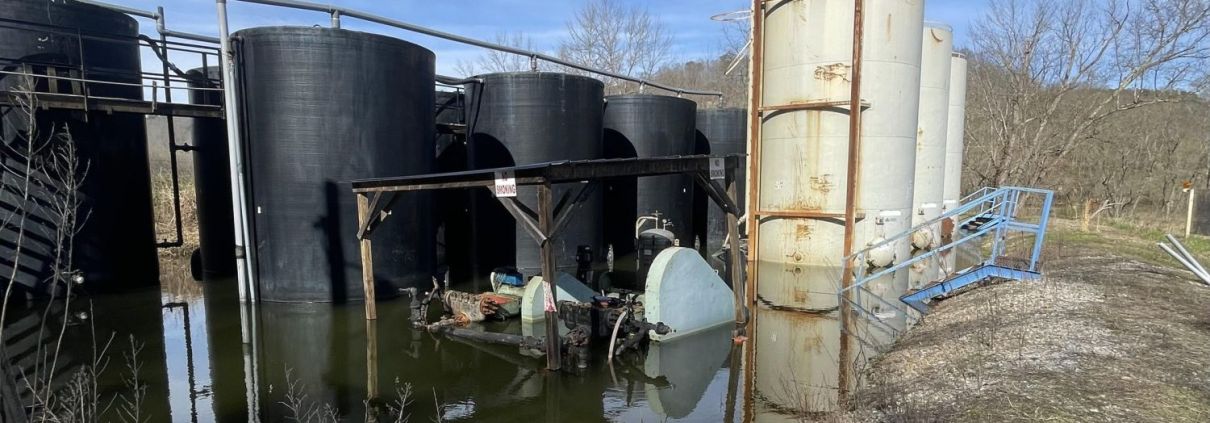

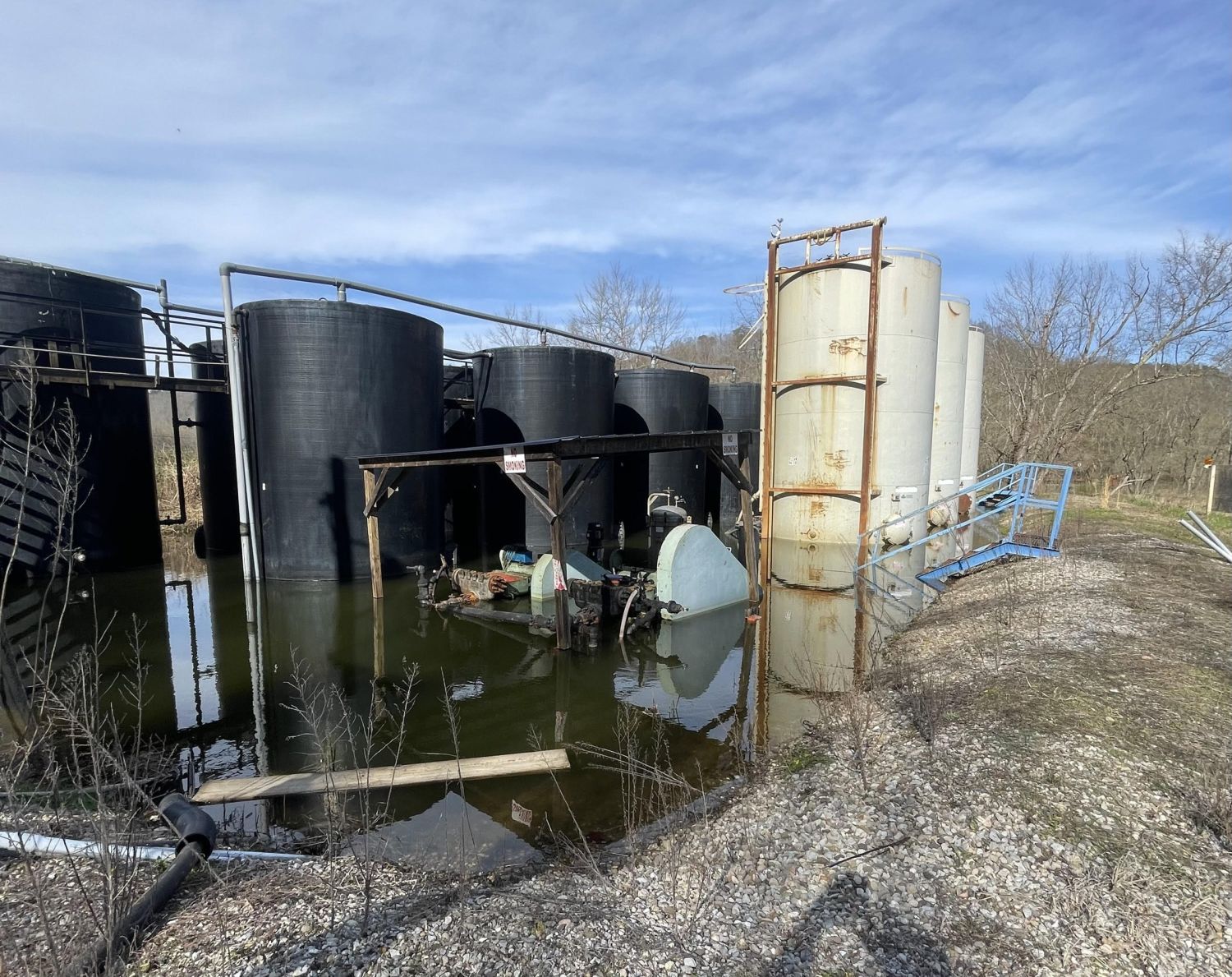

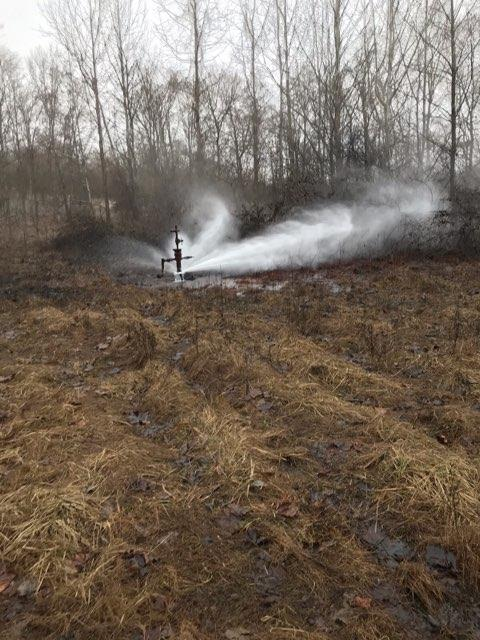
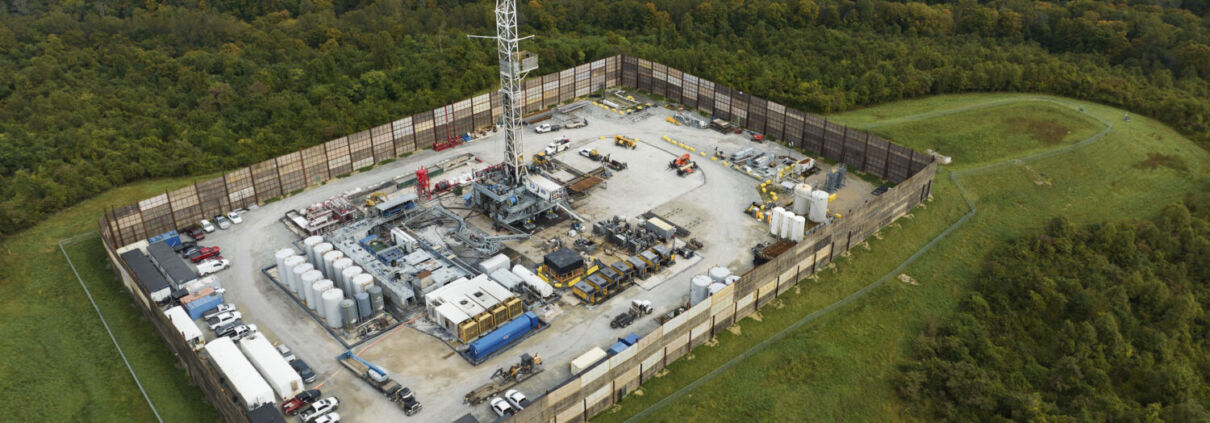 Ted Auch, 2022. Photo courtesy of FracTracker Alliance.


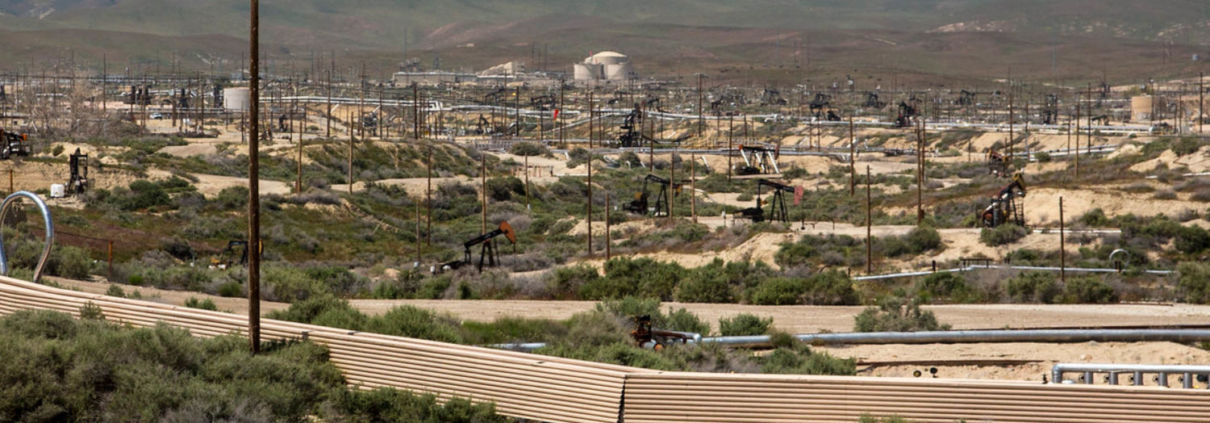

 Photo by David Becker