Data driven discussions about gas extraction and related topics.

The Devil’s Details about Radioisotopes and Other Toxic Contaminants in Marcellus Shale Flowback Fluids

and Their Appearance in Surface Water Sources and Threats to Recreationalists, Private Well Water Users, and Municipal Water Supplies

By Conrad Dan Volz, DrPH, MPH – Director, Center for Healthy Environments and Communities, University of Pittsburgh Graduate School of Public Health

In yesterday’s FracTracker post, CHEC’s data manager Matt Kelso told the tale of two stories regarding radionuclides in Marcellus Shale flowback water and in river water as sampled by the PA DEP. As he said “the devil is in the details” and here are the “devil’s details” that put both stories into their proper public health context.
There are without doubt higher levels of radioisotopes in Marcellus Shaleflowback fluids than in the fracking fluids, which are injected under highpressure to fracture the shale layer. And in general problems related tonaturally occurring radioisotope buildup in the oil and gas industry arewell documented. The following is a passage from my expert testimony in theMatter of Delaware River Basin Commission Consolidated AdministrativeAdjudicatory Hearing on Natural Gas Exploratory Wells; Filed November23, 2010:

Elevated concentrations of naturally occurring radioactive materials(NORM), including 238U, 232Th and their progeny, are found inunderground geologic deposits and are often encountered during drillingfor oil and gas deposits (Rajaretnam G, and Spitz HB., 2000). Drill cuttingsfrom the Marcellus may be enriched in radium radionuclides and off-gas the radioelement radon. Also, the activity levels and/or availability ofnaturally occurring radionuclides can be significantly altered by processesin the oil, gas and mineral mining industries (B. Heaton and J. Lambley,2000). Scales in drilling and process equipment may become enrichedin radionuclides producing technologically enhanced naturally occurringradioactive materials (TENORM). Exposure to TENORM in drillingequipment may exceed OSHA and other regulatory authority standardsfor the protection of both human and ecological health. The occurrenceof TENORM concentrated through anthropogenic processes in soils atoil and gas wells and facilities represents one of the most challengingissues facing the Canadian and US oil and gas industry today (Saint-Fortet al., 2007). The risk of contamination of surface water and ground waterby TENORM accompanies the risk of soil contamination, as TENORMgenerated may runoff of drilling equipment during rain events or if onthe soil surface into surface water sources and/or enter groundwater bytransport through the unsaturated zone.

In a review article in Environmental Science and Technology (ES&T),authors Karbo, Wilhelm and Campbell (EPA Region III leads and Office ofRadiation and Indoor Air) stated:

New York’s Department of Environmental Conservation (NYDEC) reportedthat thirteen samples of wastewater from Marcellus Shale gas extractioncontained levels of radium-226 (226Ra) as high as 267 times the safedisposal limit and thousands of times the limit safe for people to drink.The New York Department of Health (NYDOH) analyzed three MarcellusShale production brine samples and found elevated gross alpha, grossbeta, and 226Ra in the production brine. Devonian-age shales containnaturally occurring radioactive material (NORM), such as uranium (U)and thorium (Th) and their daughter products, 226Ra and 228Ra. TheMarcellus Shale is considered to have elevated levels of NORMs. NORMsthat have been concentrated or exposed to the accessible environmentas a result of human activities, such as mineral extraction, are defined bythe EPA as technologically enhanced NORM (TENORM). TENORM maybe concentrated because of (1) temperature and pressure changes duringoil and gas production, (2) 226Ra and 228Ra in produced waters reactingwith barium sulfate (BaSO4) to form a scale in well tubulars and surfaceequipment, (3) 226Ra and 228Ra occurring in sludge that accumulates inpits and tanks, and (4) NORM occurring as radon (Rn) gas in the naturalgas stream.

If this flowback-produced water with elevated TENORM is disposed ofin sewage treatment facilities or other ineffective wastewater disposalprocesses – then the TENORM level in surface water (the receiving streamor river) will be largely determined by dilution offered by fluid flows withinthe waste plant and dilution offered by the water flows themselves in theriver or stream.

So, it is entirely possible that Marcellus Shale flowback and produced fluids(yes I hesitate to call it water because it is contaminated fluid – with manyidentified toxic contaminants; if this were coming from other industries itwould be a hazardous liquid waste) will have elevated levels of TENORM and many other contaminants (see explanation in Appendix 1 below) butlevels of TENORM in the surface water it is going into will not exceedbackground levels, seen in the stream or river system, once it is completelymixed in the stream or river.

But here is the devil in the details as Matt said in his article.Recreationalists fish and boat around these outfalls (this is documentedby CHEC in the Allegheny River Stewardship Project and the PittsburghFish Consumption Project), and we have no idea of the levels of TENORM(or other contaminants) in receiving water near the outfalls before fullriver mixing occurs. Additionally we have no idea of the level of long term bioaccumulation of TENORM (and other contaminants) in fish and otheraquatic resources that may frequent or live in areas where this material isdisposed of in.

Concentrations of TENORM and the many other contaminants in the effluent from treatment of oil and gas flowback fluids will vary in receivingstreams and rivers according to the flow of water in the receiving streamor river and their concentrations in the flowback fluids. Therefore, levels ofTENORM in receiving streams and rivers will reach a peak (everything elsebeing equal) during times of low flow – such as a drought or long periodswithout rain or snowmelt – and peak levels will be higher in the surface waternear the outfall then downstream in the river after it is mixed completelywith water flow from the stream or river. The PA DEP river water samplesfor radium were not taken during periods of low flow but during the fallseason when rain was more plentiful. Furthermore, they were not taken near outfallsof plants accepting oil and gas waste fluids for treatment, before completemixing occurs—therefore, peak levels in these areas were not captured bytheir sampling plan.

Additionally, levels of TENORM (and other contaminants) from sewagetreatment plants and inefficient brine treatment plants will be higher inlow volume streams (such as 10 Mile Creek in Greene and WashingtonCounties and Blacklick Creek in Indiana County) than in large volume riversystems like the Monongahela River. We simply don’t know what levels ofTENORM are like at peak levels in low volume streams during periods oflow flow or in areas just downstream of effluent outfalls before completemixing takes place.

CHEC has data showing that levels of bromides, barium and strontiumexiting the McKeesport POTW (a sewage treatment plant) vary over a day’s sampling; they aredependent on when the slug of produced-flowback brine is introduced intothe system and the slug’s rate of entry into the treatment system. At theMcKeesport POTW, it is customary that the slug of oil and gas waste fluidis introduced into the treatment system at 7pm. One sees that the levels ofthese contaminants in outfall effluent raises sharply over a short period oftime and then falls back to baseline (See CHEC figures 1, 2 and 3), whenthe slug is through the system. Any TENORM, in the oil and gas waste fluidbeing treated, not taken out by the treatment system will reasonably followthe same pattern. That is it will come and go quickly and we have no ideaof peak levels of TENORM or any other contaminants in the stream or rivernear the treatment plant outfall.

What is the solution to all this? Are we to sample continuously – at alltreatment plant outfalls, in river and stream segments between treatmentplant outfalls and water intakes, at all water intakes and in all finisheddrinking water (and I might add in private well water systems that may pullin contaminants from nearby streams and rivers) across the entire areaMarcellus Shale waste fluids are being disposed of? (This would includePennsylvania, New York, Ohio, and West Virginia). This is exactly whatis necessary to be done to assure protection of drinking water supplies,recreationalists, and the health of aquatic resources if we continue to allowoil and gas flowback water to be disposed of in sewage treatment andinefficient brine treatment plants.

NO – this would be cost prohibitive and impractical to do on the scale thatis necessary to protect public health and aquatic resources. We must usethe precautionary principal here and insist that sewage treatment plants notaccept oil and gas wastewater, period. Batches of oil and gas wastewaterneed to be tested continuously for levels of TENORM and all other possiblecontaminants so that a determination can be made of where the fluids canbe adequately and safely disposed of. Fluids that are determined to behazardous and/or toxic should be transported only by certified haulers andloads need to be properly manifested so there is an accurate accounting ofthe volumes of waste and where it is being sent for ultimate treatment. Thetechnical capabilities and acceptance of brine fluids, of and by, oil and gaswaste fluid treatment facilities must be matched exactly to the realities oflevels of contaminants in the brine fluids.

The intent of the Resource Conservation and Recovery Act (RCRA) wasto ensure that there is a “cradle to grave” system to document, handleand dispose of all hazardous and toxic waste from all industries and evenmunicipal authorities in a safe and effective manner. RCRA is basically anextension of the environmental public health precautionary principal – andif implemented and enforced thoughtfully and comprehensively preventsthe formation of new Superfund sites and will assure that the publicand environmental receptors are protected from contaminants in oil andgas waste fluids- be they called flowback or produced water, or brine oranything else.

Figure 1, Time-plot of Barium concentration in effluent from the McKeesportPOTW, sampled beginning 10/19/2010. Hour 1 begins at 19:00 (7:00 PM).A sample was taken on the hour, every hour, for a period of 24 hours. (To zoom in, click on the image.)
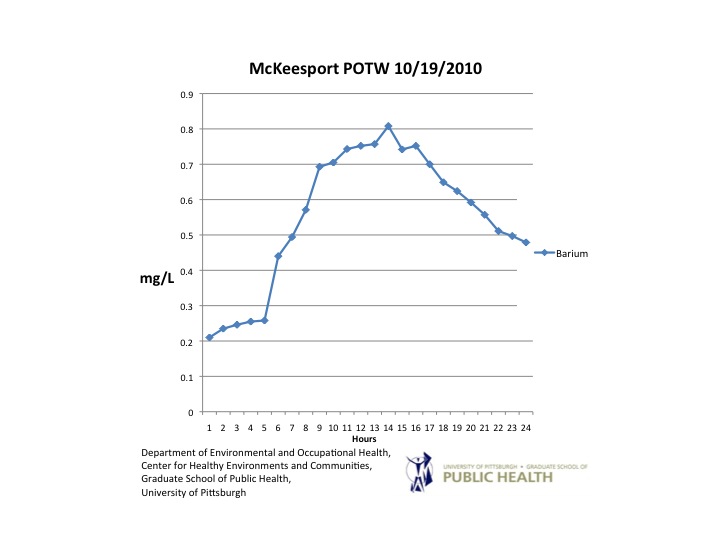
Figure 2, Time-plot of Strontium concentration in effluent from the McKeesport POTW, sampled beginning 10/19/2010. Hour 1 begins at 19:00 (7:00 PM). A sample was taken on the hour, every hour, for a period of 24 hours. (To zoom in, click on the image.)


Figure 3
, Time-plot of bromides concentration in effluent from the McKeesport POTW, sampled beginning 10/19/2010. Hour 1 begins at 19:00 (7:00 PM). A sample was taken on the hour, every hour, for a period of 24 hours. (To zoom in, click on the image.)


Appendix 1, Background Information

Hydraulic fracturing (HF) of shale gas deposits uses considerable masses of chemicals, for a variety of purposes to open and keep open pathways through which natural gas, oil and other production gases and liquids can flow to the well head. HF, also known as slick-water fracturing, introduces large volumes of amended water at high pressure into the gas bearing shale where it is in close contact with formation materials that are enriched in organic compounds, heavy metals and other elements, salts and radionuclides. Typically, about 1 million gallons and from 3-5 million gallons of amended water are needed to fracture a vertical well and horizontal well, respectively (Hayes, T; 2009, Vidic, R.; 2011). Fluids recovered from these wells can represent from 25% to 100% of the injected amended water solution (Vidic R., 2011) and are called “flowback” or “produced” water depending on the time period of their return.

Flowback and produced water contain high levels of total dissolved solids, chloride, heavy metals and elements as well as enriched levels of organic chemicals, bromide and radionuclides – in addition to the frac chemicals used to make the water slick-water. Levels of contaminants in flowback water generally increase with increasing time in contact with formation materials. There is abundant evidence that fluids recovered from this operation have high levels of total dissolved solids, barium and strontium, chlorides and bromides

While there is at present considerable scientific inquiry and even controversy regarding the potential of vertical or horizontal fracturing of shale gas reservoirs to contaminate shallow or confined groundwater aquifers (thus exposing municipal or private well water users to chemicals used in the hydrofracturing process and/or toxic elements, organic compounds, and radionuclides that exist in the formation materials); disposal of oil and gas wastewater/ Marcellus shale brine water in sewage treatment plants or inefficient brine wastewater treatment facilities is a direct exposure threat to public health through ingestion, inhalation and dermal absorption exposure pathways.

PA Marcellus Shale Production by Municipality

Average 6 month MS Well Production by Municipality (small)Marcellus Shale production by municipality. The darker red municipalities have higher production, illustrating that gas production in these gas wells comes in “hot spots”, particularly in the northeast and in the southwest.

It is no secret that there is money to be made in the natural gas industry, not only for the industry, but for those leasing their mineral rights as well. Pennsylvania law requires that a royalty of at least one eighth of the wellhead price of gas be paid to the owner of the land’s mineral rights.

And yet, we continue to hear stories, such as the one about Ron Gulla, who leased his land, which was subsequently damaged by drilling operations, all for apparently no money. How can this be? According to Mr. Gulla, it was because his gas was “wet gas” which needs to be processed. The DEP website makes no such distinction. Just to be sure, I called the Harrisburg office of the Bureau of Oil and Gas Management. Their response was that wet or dry, the drilling operators are required to pay at least one eighth of the wellhead price of gas as a royalty fee.

Is it possible that after all the drilling and hydraulic fracturing and dead fish and ruined farm that there was just no gas produced from that well?

First of all, let’s find Mr. Gulla’s former community. We know from the story referenced above that he was from Hickory in Washington County. In terms of this map, that places him in the middle of Mount Pleasant Township, so let’s take a closer look at what’s going on in that area.


Average six month gas production for Mount Pleasant Township in Washington County, PA, by municipality. Production values are from 7-1-10 to 12-31-10. Click the gray compass rose and double carat(^) to hide those menus.

If you click on the “i” button in the blue circle, then the red shape in the middle of the screen, we can learn quite a bit about gas production in Mount Pleasant Township. For example, we know that there were 94 wells in the township, each producing an average of 57.8 million cubic feet of gas in the six month period of July to December 2010, for an estimated minimum royalty check of just over $30,000. That’s a lot of gas and a lot of money. So where was Mr. Gulla’s?


Average six month gas production for Mount Pleasant Township in Washington County, PA, by municipality and by well. Production values are from 7-1-10 to 12-31-10. Click the gray compass rose and double carat(^) to hide those menus.

If the statewide trend is one of hotspots, at the township level, we are now looking at hotspots within hotspots. While many wells in Mount Pleasant Township produced over 300 million cubic feet of gas in the six month period, many others produced very little. And if Mount Pleasant is a moderately high producer of Marcellus Shale gas, and Chartiers Township to the southeast is a heavyweight, it makes it all the more curious that Cecil Township to the northeast and Smith Township to the northwest have no Marcellus Shale activity at all.

So maybe you have a neighbor who hit the jackpot with the Marcellus Shale gas boom, but does that mean that you will?


Average six month minimum royalty fees by township. Note the large number of municipalities with low or no royalty averages, and the very high dollar amounts in some other communities. Click on the gray compass rose and double carat (^) to hide those menus.

From this map, you can get an idea of what the average six month well royalty check might be for a well in your community. The figures for this map are based on the production values, above, times 0.125 times the average wellhead price of gas in 2010. But as we’ve seen in Mount Pleasant, there are some holes where the gas just doesn’t flow.

After taking this to another level of complexity, the lesson is pretty much the same as before: There is money to be made in the Marcellus Shale gas extraction industry–sometimes. As Mr. Gulla’s story reminds us, there are hardships as well. The DEP issued 9,370 oil and gas violations in a period of less than four years. Things can and sometimes do go wrong, and even when they don’t, around the clock industrial action for months on end in your backyard may be at odds with your bucolic lifestyle, or that of your neighbors.

So if you leased your land, would you cash in? At best, you can look at the numbers and play the odds, but there’s only one way to find out for sure.

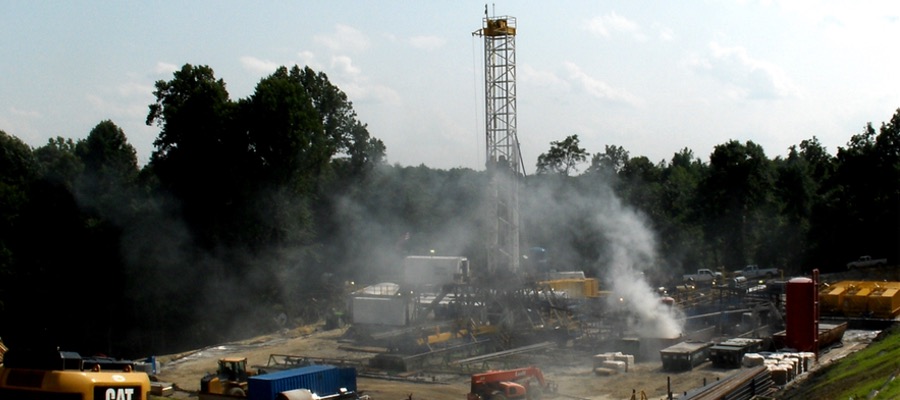
Air emissions from drilling rig

The Environmental Impacts of Shale Gas Extraction

Archived

This article has been archived and is provided for reference purposes only.

By John Stolz, PhD – Duquesne University, Department of Biological Sciences

The Marcellus Shale represents one of the largest reservoirs of unconventional natural gas in the world.It holds the potential, like other gas and oil reserves, to provide a source of energy and jobs for Maryland. It’s extraction, however, is non-trivial and if done without proper safeguards can result in the degradation of water and air quality, and loss of land use. Over the past year I have had to opportunity to observe ongoing natural gas well activities in Western Pennsylvania, attended public hearings,spoken with disaffected individuals, gas company representatives, and people from other states with gas drilling activities. I would like to share with you some of my observations.Shale gas is called “unconventional” because the gas is trapped in the rock and needs to be extracted.The process, called hydraulic fracturing, involves a mixture of water, sand, and chemicals that are injected into the group at very high pressures (~10,000 psi). Each “frac” may require up to 5 million gallons of water. In Pennsylvania, this water is withdrawn from lakes, streams and rivers.

The large volumes of water are transported to a developing “play” by water trucks and deposited in large impoundments. These impoundments can be several acres in size and hold millions of gallons of water. A typical water truck may hold 4,500 gallons, so it takes several hundreds to thousands of truck trips to fill an impoundment.

The depth of the Marcellus Shale is between 5,000 and 6,000 feet below the surface in Western PA,thus a larger drilling rig is needed. A unique feature of these wells is that they are “horizontal” and may extend outwards several thousand feet in several directions. This is needed as the formation is relatively thin (~150’) in most places. A well pad may have 6 to 12 well heads. Each well produces~1,000 tons of drilling waste (ground up rock and drilling mud) that may contain a variety of salts, heavy metals, and naturally occurring radioactive material (NORM). This drilling waste may be buried on site or, more usually, transported to a land fill.

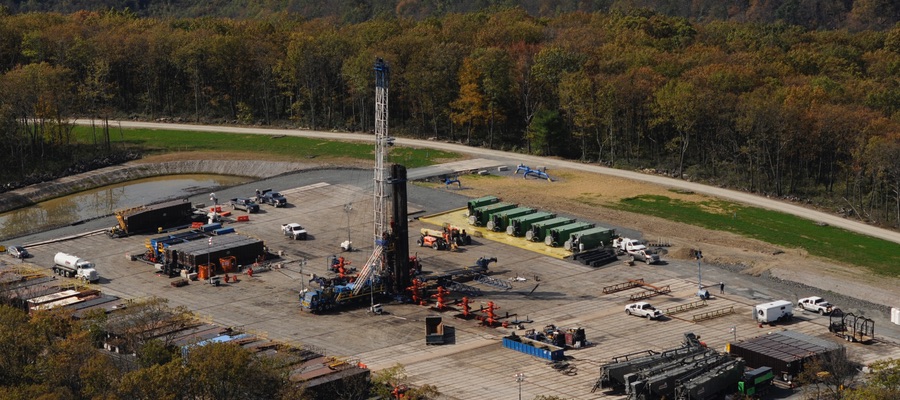
The well pad itself is 4-6 acres, in order to provide space for the trucks and containers, and impoundments for drilling mud, waste, and fracking. Once the horizontal has been drilled and cased, it is “fracked”. This process involves many vehicles, containers of sand and chemicals, the mixing trucks with fracking chemicals, and the diesel compressors (~200 vehicles). Hence the need for more space than a conventional well. During completion, the well is usually flared.

A completed well pad will typically have several well heads (the “Christmas tree), separators, small compressors, and condensate tanks (to handle the produced water). As long as a well pad is active (the well can be restimulated or used to drill a deeper formation), the footprint is still 4-6 acres. Depending on the number of wells, there may be as few as two condensate tanks or many more. They are sources of volatile organics as they are designed with “blow off” relief valves. Invisible to the naked eye these volatiles can be seen with specially designed infrared cameras.

The amount of produced water may also vary. For Marcellus, the initial flow back has been only about10 to 20% of the amount of fluids that were injected. Over time this “produced water” increases in total dissolved solid (TDS) content. The “brine” can be ten times saltier than seawater, contain high concentrations of bromide, chloride, strontium, and barium, as well as arsenic and uranium. In Pennsylvania, while the condensate tanks have hazard placards indicating the toxicity and flammability of the flow back water, the truck only is labeled “residual waste” and “brine”. Publicly owned wastewater treatment plants (POTWs) are allowed to take up to 1% of their total daily output. In Pennsylvania, there are currently at least 63 POTW’s permitted to take produced water. POTWs are not designed to“treat” produced water but merely dilute the salts.

This has resulted in increases in total dissolved solids(TDS), bromide in particular, in local rivers. The increase in TDS and bromide has caused problems with public drinking water facilities as the disinfectant process (chlorination) creates trihalomethanes (TMH, bromoform and chloroform). As a result many public drinking water facilities in the area have had to convert from chlorination to chloramination to reduce the formation of THMs. However, chloraminated water can cause the leaching of lead from older pipes and fittings. And there will be spills. Over the past 2.5 years, the PA-DEP has cited the industry with over 1,600 violations. Many of these were for improperly constructed impoundments, chemical spills, and surface contamination.

There are other aspects to the industry as well. Methane is a colorless, odorless gas, that needs to be odorized with mercaptan. The product from the Marcellus in Western PA is not dry gas but a combination of other organics as well. Thus the gas needs to be “dried” in refineries. Propane and butane are “cryo” separated in these facilities. These complexes are a source of volatile organic compounds and are frequently flaring off residual organics. They are also flanked by compressor stations that pressurize the gas for the pipeline.

The industry can move very quickly as has been recently demonstrated in Hickory-Houston, PA area,where since 2005 there are now over 80 well pads, impoundments, compressor stations, and other gasfacilities within a five mile radius.

The extraction of unconventional natural gas is heavy industry involving large tracts of land, heavyequipment and vehicles, and an extensive array of pipelines, compressor stations, and processing facilities. The level of surface disturbance is extensive, as has been demonstrated elsewhere (e.g.,Colorado, Wyoming, Texas, Arkansas, Louisiana). Existing industries such as agriculture, tourism, outdoor ventures (e.g., fishing, hunting, and camping), and wineries, will be lost or significantly impacted. In Pennsylvania there have already been loss and contamination of well water, and loss of livestock and quarantined herds after exposure to contaminated water.<

Summary of Environmental Impacts

Water

  • The amount needed for fracking (5 million gallons/frac)
  • Loss of well (aquifer) water through disruption or contamination
  • Gas migration causing methane contaminated water
  • The fate of the produced water (“treated” at POTWs)
  • Degradation of water quality in local streams and rivers
  • Degradation of drinking water quality (need to purchase bottled water)

Land usage

  • Large amount of acreage needed for well pads and impoundments
  • As long as a well can be “restimulated”, the well pad will remain active
  • Leased areas (former private and public lands) become restricted access
  • Public lands and parks no longer “public” as they are off limits due to safety

Exposure to toxic chemicals (spills, aquifer contamination)

  • Fracking fluids
  • Produced water contaminated with organics, salts, heavy metals, and NORMs
  • Failed or improper casings lead to aquifer contamination

Traffic and road degradation

  • Significant increase in trucks and vehicles cause road and bridge deterioration
  • Trucks may exceed weight and height limits

Noise

  • Heavy equipment, increased traffic,
  • Low frequency sounds during fracking
  • Compressors and compressor stations

Air pollution

  • Increased vehicle traffic
  • Well flaring
  • Release of VOC’s from well installations (condensate tanks are vented by design)
  • Compressor stations
  • Well blow outs

Property devaluation

  • Mortgages and home equity loans jeopardized by presence of wells
  • Mine subsidence insurance compromised or negated
  • Land owner ultimately responsible for taxes and environmental damage

EMS and emergency procedures

  • Evacuation plans must be in place for populated areas (a single well blow out can affect more than 1 mile radius)
  • EMS, police and fire must be trained to handle emergencies (well and impoundment fires, evacuations)

Increases taxes to cover infrastructure damage, additional public services and security.

John F. Stolz, Ph.D.
Professor, Department of Biological Sciences
Director, Center for Environmental Research and Education
Duquesne University
Pittsburgh, PA 15282

Updated Pennsylvania Marcellus Shale Production Information

Updated Marcellus Shale well production data for the period between July 1, 2010 and December 31, 2010 is now available on the DEP website and FracTracker’s DataTool. This data is self-reported by the drilling operators, and includes production in the following categories:

  • Natural Gas: Production in thousands of cubic feet (Mcf)
  • Condensate: Production in barrels
  • Oil: Production in barrels

Let’s take a look at some of the numbers.

Gas Production and Well Status

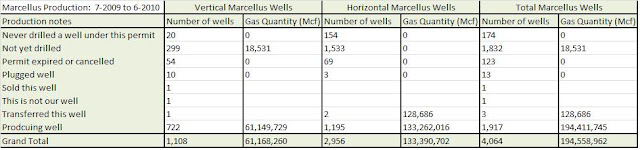
Table 1: Production notes and values for Pennsylvania Marcellus Shale wells, July 1 2009 to June 30, 2010

Table 2: Production notes and values for Pennsylvania Marcellus Shale wells, July 1 2010 to December 31, 2010

Although gas production is the focus of the six month production report, there is enough useful data to learn a few other things about the industry as well:

  • As with the waste report, there is more production reported in the last half of 2010 than the entire preceding year. Although there are more producing wells, my suspicion is that the real reason is poor reporting for the July 2009 to June 2010 report.
  • As corroborating evidence of poor reporting, the earlier report includes significant production from wells that are “Not yet drilled”. This issue has been corrected for the last half of 2010.
  • Only 26 Marcellus Shale wells are reported as plugged. This is fairly impressive, as the earliest Marcellus well in Pennsylvania was from 2006.
  • Over half of the Marcellus Shale wells which have been permitted in Pennsylvania have not yet been drilled. Almost all of these are horizontal wells.

Gas, Condensate, and Oil Production

Table 3: Gas, condensate, and oil production values for Pennsylvania Marcellus Shale wells, July 1 2009 to June 30, 2010

Table 4: Gas, condensate, and oil production values for Pennsylvania Marcellus Shale wells, July 1 2010 to December 31, 2010

The Marcellus Shale is well known as a gas producing black shale formation, but condensate and oil are also produced from these wells in Pennsylvania. There are a couple of trends of note here as well:

  • Although the more recent report is for only half the length of time as the older one, this cannot account for the tenfold decrease in oil production.
  • The amount of condensate nearly doubled, despite the fact that the reporting period was only half as long.
  • Almost all oil and condensate production now comes from horizontal wells.

Location

Now let’s take a look at the geographical distribution of this data. Here, in rapid succession, are the data in table, chart, and map formats:

Table 5: Pennsylvania Marcellus Shale production by county, July 1, 2010 to December 31, 2010

Chart 1: Pennsylvania Marcellus Shale gas production by county, July 1, 2010 to December 31, 2010


PA Marcellus Shale Oil, Gas, and Condensate Production, July 1, 2010 to December 31, 2010. Please click the gray compass rose and double carat (^) to hide those menus.

There are a couple of key points about the location information as well:

  • Although Washington county is one of several major producers of natural gas, the vast majority of the Marcellus Shale oil and condensate production in the Commonwealth comes from that county.
  • The leading producers in the state by county are (percentage of statewide total in parentheses):
    1. Bradford (25.7%)
    2. Susquehanna (23.7%)
    3. Washington (14.2%)
    4. Greene(12.3%)
    5. Tioga (8.8%)


Marcellus Shale natural gas, condensate, and oil production in Southwestern Pennsylvania, July 1, 2010 to December 31, 2010

Production by Operator

Table 6: Natural gas produced by operator in Pennsylvania’s Marcellus Shale formation, 7-1-10 to 12-31-10.

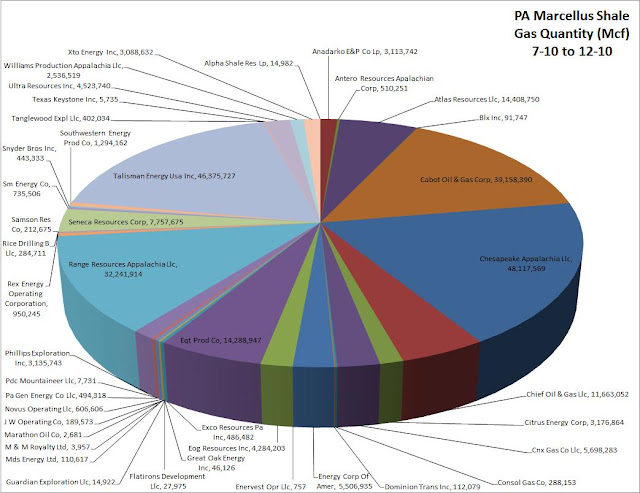
Chart 2: Natural gas produced by operator in Pennsylvania’s Marcellus Shale formation, 7-1-10 to 12-31-10.

The leading producers in the state by operator are (percentage of statewide total in parentheses):

  1. Chesapeake Appalachia Llc (18.8%)
  2. Talisman Energy Usa Inc (18.1%)
  3. Cabot Oil & Gas Corp (15.3%)
  4. Range Resources Appalachia Llc (12.6%)
  5. Atlas Resources Llc (5.6%)

Updated Pennsylvania Marcellus Shale Waste Information

Total Waste Produced by Marcellus Shale Well (small)Mixed total of waste produced by Marcellus Shale gas wells between July 1 and December 31, 2010. For more information on specific wells, click the blue “i” button, then click on one of the purple dots.

Self reported Marcellus Shale waste data for the period between July 1 and December 31, 2010 is now available on the DEP website and FracTracker’s DataTool in the following categories:

  • Basic Sediment (in barrels): Sludge that collects at the bottom of storage tanks and pits
  • Brine (in barrels): These are naturally occurring pockets of saltwater that are encountered in the drilling process.
  • Drill Cuttings (in tons): This is composed of the layers of earth that the drill passes through on the way to the target formation.
  • Drilling (in barrels): The main function of drilling fluid is to maintain the proper pressure in the well
  • Frac Fluid (in Barrels): This is what is injected into the well during the hydraulic fracturing process, much of which tends to flow back out.
  • Servicing Fluid (in Barrels): Waste produced by one of a variety of post-production services performed on a well.
  • Spent Lubricant (in Barrels): This lubricates the drill bit

I have also pivoted the data to establish how much waste is transported to the various disposal locations.


Locations accepting Pennsylvania’s Marcellus Shale waste. Please click on the gray compass rose and double carat (^) to hide those menus.

I have a few initial observations about the waste production data:

  • The totals for waste production in every category except Basic Sediment are higher for the six month period from than they were for the one year period ending on June 30, 2010. This increase almost certainly reflects better reporting rather than a dramatic increase in waste production in the last half of 2010.
  • There are some obvious inaccuracies in the map of the facilities receiving Pennsylvania’s Marcellus Shale waste. There is no reason that this waste would be shipped to Texas or Alabama, for example. Those locations are most likely corporate addresses of the waste facilities.
  • Despite the fact that companies are supposed to report both addresses and latitude and longitude of the receiving facilities, not all of the facilities receiving waste are on this map. The list of addresses appeared to be more complete, so that is what was used for mapping purposes. If you download the full dataset, addresses in Pennsylvania, New York, Ohio, West Virinia, Maryland, and New Jersey are given as recipients of Pennsylvania’s Marcellus Shale waste.

PA Fish and Boat Commission Targets Gas Extraction as Resource Threat

Archived

This article has been archived and is provided for reference purposes only.


Wastewater Facilities Accepting Marcellus Shale Brine and Major Drainage Basins. Click the map for a larger, dynamic view.

By Conrad Dan Volz, DrPH, MPH.
Director and Principal Investigator of the Center for Healthy Environments and Communities

Management Plans by the Pennsylvania Fish and Boat Commission (PFBC) have been released for public comment for the 3 major drainages in Pennsylvania:

Public meetings on each of these draft plans are underway and dates and times and places of future meetings for each basin are now available on the PFBC website.

The PFBC has as its goal of these management plans – to protect, conserve and enhance the aquatic resources of and provide fishing and boating opportunities. The PFBC also has an important role in investigating releases of brine water from oil and gas extraction operations. Mr. John Arway the Executive Director of the PFBC just published in the January / February Edition of Pennsylvania Angler and Boater a very sobering assessment of water withdrawals and permitted pollution of Pennsylvania waterways by NPDES permit holders. He states that end users of municipal water are paying increased costs for water purification because of companies that are allowed to pollute receiving waters. This is a very courageous statement and I concur wholly with him on this. His complete statement can be found here.

Below are presented excerpts from the PFBC Draft Three Rivers Management Plan that pertains to Marcellus Shale gas extraction. Most important is their statement in the draft plan that in 2008, several wastewater treatment plants located along the Monongahela River were accepting frac-flowback water from multiple sources. Unable to completely treat this water, plant outflows caused a temporary spike in conductivity (readings as high as 1,200 μS/cm) and total dissolved solids (TDS readings as high as 900 mg/L) in the Monongahela River during October and November 2008. Other passages related to Marcellus are:

  • “In June 2010, the Monongahela River was named number nine of the top ten America’s Most Endangered Rivers by American Rivers primarily because of continuing threats from water pollution impacts from natural gas extraction activities in the Marcellus Shale.”
  • “Since 2008, PADEP Southwest Regional Office in Pittsburgh has directed a comprehensive
    water quality monitoring investigation of the Monongahela River related to impacts from disposal of contaminated frac-flowback water from Marcellus Shale drilling sites. This office has also surveyed fish, mussel, and invertebrate assemblages of the Allegheny and Monongahela Rivers as well as collected water quality and sediment quality samples and evaluated riparian and instream habitats for the U.S. Environmental Protection Agency’s (USEPA) Environmental
    Monitoring and Assessment Program for Great Rivers Ecosystems (EMAP-GRE). PADEP will
    provide PFBC information and results of Allegheny and Monongahela EMAP-GRE when the
    project is complete (in 2011).”
  • “Marcellus Shale is a unit of Devonian-age sedimentary rock found throughout the Appalachian
    Plateau. Named for a distinctive outcrop located near the village of Marcellus, New York,
    Marcellus Shale contains a massive and largely untapped natural gas reserve, which has high
    economic potential (trillions of dollars) given its proximity to high-demand markets in the eastern United States. Using horizontal drilling and hydraulic fracturing techniques, numerous Marcellus Shale wells have been installed within the upper Ohio River basin for exploitation of natural gas.”
  • “With any resource extraction operation, there are environmental consequences. For Marcellus
    Shale drilling, most issues involve the transport, treatment, and disposal of contaminated frac flowback water, a byproduct of hydraulic fracturing. In 2008, several wastewater treatment
    plants located along the Monongahela River were accepting frac-flowback water from multiple
    sources. Unable to completely treat this water, plant outflows caused a temporary spike in
    conductivity (readings as high as 1,200 μS/cm) and total dissolved solids (TDS readings as high
    as 900 mg/L) in the Monongahela River during October and November 2008.”
  • “Some Monongahela River tributaries continue to be disturbed by modern industries, such as longwall mining and Marcellus Shale drilling, including Dunkard Creek and Tenmile Creek. Major tributary streams of the upper Ohio River include Chartiers Creek (one of the most disturbed streams in the basin from numerous perturbations), Raccoon Creek (a recovering stream), and the Beaver River system.”

Pennsylvania’s DCNR Shale Thickness Datasets Added to DataTool

Three Belt Thickness of Devonian Black Shales in PA (small)Three Belt Thickness of Devonian Black Shales. Click image for a larger dynamic view.
Three datasets from the Pennsylvania Department of Conservation and Natural Resources (DCNR) have been added to FracTracker’s DataTool.  Each dataset indicates the thickness of a major carbon-rich black shale layer from the Devonian Period in Pennsylvania, including the Marcellus, Rhinestreet, and Huron.


The thickness in feet of the Marcellus Shale. Click the gray compass rose and double carat (^) to hide those menus.


The thickness in feet of the Rhinestreet Shale. Click the gray compass rose and double carat (^) to hide those menus.

  • Thickness of the Huron (Ohio) Shale. The Huron Shale is an Upper Devonian black shale that is more recent (and less deep) than the Rhinestreet Shale. It is a widespread formation ranging over several states, but in Pennsylvania, it is only present in the extreme northwest corner.


The thickness in feet of the Huron Shale. Click the gray compass rose and double carat (^) to hide those menus.

For an interesting cross-section view of Northwestern Pennsylvania rock formations visit this link from the DCNR website.

Data Accessibility and Usability Index

While anyone with a registered user account can put data up on FractTracker’s DataTool, sometimes finding and collecting relevant data in a usable form is more difficult than it should be. I have examined datasets from a wide variety of places (1) and agencies, and after encountering numerous issues, I have devised a grading scheme to reflect the quality of the data being distributed, to be known as the Data Accessibility and Usability Index (DAUI).

System

The DAUI considers variables in the following seven categories:

  • Accessibility (20 points): How easy is the data to obtain?
  • Usability (20 points): How much preparation is required to be able to analyze the data?
  • Completeness (15 points): Is there anything missing from the data that would interfere with analysis or mapping?
  • Metadata (15 points): Are the data column descriptions and data source information readily available?
  • Responsiveness (10 points): Has the agency been helpful with information requests? (2)
  • Accuracy (10 points): Are there errors in the data? (3)
  • Cost (10 points): Is the data free? (4)


Data Accessibility and Usability Index grading scheme, 100 total points. Scroll to the right to see additional categories.

Grading Examples

It is important to note that each grade given represents only one specific dataset at one point in time. On occasion, certain aspects of any given dataset are updated by the agency controlling the data, hopefully for the better.

One recent example is the Pennsylvania drilled wells (spuds) database. Until recently, this was published on HTML tables on a monthly basis, but 2011 data is now available in a single Excel file. In addition, this year’s wells have location information, which was missing from previous years data. Although PASDA maintains a list of about 125,000 oil and gas locations in the Commonwealth directly from the DEP, there were still thousands of wells that didn’t match in the years between 1998 and 2010.

Since the new dataset in Pennsylvania only covers 2011 wells so far, it is appropriate to grade both datasets separately. This will also serve as a functional example on how the DAUI works.


Grades for PA DEP’s Drilled Wells Dataset. Scroll to the right for additional grades and total scores.

As you can see, the two changes that they have made have bumped the PA DEP’s grade up from a D- to a solid A. And in fact, the D- might have been generous. Several of our DataTool users have suggested that there might be significant omissions in the older report, but I have never been able to conclusively establish that as a fact. If it is true, the Accuracy rating would fall from 10 to 0, leaving a total score of 50 for that database.

Let’s look at another example, Wells in Quebec near the St. Lawrence, published by Quebec’s bureau d’audiences publiques sur l’environnement. To get the data up on FracTracker, the data had to translated to English (not a demerit, just a step in the process), copied from the PDF file to Excel and pasted so that each column of data fit on one cell. Then the data could be distributed using the space (“ “) as a delimiter, at which point the cells needed to be manually aligned to allow for proper concatenation. Once all of that was done, it was necessary to change the location information from Degree Minute Second format to Decimal Degree to be able to map the data. Finally, the units of measure for depth were mixed, including both meters and feet, which should be consistent. In short, not a very satisfactory experience with the data. Here’s how it grades, based on that experience:


Grade for Quebec’s bureau d’audiences publiques sur l’environnement Wells in Quebec near the St. Lawrence dataset. Scroll to the right for more grades and total score.

Despite my frustrations with this data, the information is published on the agency’s website, appears to be complete, and is well explained. The issue of publishing this dataset on a PDF (which cannot directly be analyzed) was the main result for the agency’s C grade.

Here’s the grade for a dataset that I can’t post: The Railroad Commission (RRC) of Texas’ Newark East (Barnett Shale) gas wells.

Clearly, the RRC is in possession of a tremendous amount of data. You can click on the “Well log” link and see dozens of pages of scanned original documents. However, there are a couple of problems with this data which makes in unusable for FracTracker. First of all, there are over 8,000 records, but it is impossible to view more than 100 at a time. Those would have to be copied and pasted manually from the HTML tables. While that is possible to do, it isn’t worth the effort, because there is no location information. Knowing that they must be able to produce an Excel sheet with some basic data about their drilled wells, I contacted the RRC, and was told that what I wanted could be obtained…for a cost. In my opinion, the RRC is being stubborn on this. They have terrific data, and yet they do everything they can to be (politely) difficult. As I did not elect to purchase data at this time, I will only grade what is available online.


Grade for the Railroad Commission of Texas’ Newark East (Barnett Shale) Drilled Wells dataset. Scroll to the right for more grades and the total score.

Because they elected not to release the data upon request, the RRC earned a failing grade. Had the RRC simply created and sent the proper Excel file from their database, they might have earned 90 points on the DAUI. If they had decided that well location information was a basic thing that citizens might want to know, and posted a downloadable link on their website, they could have full marks. If the for-cost version of the data has everything that is desired, it would have a maximum score of 80, because it was not free and had to be requested.

These three examples show how the DAUI system works. In the near future, I will grade all relevant oil and gas datasets against the same metric. Hopefully, a comprehensive picture of the various agencies that control oil and gas data will emerge.

Scoring 100 points on the DAUI should be attainable, almost 100 percent of the time. If governmental agencies really do not have data on wells, permits, violations, and production, then they are failing their respective citizens, whose lives are affeted by the oil and gas industry, often quite profoundly. If the agencies that control the data simply are in the habit of making it difficult to access, then I must remain hopeful that they will be pressured to realize that is an unacceptable strategy for the 21st century.

  1. This list includes Pennsylvania, West Virginia, Ohio, Arkansas, Texas, Utah, North Dakota, New Mexico, Colorado, and Quebec. Not all of the datasets have been complete enough to post on FracTracker, a frustration which contributed significantly to the creation of this grading scheme.
  2. If no requests have been made regarding a given dataset, or if the data simply does not exist in a desired format, full credit should be given in this category.
  3. Accuracy issues can be very difficult to verify. Also, if certain data doesn’t exist, that is accounted for elsewhere. As with Responsiveness, the agency is afforded the benefit of the doubt here.
  4. I have seen numerous datasets available from state agencies that cost money, with costs ranging from about $10 to well over $1,000. This is often explained as “recovering costs” of data distribution. In my opinion, this is unacceptable. While maintaining accurate data is undoubtedly expensive, it is an obligation of the overseeing agency to do so, and making the data available to the public is really a minimal component of that process. If it is a genuine budgetary constraint, then the agency should merely charge more for permit fees, etc., so that they are adequately able to perform their job.

PA DEP Upgrades Drilled Well Data Distribution

The Pennsylvania DEP now has a linkto download all of the drilled wells from the Spud Report in Excel file format (1). This is a major upgrade over their previous system of posting online tables for each month, not only for the ease of access, but also because it contains complete location information, which previously had to be obtained elsewhere by matching the American Petroleum Institute (API) number with an external dataset; an imperfect system which resulted in thousands of wells between 1998 and 2010 for which location information could not be found.


Drilled wells in Pennsylvania in 2011. Click the gray compass rose and double carat (^) tabs for a complete view.

In addition, it utilizes the full API number. For example, in well number 37-005-30663-01-01, the initial 37 is the state code for Pennsylvania, and the 005 is the county code for Armstrong County.

  1. The Spud Date is the day that drilling begins on a particular well.
  2. API county codes, as well as a variety of other codes used by the PA DEP are explained here.

Total Petroleum Systems in the Appalachian Basin; Definitions, Datasets and Snapshots


Stakeholder Awareness and Knowledge are Prerequisites for Informed Decision-Making Regarding Oil and Gas Extraction

By Conrad Dan Volz, DrPH, MPH

Our New York consultant, Karen Edelstein, has recently put onto FracTracker’s DataTool a number ofdatasets regarding other potential oil and gas source rocks and formations in the AppalachianBasin. Most of the formations on which she has posted data are not being actively drilled andexploited; they, therefore, only represent future areas of interest for oil and gas companies.However, the Utica-Lower Paleozoic Total Petroleum System, (FracTracker Snapshot 1below), which is more extensive and thicker than the Marcellus and underlies the extentof the Marcellus Shale by 1800 ft in western New York State and 5000 ft in south-centralPennsylvania, has already shown an ability to support commercial production.
Since capitaland human infrastructure are already in place for the Marcellus shale extraction, such as pipelines, arrangements for water withdrawals for fracturing, lease agreements, drilling and fracture capacity, and arrangements for wastewater disposal and trucking, the Utica has infrastructure advantages that may allow its exploitation sooner than other Appalachian petroleum basins.Even areas of the Utica beyond the Marcellus, particularly in eastern Ohio and Ontario, Canada,have been drilled and assessed and appear capable of producing natural gas in commerciallyviable quantities.

Utica Shale-Lower Paleozoic TPS, Applachian Basin (small)
Fractracker Snapshot 1. The Utica Shale
Click on the image for a better view.

The Appalachian Basin covers New York,Pennsylvania, eastern Ohio, West Virginia, western Maryland, eastern Kentucky, westernVirginia, eastern Tennessee, northwestern Georgia, and northeastern Alabama (USGS). Appalachian landowners, mineral rights owners, citizens, communities, environmental organizations, and state and local government units should becomefamiliar with the geographic boundaries of Assessment Units making up Total PetroleumSystems (TPS). Horizontal drilling and hydrofracturing advances may open more of these petroleumsystems to commercial exploitation. Stakeholder awareness and information is critical to assurethat knowledge and thus power is equally distributed between industry, government, andcitizens for balanced decision-making concerning questions related to: whether the resource shouldbe tapped, how the resource will be extracted, and what economic and environmental policiesshould guide resource use.

The Total Petroleum System is used by the United States Geological Survey (USGS) in itsNational Assessment Project; an Assessment unit is the fundamental geologic unit for theevaluation of undiscovered oil and gas resources. The TPS is defined as thegeographic boundary of a known or postulated oil and or gas accumulation, which includes thesource rocks or formations, as well as a geologic interpretation of the essential elements andprocesses within the system that account for its source, generation, migration, accumulation,and trapping. The province geologist was required to defend the geologic boundaries andgeologic history of each TPS in a formal petroleum system review meeting.

The TPS within province 067, the Appalachian Basin, are listed below by TPS number and name. Each snapshot contains a more thorough description of the TPS once you click on it. FracTracker contains datasets for more assessment units within each TPS. Check back for additional articles on separate assessment units and maps.

Click on the images below for a better view.

Conasauga-Rome/Conasauga TPS, Applachian Basin  (small)
506701 – Conasauga-
Rome/Conasauga
Sevier-Knox/Trenton Total Petroleum System  (small)
506702 – Sevier-Knox/
Trenton
Carboniferous Coal Bed Gas Deposits (small)
506705 – Carboniferous Coal Bed
Gas Deposits
Pottsville Coal-Bed gas deposits, Appalachian Basin  (small)
506706 – Pottsville Coal-Bed
Gas – More Info
Utica Shale-Lower Paleozoic TPS, Applachian Basin (small)
506703 – Utica Shale-Lower
Paleozoic
Devonian Shale, Middle/Upper Paleozoic, Total Petroleum System, Appalachian Basin (small)
506704 – Devonian Shale,
Middle/Upper Paleozoic

The Devonian Shale-Middle and Upper Paleozoic TPS (shown above) includes the Marcellus Shale as well as other assessment units:

  • Northwestern Ohio Shale (NWOS) AU
  • Greater Big Sandy (GBS) AU
  • Siltstone And Shale (DSS) AU
  • Marcellus Shale AU
  • Catskill Sandstones and Siltstones AU
  • Berea Sandstone AU

This TPS is well described here.

The snapshot below shows the geographical extent of all Total Petroleum Basins in the Appalachian Basin and more in-depth information on the Devonian Shales. Click on the various buttons in the gray toolbar below the image to zoom and inspect this snapshot in closer detail: