The majority of FracTracker’s posts are generally considered articles. These may include analysis around data, embedded maps, summaries of partner collaborations, highlights of a publication or project, guest posts, etc.

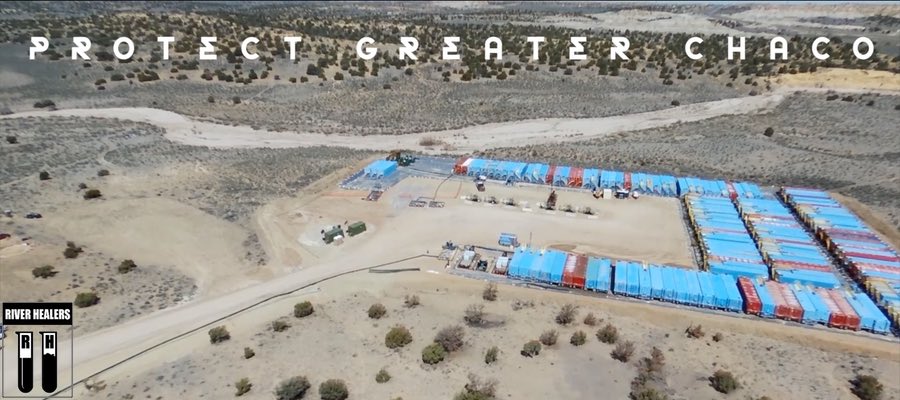
River Healers drone footage of fracking site in NM

Protect Greater Chaco: Drone surveillance of regional fracking sites in NM

The River Healers have droned multiple fracking sites in the Greater Chaco Area (New Mexico) impacted by explosions, fires, spills, and methane. See what they are finding. Hear their story.


By Tom Burkett – River Healer Spokesperson, New Mexico Watchdog

The Greater Chaco region is known to the Diné (Navajo) as Dinétah, the land of their ancestors. It contains countless sacred sites that date to the Anasazi and is home of the Bisti Badlands and Chaco Culture National Historical Park, a World Heritage Site. Currently WPX Energy has rights to lease about 100,000 acres of federal, state, and Navajo allottee lands in the oil rich San Juan Basin, which includes Greater Chaco.1 WPX Energy along with other fracking companies plan to continue establishing crude oil fracking wells on these sacred lands, although the Greater Chaco community has spoken out against fracking and continue to call for more safety and oversight from New Mexico state regulatory bodies such as the EMNRD Oil Conservation Division.

The River Healers pulled EMNRD records that show over 8,300 spills in New Mexico had been reported by the the fracking industry to EMNRD between 2011-2016 (map below). This is thousands more than reported by the Environmental Protection Agency. The records also showed how quickly reports of spills, fires, and explosions were processed by the EMNRD as ‘non-emergency’ and accepted industry reports that no groundwater had been contaminated.
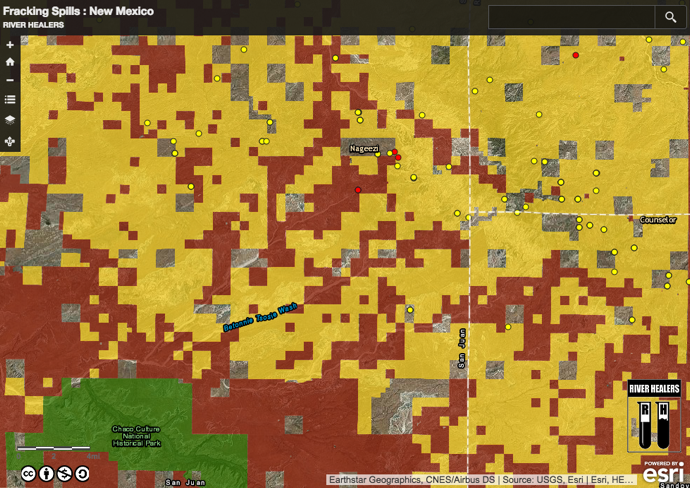
River Healers map

Zoomed in view of the River Healers’ NM fracking spills map. Learn more

Daniel Tso, Member of the Navajo Nation and Elder of the Counselor Chapter, led us to fracking sites in Greater Chaco that had reported spills and fires. Daniel Tso is one of many Navajo Nation members working on the frontlines to protect Greater Chaco, their ancestral land, and their pastoral ways of life from the expanding fracking industry. Traveling in white trucks and cars we blended in with the oil and gas trucks that dot indigenous community roads and group around fracking pads on squares federally owned land. Years of watchdogging the fracking destruction on their sacred land was communicated through Tso’s eyes looking over the landscape for new fracking disruption and a calm voice,

… the hurt on the sacred landscapes; the beauty of the land is destroyed, this affects our people’s mental, spiritual, and emotional health.

At each site our eyes were scanning the fracking sites and terrain for drone flight patterns while the native elders were slowly scanning the ground for pottery shards and signs of their ancestors. Arroyos sweep around the fracking pads and display how quickly the area can flash flood from rain that gathers on the striated volcanic ash hills of the badlands.

Fracking Regulation in NM

The EMNRD Oil Conservation Division has only 12 inspectors that are in charge of overseeing over 50,000 wells scattered throughout New Mexico.2 Skepticism around EMNRD’s ability to regulate not only comes from a short staff being stretched across 121,598 square miles of New Mexico’s terrain, but thousands of active fracking sites continue to report spills, fires, and explosions every year.3 Even more problematic is that Ken McQueen, Cabinet Secretary of EMNRD formerly served as Vice President of WPX Energy.4 Ken McQueen managed WPX Energy’s assets in the Four Corners area of New Mexico, Colorado, and in addition, part of Wyoming. New Mexico Governor, Susana Martinez’s appointment of McQueen severely compromises the state’s ability to impartially oversee WPX Energy and regulate the fracking industry. Governor Martinez has been called to clean up the EMNRD, and rid the regulatory body of cabinet members more interested in protecting the assets of WPX than the health and rights of New Mexicans. Tso remarks,

The sacrifices of indigenous communities continue for a society that thinks gasoline comes from a gas station. That thinks oil is a commodity that is unending resource. This is unfortunate, and ultimately compromises our physical health. Yet this doesn’t matter to the industry. They want every last drop of crude oil even if it is cost prohibitive.

The River Healers maintain that Governor Martinez is complicit in the exploitation of human water rights as long as the EMNRD remains a compromised and unreliable regulatory body.
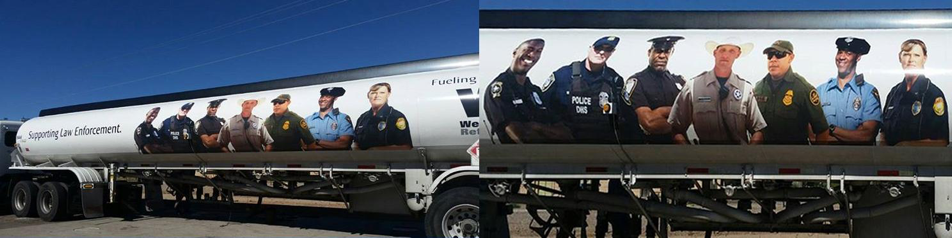
riverhealers-pic-1

New Mexico governmental assimilation with the oil and gas industry is presented to the Greater Chaco indigenous communities in the form of 90,000-lb gross weight oilfield trucks. Western Refining started rolling out trucks with larger-than-life prints of state and county law enforcements officers and military personnel at the same time water protectors at Standing Rock were being arrested and assaulted by the Morton County Sheriff’s Department in North Dakota.5 The indigenous-led movement to stop the Dakota Access Pipeline from desecrating sacred land and threatening rights to clean water has drawn greater resistance to oil and gas projects around the country.

Indigenous solidarity is felt in Greater Chaco, but Western Refining’s blatant propaganda campaign demonstrates how oil and gas corporations continue to threaten and silence the communities they extract oil from by displaying the paid power of state and federal law enforcement. The River Healers view this as a direct form of intimidation that aims to further a corporate ideology and remind native communities of the violence they experienced at the hand of the United States Federal Government in the past. The Western Refining campaign is a direct form of corporate-sponsored terrorism and should be grounds to ban their ability to use images of law enforcement officers to further their interests. Furthermore, the state should discontinue paying for officers to patrol facking roads and pads and instead use state funds to make state regulatory bodies work for the communities most impacted by the oil and gas industries.

What we are finding

Drone surveillance of fracking sites in Greater Chaco show how quickly the fracking industry has exploited a state government tied to the interests of a booming and unchecked resource extraction industry. In Greater Chaco this element of time is more deeply understood through the lens of the indigenous community.

Ultimately, the health of the fauna and flora are devastated. The adaptation of the delicate ecosystem is forever destroyed. Their recovery and healing will take years and years.

The Anasazi Kivas in Chaco Canyon took over 300 years to construct, while drill rigs such as Cyclone 32 take less than 10 days to drill 6,500 ft wells in the canyon plateau. We hiked 12 miles of the sacred Chaco Wash, pulled water samples, and saw the red palm of the Supernova Petrograph clinging to the understory of the canyon wall, clearly taking notice of what is happening above.

We deeply thank members of the Navajo Nation for inviting us into their lives, and our hearts stand with them in solidarity. Protect Greater Chaco! Dooda Fracking!


River Healers Site Videos

Site 1

Nageezi, NM
County: San Juan
Kimbeto Wash/Chaco River
GPS: 36°14’22.38”, -107°43’51.38”

Protect Greater Chaco : Site 1 from River Healers on Vimeo.

This particular site caught fire on June 11th, 2016 and was allowed to burn until July 14th. The fracking fire and contaminates spread to areas north and south of the fracking pad, burning Juniper trees within 200 feet of residential buildings. This fire is not the only documented case in the Greater Chaco Area where communities were disrupted and evacuated in the middle of the night. While community members remain concerned about their health, WPX reported that the incident was not an emergency and that no damage was caused to groundwater.

Site 2

Nageezi, NM
County: San Juan
Kimbeto Wash/Chaco River
GPS: 36°13’43.23″, -107°44’28.72″

Protect Greater Chaco : Site 2 from River Healers on Vimeo.

Drone surveys of this particular site show Cyclone 32, a 1500 Horsepower 755 ton drill rig manufactured in Wyoming. The drill rig is transported through Greater Chaco communities on small dusty single lane dirt roads used by the community members and school buses. The drilling is heard and seen moving from pad to pad. The rig is establishing multiple drill heads on pockets of land tucked along the Kimbeto Wash, a tributary to the Chaco River and sacred source of water security for members of the Greater Chaco Area in Nageezi, New Mexico.

Site 3

Nageezi, NM
County: San Juan
Kimbeto Wash/Chaco River
GPS: 36°13’27.51″, -107°45’3.24″

No video available

Site 4

Counselor, NM
County: Rio Arriba
Canada Larga River
GPS: 36°13’18.19″, -107°28’56.24″

Protect Greater Chaco : Site 4 from River Healers on Vimeo.

Drone surveys show Lybrook Elementary School only 1600ft from a WPX Energy fracking site. The crude oil tanks of the site can be seen from the classroom windows of the school. The elementary school was moved to this location in 2006 because it was right across the highway from a large and expanding natural gas plant and had to relocate elementary students to a safe location.

Although the WPX Energy site is established on federal land, this area of Counselor, New Mexico is referred to as ‘The Checkerboard’ because of the quadrants of federal land that break up tribal land. The 5 well heads are highlighted to show that these pockets of federal land are being fracked with a high concentration of fracking wells. By drilling multiple wells in one pad location fracking companies are able to quickly drain the plays of crude oil under the the Greater Chaco Area and avoid signing contracts with the native property owners that live and attend school in the area they are fracking.

Site 5

Counselor, NM
County: Sandoval
Chaco Wash/Chaco River
GPS: 36° 9’45.22″, -107°29’11.47″

Protect Greater Chaco : Site 5 from River Healers on Vimeo.

Drone surveys show crude oil being fracked within 840 ft of an indigenous community in Sandoval County, NM (Greater Chaco). The fracking site is located in the path of the community water supply, which had to be routed around the wellhead and crude tanks. The underground water line remains only 110 ft from active fracking activity.

Particular communities in Greater Chaco are dependent upon pastoral industry and the health of their livestock. Horses owned by the indigenous community are seen grazing on open and unprotected fracking pads. Many of these fracking pads have recorded spills of either fracking fluid, wastewater, or crude oil and pose health risks to the livestock grazing on potentially contaminated grasses and wastewater.

A Western Refining (WPX) crude truck can be seen driving down the community road. These dirt roads were designed to support local community traffic and school buses but are now heavily used by the fracking industry. 90,000-lb gross weight oilfield trucks haul the volatile crude oil through pastoral lands, endangering livestock and community members. Fracking companies continue to level dirt roads to accommodate the weight of their crude trucks. The practice cuts roads deep into the landscape. Roads in Greater Chaco now resemble trenches and make travel dangerous, block scenic views of ancestral land, and hinder the ability to monitor livestock and fracking development.

Site 6

Nageezi, NM
County: San Juan
Kimbeto Wash/Chaco River
GPS: 36°15’20.46”, -107°41’43.14”

Protect Greater Chaco : Site 6 from River Healers on Vimeo.

Drone surveys show 3 well heads, crude tanks, and compressors north of Hwy 550 in Nageezi, NM. The location is of importance because it shows how flaring is used to burn off methane caused by fracking and the transportation processes of crude oil. The River Healers droned this site when workers were not present and the flare tower was turned off for safety concerns, but the flame can usually be seen all the way from Hwy 550 tucked into the distinct hills of the Bisti Badlands. Such methane hotspots are of concern because methane causes severe health risks for individuals living near crude oil facilities. NASA has identified two large methane gas clouds in new Mexico. The methane gas is concentrated above fracking occurring in the San Juan Basin and Permian Basin and disproportionately affects the air quality of Greater Chaco, Four Corners Region, Farmington, and South East region of New Mexico.

Two unlined wastewater pits can be seen on the edge of the fracking pad near the well heads and compressors. Erosion caused by water drainage can be seen leading from the well heads and compressor areas directly to the wastewater pits. Drainages can also be seen coming directly out of the waste water pits and going into the Upper Kimbeto Wash, a tributary of the Chaco River. It is illegal for fracking companies to keep fracking wastewater in unlined pits in the state of New Mexico. The River Healers reported this possible water violation to the EMNRD Oil Conservation Division (a state regulatory body for the fracking industry). EMNRD replied that WPX Energy maintains that the wastewater is caused by stormwater runoff and contains no fracking contaminates. This is the first time we have heard of the fracking industry creating stormwater runoff pits and find the practice to be unusual. Further skepticism that these runoff pits are not contaminated comes from research about the site. In June of 2016, WPX Energy reported a spill of 600 gallons of crude oil at this site because of a fire. WPX maintains that no groundwater was impacted and marked the incident as not an emergency.


References

  1. WPX Adds Accreage in Gallup Oil Play, press release
  2. NM Oil and Gas Enforcement Inspections, Earthworks
  3. New Mexico Geologic Mapping Program, NM Bureau of Geology and Mineral resources
  4. New Mexico Energy, Minerals, and Natural Resources Department – Cabinet Secretary Ken McQueen
  5. Western Refining, Community Supporting Law Enforcement
About River Healers: New Mexico Chapter

newmexicoriverhealers.com

The River Healers organize anonymous watchdog operations and tactical campaigns to protect water. The artist collective is engaged in direct action through analyzing, exposing, and bringing down systematic abuses of water rights. The River Healers work to accelerate theories of water democracy, decentralize aesthetics of environmentalism, and expose corporate sponsored water terrorism. ‘Water is a commons – No one has the right to destroy’

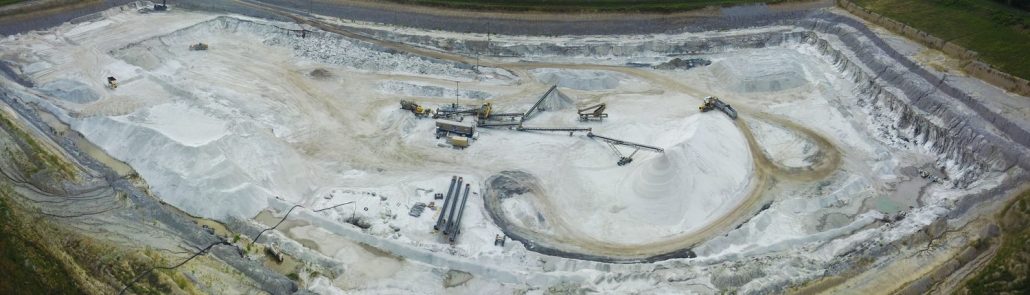
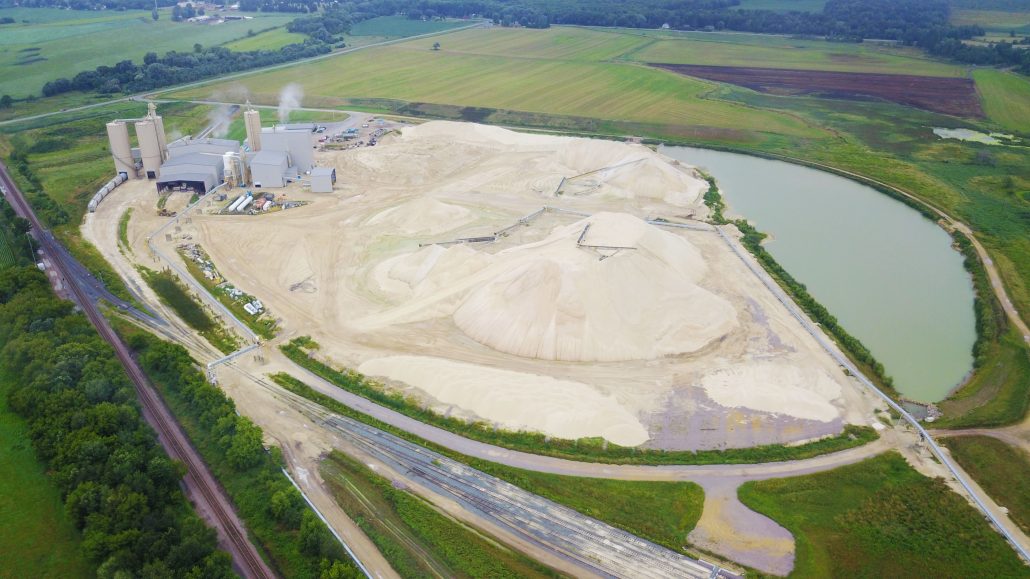
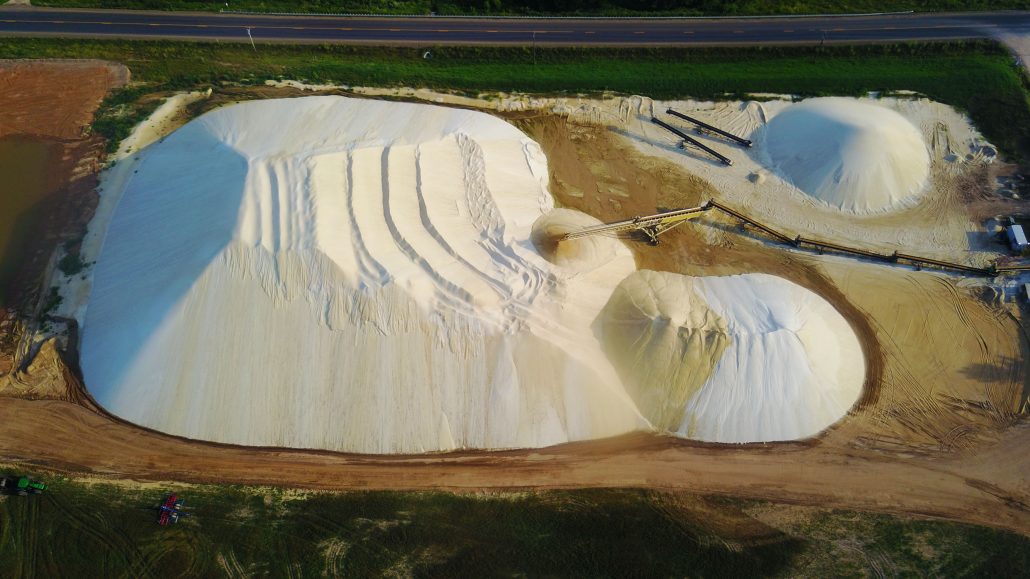
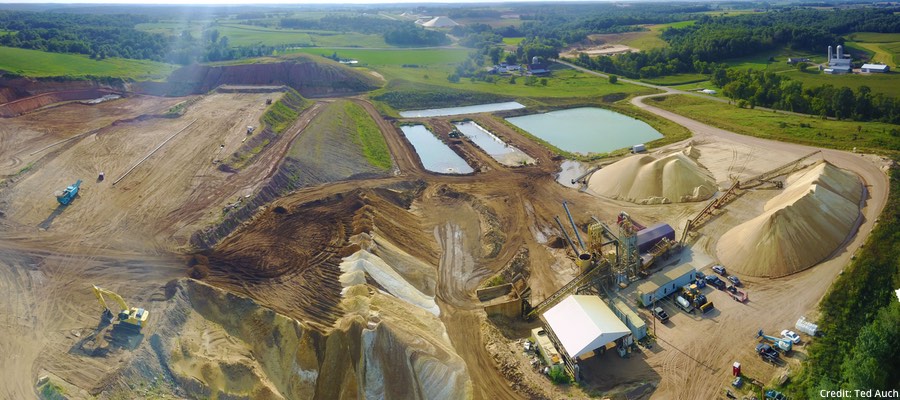
Superior Silica Sand, LLC, Lundequam Picknell site, Barron County WI

New frac sand mining photos and videos are now available via FracTracker

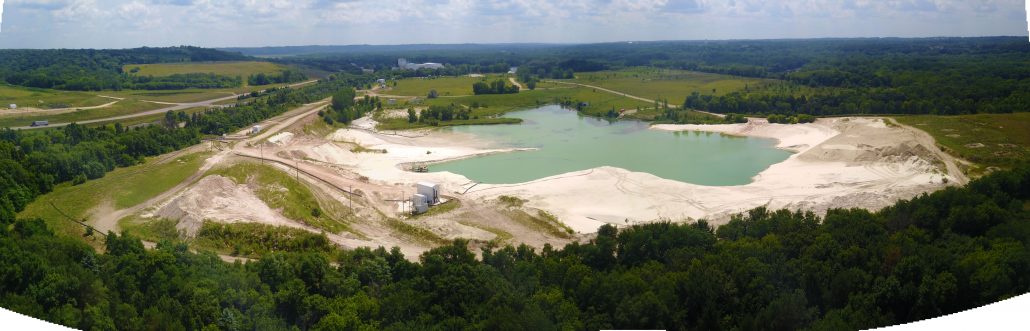
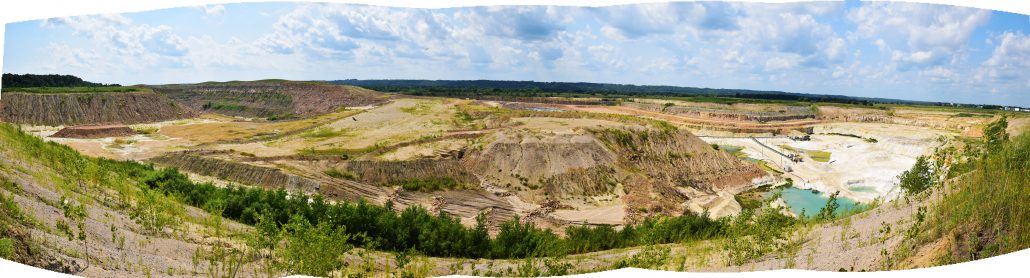
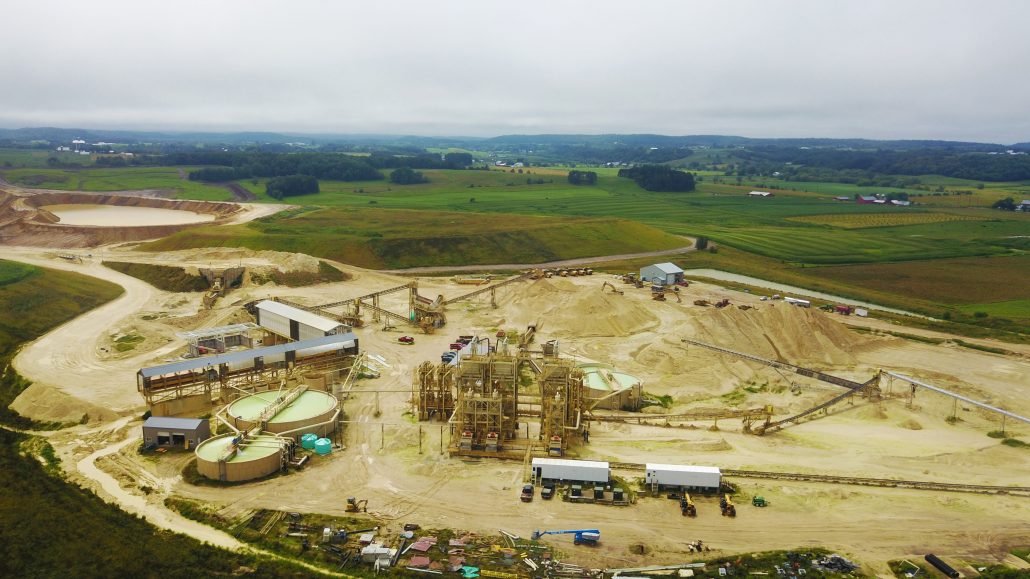
Surface mining to obtain sand that is perfectly sized for use in the hydraulic fracturing process has been increasing in recent years. Over the summer, FracTracker had the opportunity to document a number of sand mining activities occurring in Michigan, Minnesota, and Wisconsin that supply frac sand to the oil and gas industry. Explore a selection of this imagery below:

Explore these and other frac sand mining photos and videos in our online album. The most recent imagery can be found at the bottom of the album. Additional videos are also available on this YouTube channel.

View All Albums

All of these frac sand photos, and more, can also be found on our Energy Imagery page, organized by topic and also location.

If you have photos or videos that you would like to contribute to this growing collection of publicly available information, just email us at info@fractracker.org, along with where and when the imagery was taken, and by whom.

Lofoten Declaration heading

A Declaration of Independence – FracTracker signs the Lofoten Declaration

FracTracker Alliance is proud to be a signatory of the Lofoten Declaration. It is a global call – signed by over 220 organizations from 55 countries – to put an end to exploration and expansion of new fossil fuel reserves and manage the decline of oil, coal, and gas in a just transition to a safer climate future.

It is also a call to prioritize support for communities on the front lines of climate change and fossil fuel extraction, and ideally a helpful tool to rally our global movement around the worldwide grassroots efforts to stop fossil fuel projects.

Wealthy fossil fuel producers like the United States have an obligation and responsibility to lead in putting an end to fossil fuel exploitation. Support for impacted regions is imperative, and frontline communities are the leaders we must look to as we all work together for a safer future.

The recent inundation of southeastern Texas, raging fires in the west, and ravaging hurricanes in the Atlantic underscore the dangers wrought by climate change. We need more action and we need it to be rapid, comprehensive, and systemic. Countries can’t be climate leaders until they tackle fossil fuel production – not just consumption.

The Lofoten Declaration is a new affirmation of independence: a world free from the injustice of extractive energy. It is a bold, righteous pronouncement in step with the courageous and visionary traditions of our nation.
With more than 1.2 million active oil and gas wells and thousands more planned, now is the time for America to change its old, tired habits and flex its might through the virtuous power of example.

Full Declaration and Signatories: LofotenDeclaration.org

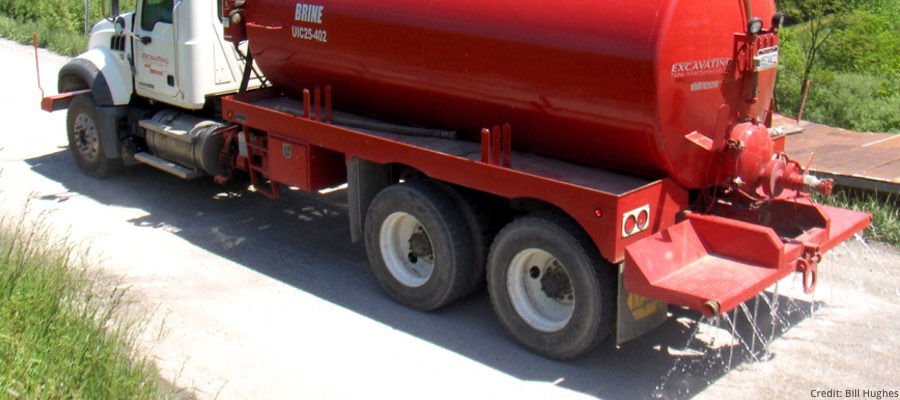
Brine or water roadspreading in WV

Does roadspreading of brine equate to oil and gas waste dumping?

air quality impact, which is why roadspreading of brine occurs

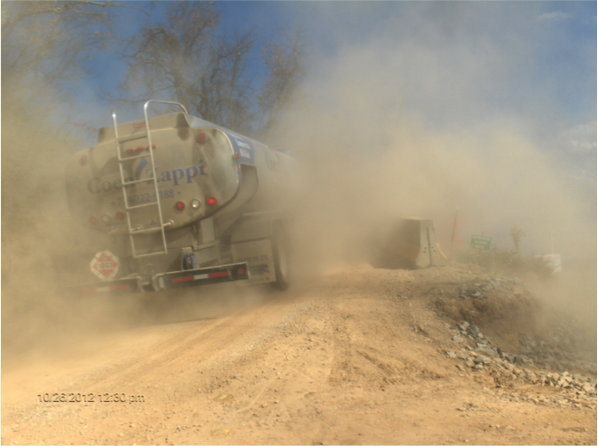
This 2015 photo from West Virginia illustrates that large trucks on dirt roads create a legitimate dust problem, which impacts both air and water quality.

The application of liquid oil and gas waste from conventional wells onto roadways for dust control and road stabilization is permitted in Pennsylvania, provided that operators adhere to plans approved by the Department of Environmental Protection (DEP). There are brine spreading guidelines that operators are required to follow, but overall, DEP considers roadspreading to be a beneficial use of the liquid oil and gas waste products.

Dust suppression is a legitimate concern, particularly in areas that see a lot of heavy truck traffic on dirt roads, such rural oil and gas fields. Prolonged exposure to airborne dust contributes to a number of different health problems, ranging from temporary irritation to debilitating diseases of the heart, lungs, and kidneys. This road dust can also impact aquatic life, from plants to aquatic insects to fish.

While applying liquid waste from the oil and gas industry undoubtedly seems like a convenient solution to dusty roads, is roadspreading really advisable?

PA Oil and Gas Liquid Waste Road Applications


View map fullscreen | How FracTracker maps work

In the map above, the areas in green are municipalities where liquid waste from Pennsylvania’s conventional wells were applied to roadways in 2016. The purple areas are counties where additional quantities of the liquid waste were applied in cases where the exact municipality was not specified on the 2016 waste report. The majority of the state’s oil and gas roadspreading remains in Pennsylvania, but some of the brine is spread on roads in New York, as well.

What’s in the brine?

In Pennsylvania, the large-scale extraction efforts from deep carbon-rich shales like the Marcellus and Utica formations are classified as unconventional oil and gas, whereas the shallower formations requiring smaller amounts of hydraulic fracturing stimulation to bring the wells into production are considered to be conventional.

While the chemical components of these brines vary from formation to formation, in general they are known for containing high-salinity toxic metals, such as barium and strontium, as well as volatile organic compounds including benzene. Bromide in the brine can interact with purification processes at treatment plants to create carcinogenic compounds called trihalomethanes. These compounds actually created a problem in the early parts of the Marcellus boom in Western Pennsylvania, when large enough quantities of bromide were added to the region’s rivers and streams. And of particular concern is naturally occurring radioactive materials (NORMs), which sometimes occur at very high concentrations, even in brines from conventional wells.

The Pennsylvania Geological Survey commissioned Evan Dresel and Arthur Rose from Penn State to investigate oil and gas brine from a sample of 40 wells in 1985, although the accompanying paper wasn’t published until 2010.  Their samples included dissolved solids of 343,000 milligrams per liter, and radium occurring at up to 5,300 picocuries per liter. As a point of comparison, the US Environmental Protection Agency mandates that drinking water not exceed 5 picocuries per liter, and the authors of this report express concern about the high levels shown in these brines.

Based on the six samples analyzed, radium shows a general correlation with barium and strontium and an inverse correlation with [sulfate], though the correlation is not perfect. The radium values are high enough that a possible radiation hazard exists, especially where radium could be adsorbed on iron oxides and accumulate in brine tanks.

The article’s preface, written in 2010, echoes the concern, stating, ” the very high radium contents indicate that caution should be used in handling these brines.” One imagines that the radium content might also be a concern for people walking their dogs along dirt roads where these brines are spread.

Testing for radiological contamination appears to be insufficient for liquid oil and gas waste. Ben Stout, PhD, a professor of Biology at Wheeling Jesuit University (and a FracTracker Alliance board member) sampled liquid waste from Marcellus Shale wells in 2009. Here is what he found:

In terms of radiation, 9 of the 13 samples exceeded the drinking water standard for radium. Furthermore, 7 of the 13 samples exceeded the drinking water standard for gross alpha particles, which are a strong indicator of radioactivity. Most notably, one sample from a frac pit at the Phillips #20 site in Westmoreland County, PA yielded a gross alpha reading of 4846 +/‐ 994 picocuries per liter (pCi/L), though the drinking water standard is 15 pCi/L. In fact, the same sample had combined radium readings well over 1,000 pCi/L, a multiple in excess of 200 times the (5 pCi/L) standard. It should be noted that none of the samples triggered a response from radiation meters.

What to do?

From environmental concerns of high salinity to health concerns about the toxic and radiological content of oil and gas brines, intentionally introducing this waste product to public spaces is a dubious practice. It is understandable that township supervisors would want to use readily available materials for dealing with dust control on dirt roads, but if you are concerned about the practice and your area is indicated on the map above, you may wish to contact them to find out where this waste is being spread in greater detail.

By Matt Kelso, Manager of Data and Technology, FracTracker Alliance

Allegheny County, PA map of zoning designations

Allegheny County, PA – Drilling, Leasing, and Zoning Trends

By Kirk Jalbert, Manager of Community-Based Research and Engagement
and Matt Kelso, Manager of Data and Technology

FracTracker recently updated its Pennsylvania Shale Viewer to reflect the latest data on unconventional oil and gas permits and active wells in the state. Within this data, we noticed an increase in permitting over the past year for Allegheny County, PA. We have worked on a number of recent initiatives aimed at expanding conversations about unconventional oil and gas drilling by mapping mineral rights leasing and zoning ordinances in Allegheny County. In this article, we bring these various analyses together.

The analysis below can assist residents and public officials in preparing for what appears to be a pending wave of new development.

Untapped Reserves

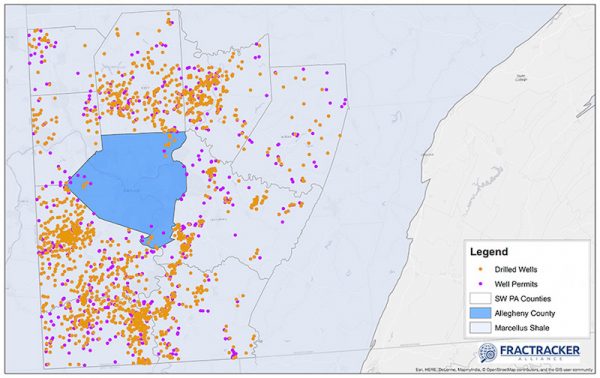
Over the past decade, unconventional oil and gas development has predominantly occurred in areas where shale formations are densest and most productive. For instance, the map below illustrates wells and permits in Southwestern Pennsylvania that track along the Marcellus Shale. An outlier on the map is Allegheny County when compared to its neighbors such as Washington and Greene Counties just to the south—two of the most drilled in the Commonwealth.

swpa_ac_og

Unconventional wells and permits in Southwest Pennsylvania

A few factors may explain these spatial anomalies. First, oil and gas companies are generally reluctant to operate in heavily populated areas. This is partly due to the complications of acquiring leases and easements in tightly packed communities.

Infrastructure is second consideration. In the absence of compressor stations and midstream pipelines, companies can’t get their product to market.

A third factor is the stronger political opposition often found in urban centers. For example, Pittsburgh’s 2010 fracking ban pushed back against drillers and had a chilling effect in bordering municipalities. Many of Allegheny County’s municipalities have, thus, had the luxury of putting oil and gas-related land use decisions on the back burner. Nevertheless, operators have maintained interest in extracting untapped shale reserves that lie beneath their borders.

Recent Permitting & Drilling Trends

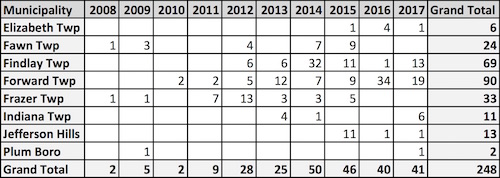
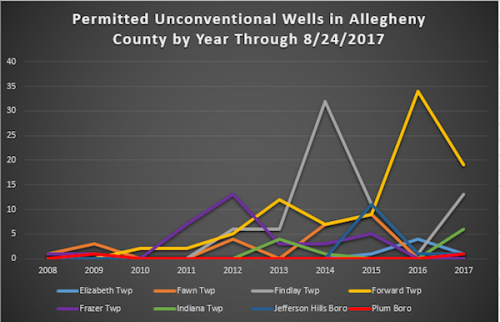
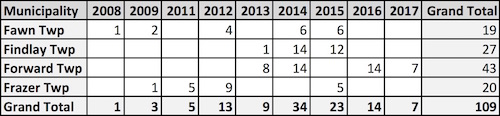
Within Allegheny County, PA, there are now 24 well pads containing a combined 248 permitted wells, of which 109 currently have an active status. On average, these numbers show a 20% increase in well permits annually (40-50 per year) since 2014. This figure compares to less than 10 per year prior to 2012. Furthermore, while only partway through 2017, we’ve already reached this 20% increase in new permits (41 since 8/24), with the overwhelming number of these being issues for Findlay and Forward Townships. A table and graph of permitting activity since 2008 is seen below.

ac_permits_table_08242017

ac_permits_graph_08242017

Table and graph of permitted wells in Allegheny County

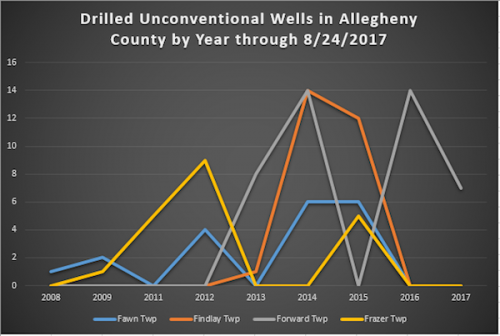
Interestingly, the number of active wells over the past few years does not track with increasing number of permits. In fact, active wells peaked in 2014-2015 and have steadily declined since, as is seen in the table and graph below. We credit these opposing trends to operators placing their wells into inactive status during a period of lower gas prices. Meanwhile, operators are increasing their applications for new wells in preparation for a predicted rebound as well as new pipelines and processing facilities coming online for delivering to new markets.

ac_dw_table_08242017

ac_dw_graph_08242017

Table and graph of active wells in Allegheny County

Predicting Development: Mineral Rights Leasing

The locations of permits and active wells are not always good indicators of long-term future development. A better picture can be painted with data on properties leased for eventual drilling. In 2016, FracTracker built the Allegheny County Lease Mapping Project, which revealed the extent of oil and gas leasing agreements across the region. From that work came some interesting findings.

There are 467,200 acres in Allegheny County. We found 63,014 acres (18% of the county) are under some kind of oil and gas agreement – this includes mineral rights leases, as well as other agreement such as pipeline rights of ways. It is important to note that as many as 15% of the records we obtained in executing the project could not be mapped due to missing metadata (many block/lot numbers were no longer provided with online records after 2010), so these are conservative estimates.

The list below shows the top five municipalities found to have the most leases. Of note is how West Deer, North Fayette, and Elizabeth townships all have a significant number of leases, but do not yet register in permitting activity.

Most Leased Municipalities in Allegheny County, PA

  1. West Deer Township (5,325 leases)
  2. North Fayette Township (5,070 leases)
  3. Elizabeth Township (4,070 leases)
  4. Fawn Township (3,872 leases)
  5. Forward Township (3,801)

We also discovered that more than 70% of leased properties were zoned residential or agricultural, despite the fact that unconventional oil and gas development is a highly disruptive and industrialized activity. The list below shows a breakdown of zoning designations.

Leased Properties Zoning

    • Residential (37%)
    • Agricultural (34%)
    • Commercial (23%)
    • Industrial (3%)
    • Other (3%)

Status of Protective Zoning

In 2013, the Pennsylvania Supreme Court upended state laws governing local oil and gas zoning rights with its landmark Robinson Township v. Commonwealth of Pennsylvania decision. The court struck down parts of Act 13 that imposed statewide zoning standards for oil and gas development. Zoning ordinances with stronger ordinances are now being adopted by some townships. However, many others have zoning codes that reflect pre-Robinson language, which allows mineral extraction everywhere, regardless of whether it is a compatible land use.

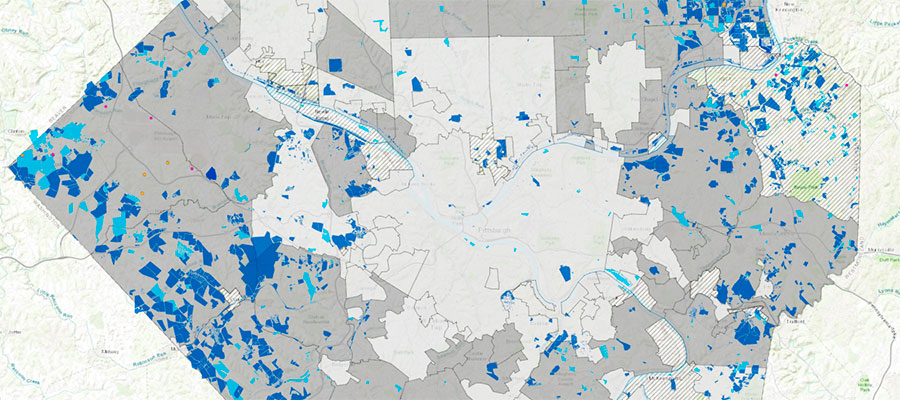
Drawing the connections between drilling trends, leasing activity, and protective zoning is, therefore, significant. Over the past six months, FracTracker has worked with Food & Water Watch to put our lease mapping data and state drilling data in context with assessments of Allegheny County’s municipal oil and gas zoning ordinances. The map below illustrates these overlaps.

Map of Allegheny County Drilling, Leasing, and Zoning


View map fullscreen | How FracTracker maps work

Analysis

Allegheny County contains 130 municipalities. Food & Water Watch was able to obtain and review zoning codes for 104 of these 130. At least 56 municipalities have no zoning ordinances specific to oil and gas development. Of greatest concern, when placed in context with leasing and permitting data, FracTracker found that leases already existed in 43 of these 56 municipalities without oil and gas ordinances, although 8 of these 43 were found to have other less restrictive language regulating specific oil and gas activities, such as seismic testing. Fawn Township, one of the most permitted and most leased municipalities in the county, was found to have no oil and gas zoning ordinance.

Conclusions

It’s important to recognize that there is a significant difference between conventional oil and gas development and today’s heavily industrialized unconventional extraction industry. In many of Allegheny County’s municipalities there seems to be a presumption that there is no need to prepare zoning codes for drilling, despite data that suggest increased oil and gas development may be just around the corner.

With the deeper understanding of Allegheny County’s permitting trends, leasing activities, and the state of protective zoning presented in this article, municipalities would be wise to assess where they stand. Reviewing and updating their respective zoning codes to determine if they sufficiently address concerns related to unconventional drilling could be the most effective way to protect the interests of their residents.

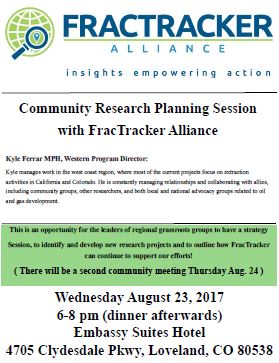
FracTracker Alliance to Host Community Meetings in Colorado

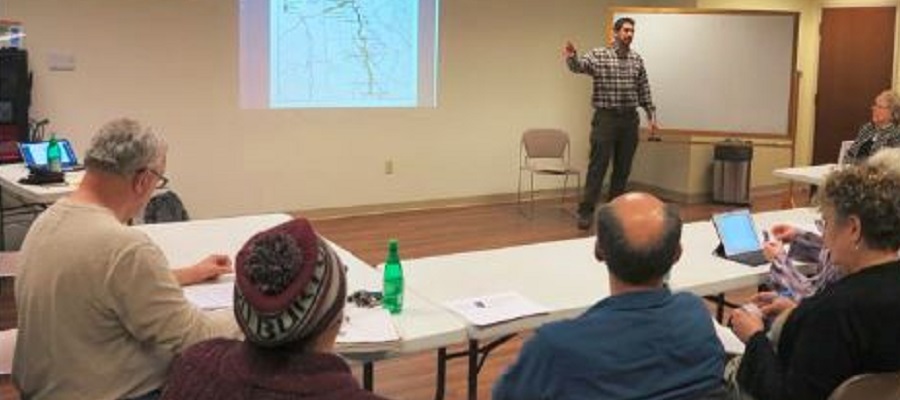
FracTracker Alliance invites Colorado’s Front Range communities to attend and participate in two community meetings, open to the public on August 23rd and 24th. Our shared goals will be to craft new research projects for FracTracker to study related to the environmental health impacts resulting from oil and gas development in Colorado. We also welcome Dr. Stephanie Malin, who will be giving a short presentation on her current work.

Background

FracTracker is returning to Colorado’s Front Range to continue working with communities where oil and gas exploration and production impacts the daily lives of Coloradoans and degrades the environment. While Colorado is not well known for oil and gas extraction, development within recent years using unconventional techniques like fracking has bloated production to over 60,000 active wells. The majority of these wells, over 33,000, are located in Weld County. These Front Range communities are also the most densely populated regions near major unconventional oil and gas development. FracTracker will, therefore, continue to support these communities under assault by the fossil fuel industry.

Community Workshops

FracTracker will be hosting two community engagement workshops in Weld County on August 23rd and 24th. You can find the flyers with times posted below. The meetings will serve to both inform the communities of the work FracTracker is currently conducting or has already completed to date, and to direct and inform future research in Colorado. Active communty engagement is most important to the environmental health research process. Researchers rely on community members. You, the community, are the experts we need to create responsibly informed research projects!

Below are flyers with more information about the events (click to expand).

Our agenda for the August 23rd meeting includes a synopsis of the research products that have been generated by FracTracker thus far. Below you will find links to the research that has been summarized into blog posts. Current, active research will also be presented:

Meeting Goals

Instead of coming in with a preconceived research question, we’re starting with your concerns. The goal of these meetings is to narrow down topics for future research, and then to refine the questions associated with each topic. The meeting on the 23rd will serve to nail down the issues that are most important to community members. This conversation may include expanding existing research and revisiting topics. On the evening of August 24th, we will present these topics to the greater community for further discussion. The issues will be prioritized with the help of a larger audience, and specific research aims will be synthesized.

workshop-wheel

For more information about these community meetings in Colorado, please contact Kyle Ferrar at ferrar@fractracker.org.

Stock photo - European Renewable Energy Tour 2018

Participate in a European Renewable Energy Tour with FracTracker & Ecologic Institute

Next spring, join FracTracker Alliance and Ecologic Institute on a unique and timely European Renewable Energy Tour. Witness the incredible – and essential – energy revolution happening in Europe in an immersive, holistic way.

Europe’s energy policies are set to reduce dependence on foreign providers of fossil fuels, and substantially reduce the region’s climate change footprint.  In addition to learning how select European cities are expanding their renewable energy portfolios, the goal of this trip is to stimulate and inspire new perspectives and connections that will accelerate a better energy future in the United States.

Save the dates: May 27, 2018 – June 2, 2018

The full price of the tour ($1990.00*) includes all site visits, meetings, admission fees, 14 meals (except alcoholic beverages), accommodations, and in-Europe travel from Copenhagen, to Hamburg, to Berlin, to Frankfurt. The fee includes a small donation to both partnering organizations. International flights to Copenhagen and from Frankfurt (back to the U.S.) are not included. Financial assistance may be available. Contact us for more information.

The deadline to buy your tickets has been extended to December 31, 2017. We hope you will join us for this unique, 7-day educational experience. 


Renewable Energy Tour Summary

  • Dates: May 27 – June 2, 2018
  • Stops: Copenhagen | Hamburg | Berlin | Frankfurt
  • Draft itinerary

Timeline

  • Deposit due December 31, 2017: $995 (Extended)
  • Balance due March 1, 2018: $995
  • Or – pay in full by December 31, 2017: $1,990
  • A $300 discount on the full price of the tour is available for people who would like to opt for double occupancy accommodations.

Price Includes

  • All lodging *
  • 14 meals
  • In-Europe train tickets **
  • Group taxi and bus fares
  • Guided services
  • Entry fees for all tours
  • Financial assistance may be available. Contact us for more information.

* Double occupancy receives a $300 discount. Select the Double Occupancy option when purchasing your tickets.

** Airfare to and from Europe is not included in the total price of the trip. Participants should book their flights to arrive in Copenhagen, Denmark on May 27th, departing for the US from Frankfurt, Germany on June 2, 2018.

Contact Information

Brook Lenker, Executive Director, FracTracker Alliance
lenker@fractracker.org or (717) 303-0403

The deadline to submit your deposit online is December 31, 2017.

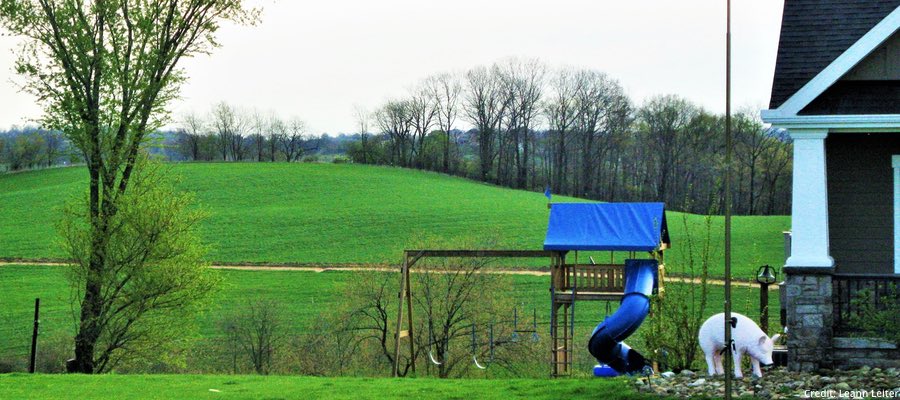
Right to a healthy home - Photo credit: Leann Leiter

The Right to a Healthy Home

Reframing Fracking in Our Communities

Imagine that tonight you head home to cook dinner. But, standing at your kitchen sink, you find that your tap water is suddenly running a funny color or gives off a bad smell. So instead of cooking, you order a pizza and decide to work outside in your garden. Just as you’re getting your hands dirty, however, you hear the roar of the compressor station that you see from your yard as its “blows off” some substance. Going back inside, and closing your windows to keep out the foul air, you think of the tap water and decide a shower is out of the question. Imagine that you resign yourself to just going to bed early – only to be kept awake by the bright and unnatural glow of gas being flared at the nearby wellhead.

Scenarios just like these can and do happen when hydraulic fracturing, or fracking, encroaches upon residential areas.

In Part 1 of this two-part series, we described how the many aspects of fracking can destroy a healthy home environment and argued for a frame that focuses on those impacts. A frame is a way of contextualizing, communicating about, and understanding an issue.

This article brings in the idea of rights, and lists several declared rights that fracking violates. Returning to the topic of framing, we then challenge the fracking-friendly frame, by calling into question three common ways of talking about fracking that ignore the rights of those impacted.

In short, the push to support fracking often ignores the rights of people living near it.

Healthy Homes for Human Flourishing

First, let’s explore why a having healthy home matters.

Everyone has a basic need for a safe, healthy place to live. The World Health Organization identifies the social determinants of health (SDH) as the “conditions in which people are born, grow, work, live, and age, and the wider set of forces and systems shaping the conditions of daily life.” Applied to healthy homes, these SDH include access to clean air and safe drinking water, and protection from intrusion and disaster. Health is not merely the absence of disease. Health can mean the ability to function, to live one’s life,[1] to flourish.

Human flourishing demands a healthy home environment. Picture again the scenario at the beginning of this article. Would you be able to care for yourself and your family members, to meet your basic needs, or to lead a satisfying life if your home didn’t seem like a safe place to live?

Using Rights to Make the Case

Many people who live near drilling often ask themselves that very question. These include people like Pam Judy, with a compressor station less than 800 feet from her house, who questions the long term effects of breathing in the 16 chemicals detected in air test conducted by the PA Department of Environmental Protection.

Greene County, PA resident Pam Judy and the compressor station near her home in Gas Rush Stories, part 5: A Neighbor from Kirsi Jansa on Vimeo.

Simply reading or watching the stories of those directly impacted by gas development makes a moving argument for the right to a healthy home environment – and that argument also has a lot of backing. Researchers[2] have made a powerful case that fracking can and has violated human rights, by impacting the health for those downwind or downstream and by denying civil liberties to those pushed aside or silenced during the debate. These same researchers showed specifically that fracking has violated the rights to privacy, family, home, and protection of property.

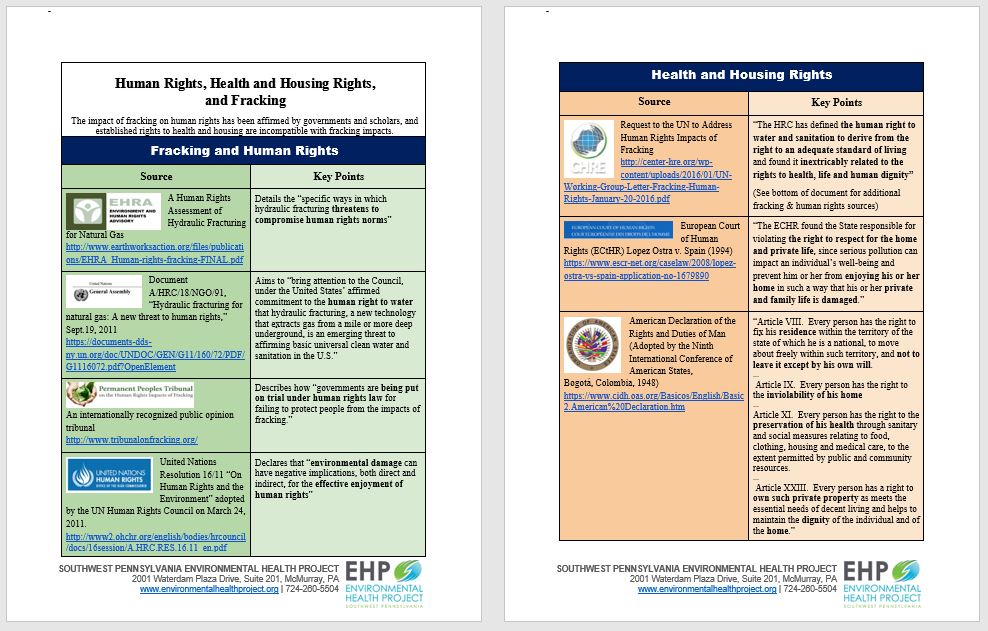
Various governments and non-governmental organizations around the world have likewise called out human rights violations due to fracking. Other human rights declarations are relevant here, too. Fracking’s impacts are incompatible with the rights to health and to housing. Here’s a sampling:

side-by-side-rights-table

This sampling of precedents includes statements and declarations by the United Nations and the Organization of American States. It shows that when it comes to human rights and fracking, a strong case has already been made by respected international organizations.

Challenging the fracking-friendly frame

A rights-based perspective, informed by precedents like those above, gives us a strong platform from which to examine and counter arguments that support or promote fracking. We can call those pro-fracking arguments a “fracking-friendly” frame.

A fracking-friendly frame denies or minimizes the human impacts. We can hear elements of the fracking-friendly frame underlying industry promises and political talking points, and witness how they leach into common dialogue between citizens.

Element #1: “Economic impacts”- but only the positives

An “economic impacts ” emphasis tends to focus on narrowly-defined economic benefits , while excluding other real, negative economic drawbacks , like the latter half of boom & bust cycles. Consider this infographic of the “economic impacts” of an Appalachian petrochemical hub scenario–an industry reliant upon the cheap and abundant fracked natural gas of the region. The document offers projected estimates for industry profits and employment levels potentially generated by the five ethane crackers planned for the region. But this document – and its focus on economics – says nothing about the negative consequences to the community. Due to air emissions from these facilities, health costs from fine particulate matter (PM 2.5) could amount to between $120 and $270 million each year, without even factoring in the additional impacts of ozone or toxics. A focus on economic impacts also says nothing about  the incalculable value of lives – and quality of life – lost, which could amount to between 14 and 32 additional deaths annually, plus increased asthma, heart attacks, and bronchitis.[3]

Element #2: “Choice”

A false assumption of choice is built into the fracking-friendly frame. This element assumes that people have a choice–if they don’t like the drilling next door, they can just move. Yet, as well water becomes degraded and countryside views become dominated by unprecedented industrial development, selling a home can be a difficult proposition. As one researcher summed it up,

the various forms of land damage from fracking often result in decreased property values, making resale and farming difficult , and also making it harder to acquire mortgages and insurance. Properties adjoining drilling sites are often simply unsellable, as no one wants to live with the noise, the bad air, and the possibility of water pollution.[4]

Others confirm this fallout to home values. A recent report assessing 16 other studies on how UOGD affects home prices points to significant potential decreases in housing values for those on well water (up to -$33,000) and those without ownership of their mineral rights (up to -$60,000). These unfortunate realities belie the idea of choice.

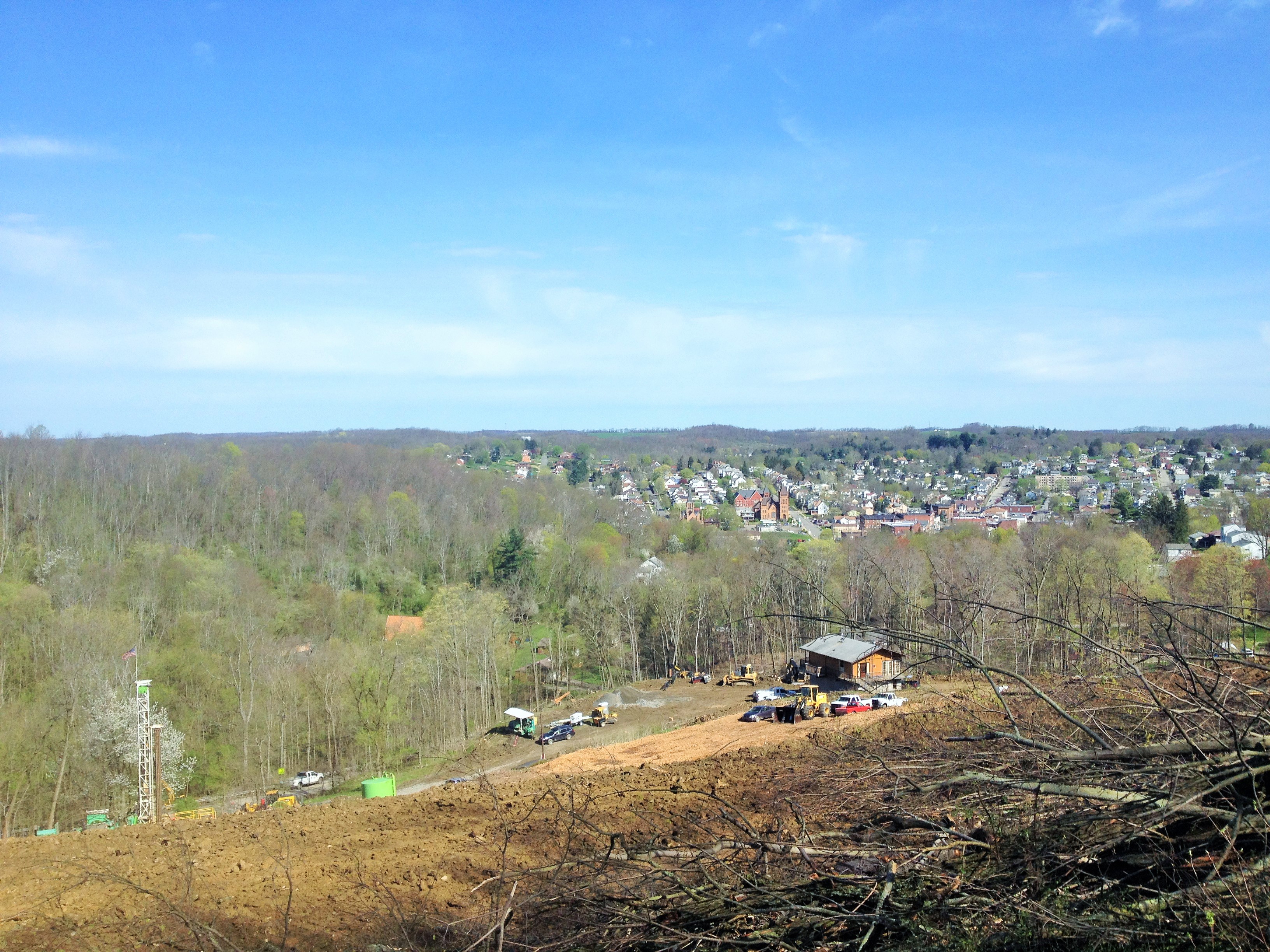
drilling-rig-home-town-of-mcdonald

pipeline-path-among-homes-washington-county

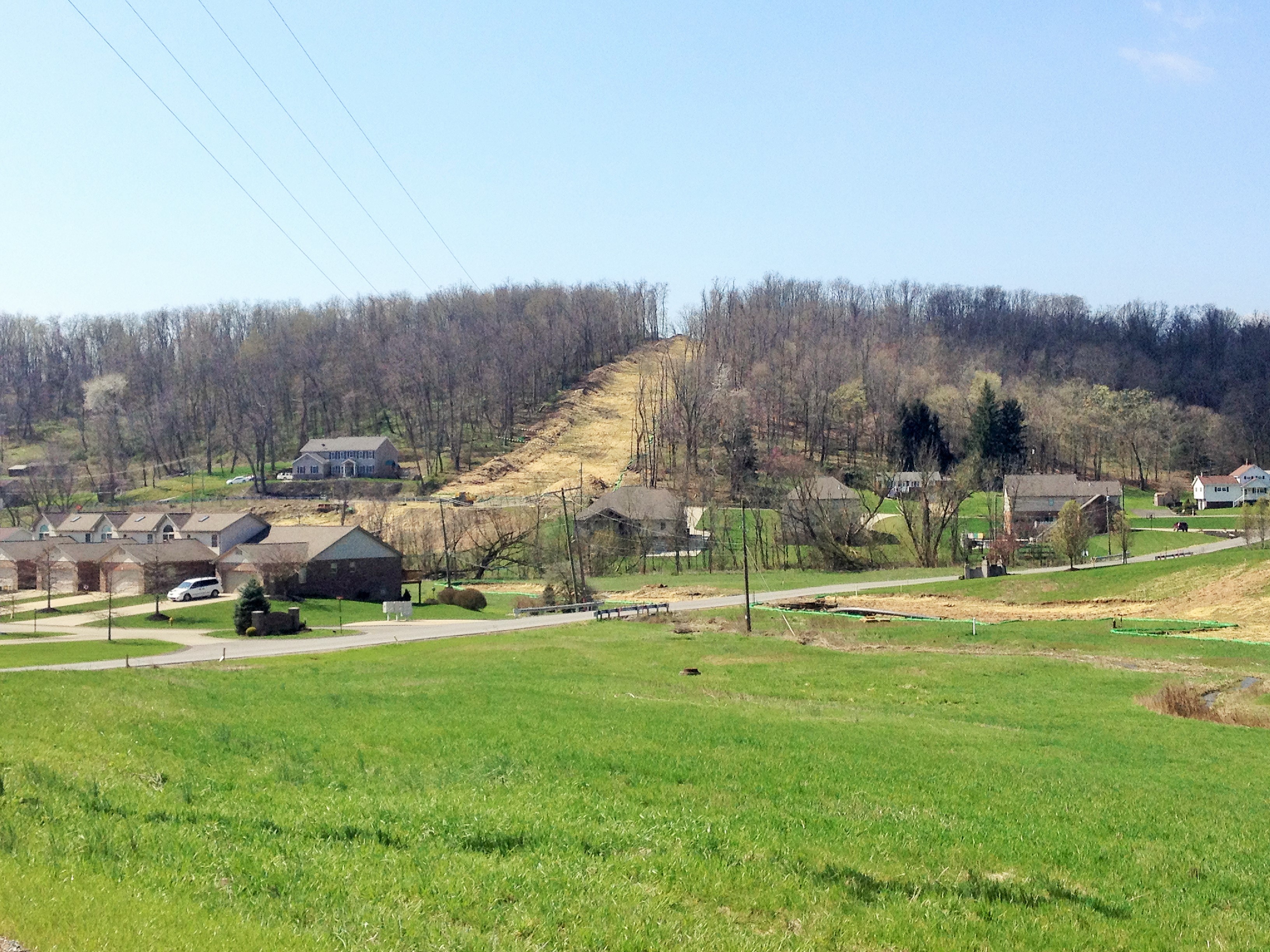
On left, a white fracking rig at the far left of the image sits near a cabin overlooking the town of McDonald, PA. On right, a pipeline cut descends a hillside and into a residential development outside of Houston, PA. Photo credit: Leann Leiter.

In interviews conducted with women living in close quarters to drilling activity, three health care professionals[5] discovered the sense of powerlessness experienced they felt. One woman contemplated moving away from the region in spite of opposition from her husband and her own attachment to her home. In my own interaction with affected families, many express powerful feelings about relocation like sadness about leaving land owned for generations, or an eagerness to escape a home that no longer feels safe. Many express a sense of injustice for being forced to make such painful choices.

Element #3: “Sacrifice of the few for the good of the many”

Another underlying assumption of a fracking-friendly frame is that of “sacrifice of the few for the good of the many.” It declares that a “few” people will have to live near fracking and bear the unfortunate consequences, so many others can have cheap oil and gas. The belief bubbles up among the public, such as in this comment collected during a survey[6] of people living in the Marcellus shale gas region:

Energy has to come from somewhere. The needs of the many may outweigh the inconvenience of the few who live near the exploration efforts. This is not an ideal situation for all residents, but it is the reality.

This person’s statement shows acceptance of the assumption that energy for all requires unevenly shared sacrifice, and indicates a drastic underestimation of the populations impacted. It also indicates a misperception of the impacts, which unfortunately go far beyond mere “inconvenience” for many residents.

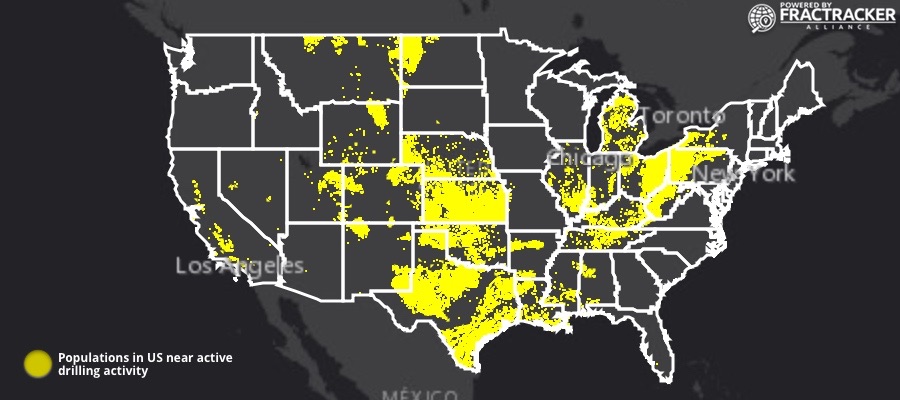
We can break down these assumptions by questioning how many people make sacrifices in the name of gas extraction. An interactive map by FracTracker shows that over 12 million Americans live within a risky ½ mile of oil and gas facilities (including both fracking wells and other types). Mounting research indicates health threats for distances of ½ mile or greater. That meaning this ever-growing number of Americans have increased rates of asthma and prenatal harms, with the most vulnerable – the young, the elderly, and those with pre-existing conditions – at the highest risk. The 12 million figure, already a conservative estimate, would be significantly higher if factoring in other oil and gas infrastructure like pipelines or frac sand mining operations, each of which carry their own risks.

Populations in US near activity oil and gas drilling activity in 2016

Populations in US near activity oil and gas drilling activity in 2016. Click to explore the interactive map.

We can also question the nature of their sacrifice. In terms of health, research has shown correlations between how close women live to fracking operations and certain birth defects and noise-induced sleep disturbance and cardiovascular disease, as just a few examples. Facilities like well pads also come with risks to public safety, such as the Monroe County, Ohio well pad fire that burned unknown chemicals for five days near homes and resulted in 70,000 fish killed in a creek that flows to the Ohio River. Other fracking infrastructure likewise poses potential dangers from the 2.5 million miles of gas pipeline and additional 200,000 for hazardous liquids including  crude oil that crisscross the United States. Between 2010 and 2016 the US experienced 230 reported pipeline explosions, 635 fires, over 20,000 people evacuated, 470 injured, and 100 lives lost.

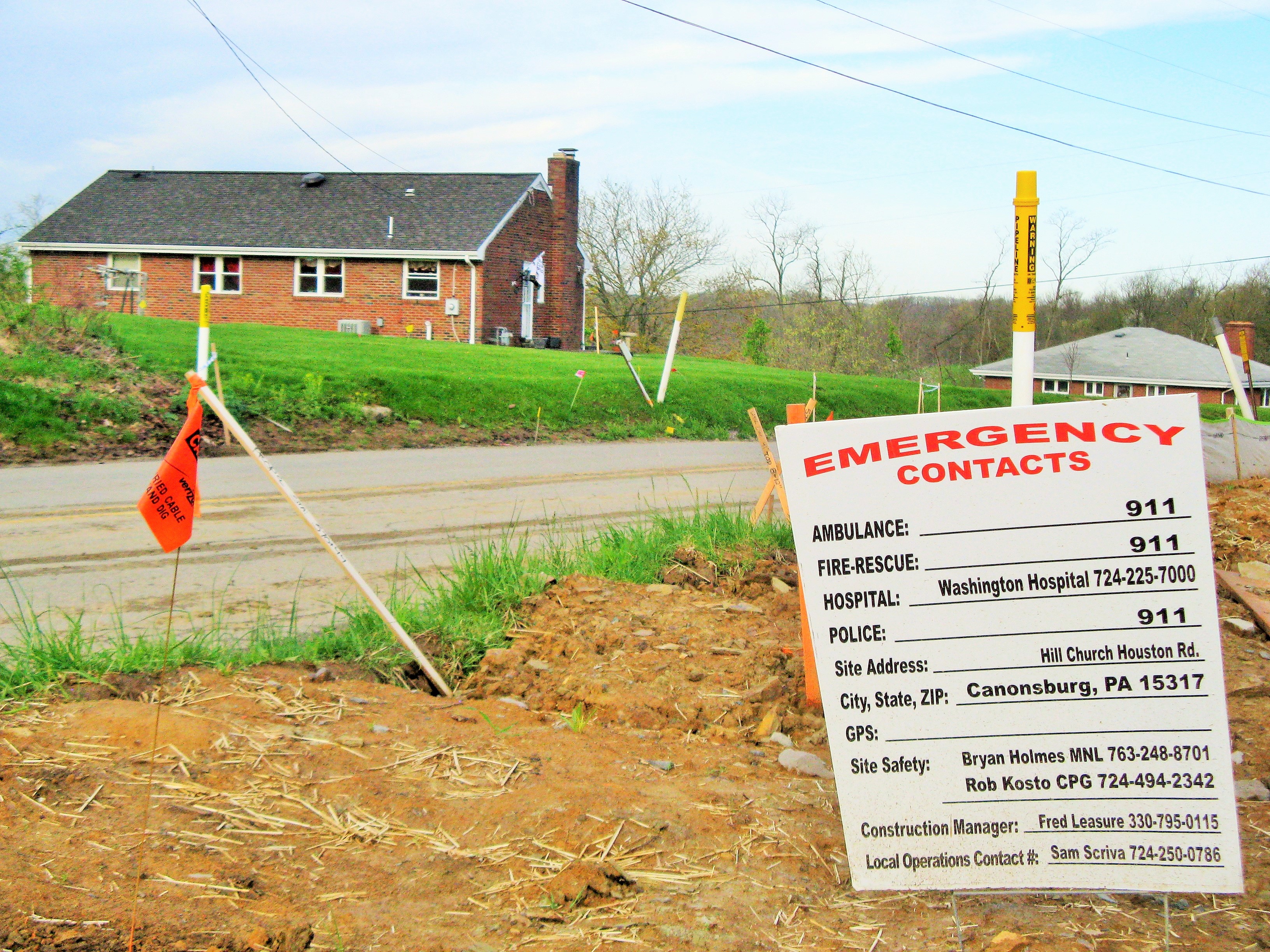
emergency-contacts-sign-at-pipeline-road-crossing

The view of nearby homes from a pipeline right-of-way, along with list of emergency contacts in case of incident. Safety precautions like these remind us of the potentially injurious nature of gas infrastructure. They also highlight the level of sacrifice being demanded of households near the hazard. Photo credit: Leann Leiter.

Building social support

These elements of a fracking-friendly frame function to isolate those who are experiencing negative effects in their own homes by minimizing, even denying, the impacts they are experiencing. Researchers in extractive regions have observed the power of this isolation. In some rural areas, isolation may be supported in part by cultural norms, such as an Appalachian appreciation for “minding one’s own business.” In at least one fracking-affected community, this widely-accepted norm hampers sharing among neighbors, prompting one resident’s complaint that “we’re all fighting like individuals.”[7] In a study of a community being driven from their homes by coal mining and power generation, another set of extractive, industrial activities, one participant lamented:

I think one of the problems of the mining and the industry is, they play on the basic everyday person’s lack of resources. There’s no social support for displacement, none whatsoever.[8]

A healthy homes frame, focused on universally shared human rights, powerfully counters the isolation. It reminds those who are suffering or have concerns about the changes to their home environment that they are not alone; others around the world are experiencing similar impacts to their households. Adopting this frame for understanding fracking is a show of support, one that acknowledges their plight.

Nearly everyone values and desires a healthy home, regardless of whether that home is an apartment, a nursing home, a cabin, or a mobile home. This frame extends beyond geographical, economical, and cultural barriers. It encourages social support from those currently removed from shale plays and the hydraulic fracturing used in extracting their resources. It empowers action, with the home front as a site of resistance, by articulating the range of rights being violated.

Focusing on what we’re fighting for

Re-centering the problems of fracking as they impact the right to a healthy home makes sense to those of us witnessing the degradation of the places people need in order to live and flourish. A rights-based approach focuses on what we’re fighting for, rather than giving extra airtime to the already-powerful frame we must fight against.

  • If you need assistance protecting your rights from planned fracking, the Delaware Riverkeeper Network offers a guide for communities and their local leaders to defending environmental rights at the municipal level.
  • For those already impacted, Fair Shake Environmental Legal Services provides “sliding scale” legal help to people in the Appalachian basin.
  • For communities at any stage of gas development, Environmental Health Project has created a Where to Turn for Help directory full of sources for air testing services, community organizing, health information, tracking and reporting fracking development and violations, and much more.

Whether or not you feel the direct impacts of fracking, we are all connected to this extensive process. Fracking’s commodity products – energy and plastics – are part of all of our lives; it’s climate-altering effect diminishes all of our futures. More importantly, we all have a crucial role to play. Here is how you can get further involved:

  • Communicate with your lawmakers – share with them this article series or your own take on fracking, and ask what frame they are using when they make decisions on this and other dangerous modes of energy extraction.
  • Join Halt the Harm Network to get connected to people, groups and events “working to fight the harms of oil and gas development.”
  • Follow @EnvironmentalHealthProject on Facebook and @EHPinfo on Twitter, and participate in the evolving discussion!

Bringing rights into the conversation on fracking challenges the fracking-friendly frame, and promotes instead protection for those in fracked households.


Special thanks to the many individuals and families who shared the experiences that informed this article series. 

References:

  1. Resick, L. K., Knestrick, J. M., Counts, M. M., & Pizzuto, L. K. (2013). The meaning of health among mid-Appalachian women within the context of the environment. Journal of Environmental Studies and Sciences , 3 (3), 290-296.
  2. Short, D., Elliot, J., Norder, K., Lloyd-Davies, E., & Morley, J. (2015). Extreme energy, ‘fracking’ and human rights: a new field for human rights impact assessments? , The International Journal of Human Rights, 19:6, 697-736, DOI:10.1080/13642987.2015.1019219
  3. John Graham, Senior Scientist at Clean Air Task Force, personal communication, June 9, 2017. Health impacts modeling completed using EPA Co-Benefits and Risk Assessment (COBRA) Screening Tool, using estimated PM 2.5 air emissions for permitted Shell ethane cracker in Beaver County, PA and four additional facilities planned in Ohio and West Virginia.
  4. Richard Heinberg cited in Short, D., Elliot, J., Norder, K., Lloyd-Davies, E., & Morley, J. (2015). Extreme energy, ‘fracking’ and human rights: a new field for human rights impact assessments? , The International Journal of Human Rights, 19:6, 697-736, DOI:10.1080/13642987.2015.1019219
  5. Resick, L. K., Knestrick, J. M., Counts, M. M., & Pizzuto, L. K. (2013). The meaning of health among mid-Appalachian women within the context of the environment. Journal of Environmental Studies and Sciences , 3 (3), 290-296.
  6. Cooley, R., & Casagrande, D. (2017). Marcellus Shale as Golden Goose. ExtrACTION: Impacts, Engagements, and Alternative Futures. Routledge.
  7. Resick, L. K., Knestrick, J. M., Counts, M. M., & Pizzuto, L. K. (2013). The meaning of health among mid-Appalachian women within the context of the environment. Journal of Environmental Studies and Sciences , 3 (3), 290-296.
  8. Connor et al., p. 54. Linda Connor, Glenn Albrecht, Nick Higginbotham, Sonia Freeman, and Wayne Smith. (2004). Environmental Change and Human Health in Upper Hunter Communities of New South Wales, Australia. EcoHealth 1 (Suppl.2), ,47-58. DOI: 10.1007/s10393-004-0053-2

By Leann Leiter, Fellow with the Environmental Health Project and FracTracker Alliance

ME2 pipeline and spills map by Kirk Jalbert

Mariner East 2 Drilling Fluid Spills – Updated Map and Analysis

Updated 8/2/17: An analysis by FracTracker and the Clean Air Council finds that approximately 202,000 gallons of drilling fluids have been accidentally released in 90 different spill events while constructing the Mariner East 2 pipeline in Pennsylvania. In a more recent update, FracTracker estimates these occurred at 42 distinct locations. Explore the map of these incidents below, which we have updated to reflect this growing total.

Last week, a judge with the PA Environmental Hearing Board granted a two week halt to horizontal directional drilling (HDD) operations pertaining to the construction of Sunoco Logistics’ Mariner East 2 (ME2) pipeline. The temporary injunction responds to a petition from the Clean Air Council, Mountain Watershed Association, and the Delaware Riverkeeper Network. It remains in effect until a full hearing on the petition occurs on August 7-9, 2017.

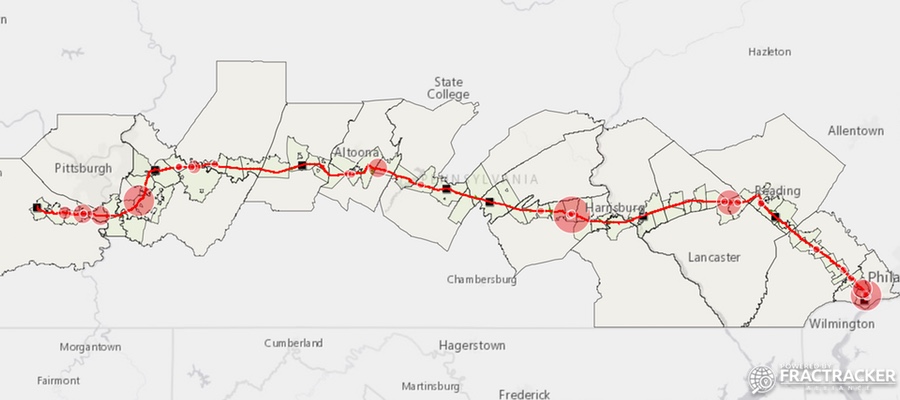
ME2 is a 350-mile long pipeline that, when complete, will carry 275,000 barrels of propane, ethane, butane, and other hydrocarbons per day from the shale gas fields of Western Pennsylvania to a petrochemical export terminal located on the Delaware River.

The petition relates to a complaint filed by the three groups detailing as many as 90 “inadvertent returns” (IRs) of drilling fluids and other drilling related spills along ME2’s construction route. IRs refer to incidents that occur during HDD operations in which drilling fluids consisting of water, bentonite clay, and some chemical mixtures used to lubricate the drill bit, come to the surface in unintended places. This can occur due to misdirected drilling, unanticipated underground fissures, or equipment failure.

What is Horizontal Directional Drilling?

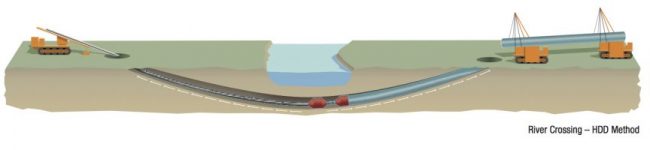
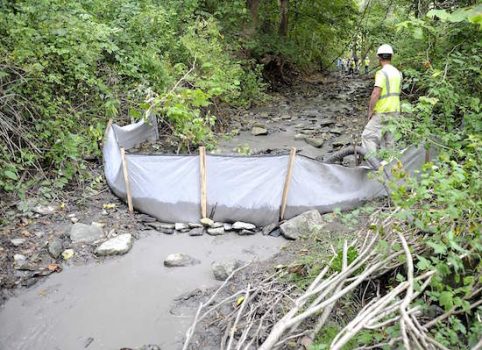
An illustration of an “ideal” horizontal directional drilling boring operation is seen in the first graphic below (image source). The second image shows what happens when HDDs go wrong (image source).

hdd_crossing_example

hdd_ir

Mapping Inadvertent Returns

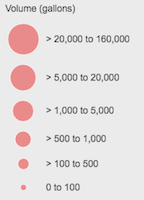
me2_ir_legendThe Pennsylvania Department of Environmental Protection (DEP) posted information on potential regulatory violations associated with these IRs on the PA Pipeline Portal website on July 24, 2017. This original file listed 49 spill locations. Our original map was based on those locations. As part of their legal filing, volunteer at the Clean Air Council (CAC) have parsed through DEP documents to discover 90 unique spills at these and other locations. On July 31, 2017, the DEP posted a new file that now lists 61 spills, which account for some of these discrepancies but not all.
Working with the CAC, we have created a map, seen below, of the 90 known IRs listed in the DEP documents and from CAC’s findings. Also on the map are the locations of all of ME2’s HDD boring locations, pumping stations, and workspaces, as well as all the streams, ponds, and wetlands listed in Sunoco’s permits as implicated in the project’s construction (see our prior article on ME2’s watershed implications here). Open the map full-screen to see many of these features and their more detailed information.


View map fullscreen | How FracTracker maps work

Analysis Results for ME2

From our analysis, we find that, conservatively, more than 202,000 gallons of drilling fluids have been accidentally released while constructing the Mariner East 2 pipeline in Pennsylvania since the first documented incident on May 3rd. We say conservatively because a number of incidents are still under investigation. In a few instances we may never know the full volume of the spills as only a fraction of the total drilling muds lost were recovered.

We analyzed where these 90 spills occurred relative to known HDD sites and estimate that there are 38 HDDs implicated in these accidents. An additional 11 spills were found at sites where the DEP’s data shows no HDDs, so we calculate the total number of “spill locations” at 42. A full breakdown by county and known gallons spilled at these locations is seen below.

County Number of IRs/Spills Gallons Spilled
Allegheny 4 2,050
Berks 3 540
Blair 3 2,400
Chester 4 205
Cumberland 32 162,330
Delaware 8 2,380
Huntingdon 1 300
Lancaster 7 5945
Lebanon 1 300
Washington 9 4,255
Westmoreland 17 21,532
York 1 25
Total 90 202,262


A few important notes on our methods and the available data we have to work with:

  1. CAC obtained spills from DEP incident reports, inadvertent return reports, and other documents describing spills of drilling fluid that have occurred during Mariner East 2 construction.  Those documents reflected incidents occurring between April 25, 2017 and June 17, 2017. In reviewing these documents, volunteers identified 61 discrete spills of drilling fluid, many of which happened at  similar locations. Unfortunately, separate coordinates and volumes were not provided for each spill.
  2. When coordinates were not provided, approximate locations of spills were assigned where appropriate, based on descriptions in the documentation. Two IRs have no known location information whatsoever. As such, they are not represented on the map.
  3. Spill volumes were reported as ranges when there was inconsistency in documentation regarding the same spill. The map circles represent the high-end estimates within these ranges. Of the 90 known spills, 29 have no volume data. These are represented on the map, but with a volume estimate of zero until more information is available.
  4. All documentation available to CAC regarding these spills was filed with the Environmental Hearing Board on July 19, 2017. DEP subsequently posted a table of inadvertent returns on its website on July 24, 2017.  Some of those spills were the same as ones already identified in documents CAC had reviewed, but 29 of the spills described on the DEP website were ones for which CCAC had never received documentation, although a subset of these are now listed in brief in the DEP spreadsheet posted on July 31, 2017. In total then, the documentation provided to CAC from DEP and spreadsheets on the DEP website describe at least 90 spills.

HDD Implications

The DEP’s press release assures the public that the drilling fluids are non-toxic and the IRs are “not expected to have any lasting effects on impacted waters of the commonwealth.” But this is not entirely the case. While the fluids themselves are not necessarily a public health threat, the release of drilling fluids into aquifers and drinking wells can make water unusable. This occurred in June in Chester County, for example.

More commonly, drilling fluid sediment in waterways can kill aquatic life due to the fine particulates associated with bentonite clay. Given that HDD is primarily used to lay pipe under streams, rivers, and ponds (as well as roads, parks, and other sensitive areas), this latter risk is a real concern. Such incidents have occurred in many of the instances cited in the DEP documents, including a release of drilling muds into a creek in Delaware County in May.

We hope the above map and summaries provide insights into the current risks associated with the project and levels of appropriate regulatory oversight, as well as for understanding the impacts associated with HDD, as it is often considered a benign aspect of pipeline construction.


By Kirk Jalbert, Manager of Community Based Research and Engagement, FracTracker Alliance

If you have any questions about the map on this page or the data used to create it, please contact Kirk Jalbert at jalbert@fractracker.org.

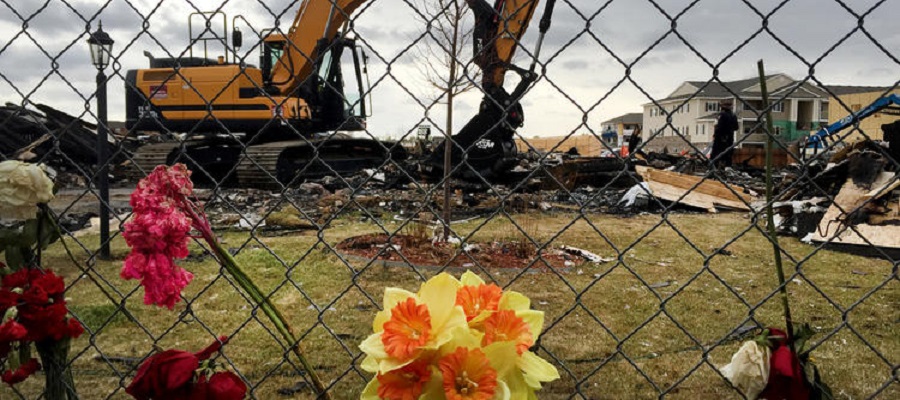
Heavy equipment moves debris from the site of a house explosion April 17 in Firestone, Colo., which killed two people. (David Kelly / For The Times)

Risks from Colorado’s Natural Gas Storage and Transmission Systems

Given recent concerns about underground natural gas storage wells (UGS), FracTracker mapped UGS wells and fields in Colorado, as well as midstream transmission pipelines of natural gas that transport the gas from well sites to facilities for processing. Results show that 6,673 Colorado residents in 2,607 households live within a 2.5 mile evacuation radius of a UGS well. Additionally, the UGS fields with the largest number of “single-point-of-failure” high-risk storage wells are also the two fields in Colorado nearest communities.

Worst Case Scenario

A house exploding from a natural gas leak sounds straight out of a 19th century period drama, but this tragedy just recently occurred in Firestone, Colorado. How could this happen in 2017? We have seen pictures and read reports of blowouts and explosions at well sites, and know of the fight against big oil and natural gas pipelines across the country. At the same time we take for granted the natural gas range that heats our food to feed our families. The risk of harm is seemingly far removed from our stove tops, although it may be much closer to home than we think – There are documented occupational hazards and compartmentalized risks in moving natural gas off site.

Natural gas is an explosive substance, yet the collection of the gas from well sites remains largely industry-regulated. Unfortunately, it has become clear that production states like Colorado are not able to provide oversight, much less know where small pipelines are even located. This is particularly dangerous, since the natural gas in its native state is ordorless, colorless, and tasteless. Flowing in the pipelines between well sites and processing stations, natural gas does not contain the mercaptan that gives commercial natural gas its tell-tale odor. In fact, much of the natural gas or “product” is merely lost to the atmosphere, or much worse, can collect in closed spaces and reach explosive levels. This means that high, potentially explosive levels of methane may go undetected until far too late.

Mapping Flow Lines

As a result of the house explosion in Firestone on April 17th CO regulators are now requiring oil and gas operators to report the location of their collection flow pipelines, as shown in Figure 1.

Figure 1. Map of Gathering Pipeline “Flowlines”


View map fullscreen

The locations of the collection of pipeline “flowlines”, like the uncapped pipeline that caused the house explosion in Firestone, have been mapped by FracTracker Alliance (above). The dataset is not complete, as not all operators complied with the reporting deadline set by the COGCC. For residents living in the midst of Colorado’s oil and gas production zones, addresses can be typed into the search bar in the upper left corner of the map. Users can see if their homes are located near or on top of these pipelines. The original mapping was done by Inside Energy’s Jordan Wirfs-Brock.

Underground Storage

When natural gas is mixed with mercaptan and ready for market, operators and utility companies store the product in UGS fields. (EDIT – Research shows that in most cases natural gas in UGS fields is not yet mixed with mercaptan. Therefore leaks may go undetected more easily. Aliso Canyon was a unique case where the gas was being stored AFTER being mixed with mercaptan. Odorization is not legally required until gas moves across state lines in an interstate pipeline or is piped into transmission lines for commercial distribution.) In August 2016, a natural gas storage well at the SoCal Gas Aliso Canyon natural gas storage field failed causing the largest methane leak in U.S. history. The Porter Ranch community experienced health impacts including nosebleeds, migraines, respiratory and other such symptoms. Thousands of residents were evacuated. While Aliso Canyon was the largest leak, it was by no means a unique case.

FracTracker has mapped the underground natural gas storage facilities in Colorado, and the wells that service the facilities. As can be seen below, there are 10 storage fields in Colorado, and an 11th one is planned. All the fields used for storage in Colorado are previously depleted oil and gas production fields. The majority of storage wells used to be production wells. All sites are shown in the map below (Figure 2).

Figure 2. Map of Natural Gas Underground Storage Facilities


View map fullscreen | How FracTracker maps work

Impacted Populations

Our analysis of Colorado natural gas storage facilities shows that 6,673 Colorado residents living in 2,607 households live within a 2.5 mile evacuation radius of a UGS well. The majority of those Coloradans (5,422) live in Morgan County, with 2,438 in or near the city of Fort Morgan. The city of Fort Morgan is surrounded by the Young Gas Storage Facility with a working capacity of 5,790,049 MCF and Colorado Interstate Gas Company with a working capacity of 8,496,000 MCF.

By comparison, the failure in Aliso Canyon leaked up to 5,659,000 MCF. A leak at either of these facilities could, therefore, result in a similar or larger release.

UGS Well Risk Assessment

A FracTracker co-founder and colleague at Harvard University recently completed a risk assessment of underground natural gas storage wells across the U.S. The analysis identified the storage wells shown in the map above (Figure 1) and defined a number of “design deficiencies” in wells, including “single-point-of-failure” designs that make the wells vulnerable to leaks and failures. Results showed that 2,715 of the total 14,138 active UGS wells across the country were constructed using similar techniques as the Aliso Canyon failed well.

Applying this assessment to the wells in Colorado, FracTracker finds the following:

  • There are a total of 357 UGS wells in Colorado.
  • 220 of which are currently active.
  • Of those 220 UGS wells, they were all drilled between 1949 and 1970.
  • 43 of the UGS wells are repurposed production wells.
  • 40 of those repurposed wells are the highest risk single barrier wells.

Specifically focusing on the UGS fields surrounding the city of Fort Morgan:

  • 21 single barrier wells are located in the Flank field 2.5 miles North of the city.
  • 13 single barrier wells are located in the Fort Morgan field 2.5 miles South of the city.

We originally asked how something as terrible as Firestone could have occurred. Collectively we all want to believe this was an isolated incident. Sadly, the data suggest the risk is higher than originally thought: The fields with the largest number of “single-point-of-failure” high-risk UGS wells are also the two fields in Colorado nearest communities. While the incident in Firestone is certainly heartbreaking, we hope regulators and operators can use the information in this analysis to avoid future catastrophes.


By Kyle Ferrar, Western Program Coordinator, FracTracker Alliance

Feature Image: Heavy equipment moves debris from the site of a house explosion April 17, 2017 in Firestone, Colorado, which killed two people. (David Kelly / For The Times)