Tag Archive for: Pennsylvania

Logbook FracTracker Postcard Front

Summer Summary of the Trail Logbook Project

As summer transitioned into fall, and as winter knocks on our doorsteps in PA, I would like to take some time to summarize the preliminary feedback coming in through our pilot Trail Logbook Project. The project, for those of you who aren’t familiar, is a collaboration between Keystone Trails Association (KTA) and FracTracker Alliance. With the expansion of unconventional natural gas extraction into our state forests, we wanted to understand the experiences of people who are using those areas for recreation – and to document the change in those experiences as drilling continues. Most of the results of the project so far indicate that drilling is having a small, but notable effect on the traditionally tranquil experiences of hikers, bikers, and the like across the Commonwealth. The most common complaints are those of noise and degradation of scenery (see complete list ofLogbook reports below, or trail alerts on KTA’s website). Some people who entered information into the Logbook have noted that gas-drilling opponents have actually contributed to the degradation of the local scenery with graffiti and protest signs.

Given the number of hikers and other outdoor enthusiasts that frequent the Commonwealth every year, we need more people to report back to us in order to make a comprehensive and accurate statement about the overall impacts that drilling may be having on some of PA’s most beautiful natural resources. Perhaps there are no more issues to report, or perhaps people just don’t know who to tell. Regardless, we hope to expand our efforts to promote the project, which includes working with trail organizations in other states where shale gas activities may conflict with trail use.

On a side note, the lack of awareness about the Logbook and the state of drilling in popular recreation areas are key reasons why we are hosting a series of media tours this fall. The first was held on October 25th in Loyalsock State Forest due to the conerns of environmental concervation groups and residents about the communication barriers in existence between DCNR, the natural gas industry, and the public. If you are interested in participating in one of the next two tours, learn more here.

The full list of Logbook complaints to-date and the main areas impacted by unconventional natural gas extraction activity according to those reports are listed below:

Complaints from Logbook

Visual Degradation of Scenery

  • Anti-gas drilling graffiti
  • Flagging tape indicating seismic testing or road widening littered the area, called into question the “leave no trace” character of the trail
  • Intense construction activity and clearings for pipelines

Noise Pollution

  • Constant noise from compressor station
  • Helicopters
  • Construction and well pad noise

Safety

  • Seismic Testing: One hiker found 2 red wires with labels “Danger Explosives” portruding up from the ground
  • Seismic Testing: Equipment left right on the trail

Convenience

  • Trail relocation (4 miles)
  • Flagging tape caused confusion regarding the direction of trail

Main Areas Impacted

Production Data by Operator for PA’s Unconventional Wells

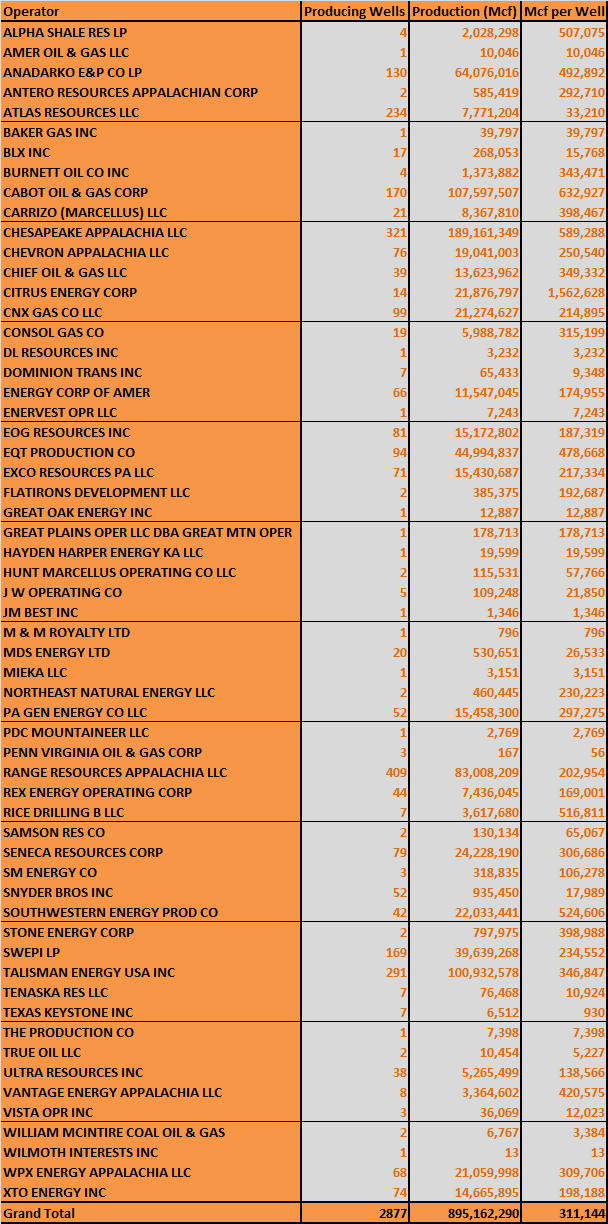
A visitor to our site recently asked about the amount of shale gas produced in Pennsylvania by operator.  The following table contains data from the first six months of 2012, summarized by operator. It includes the number of wells showing gas production, the total sum of gas produced, and the average production of each operator’s producing wells. The dataset was downloaded on October 30, 2012, which is important to note, as it is sometimes updated without notice.

The results vary tremendously.  There could be numerous reasons for this, including the age and location of the wells.  This table does not take into consideration condensate or oil production, however those categories are rare in Pennsylvania’s Marcellus Shale and other unconventional wells.

Trends in PA Data for Unconventional Wells

The Pennsylvania Department of Environmental Protection (PADEP) maintains datasets that are updated nightly for permits, drilled wells, and violations.  It seems like it should be a fairly simple task to find totals and trends in this data, but this isn’t always as straight-forward as one might hope.

For example, on the permits data that I downloaded from PADEP on October 22, 2012, there were 13,847 entries, but only 10,512 unique wells as defined by their eight digit API number.  This part is explainable, since additional permits are required for alterations to existing wells, but then there is the PADEP workload report, which counts 11,819 permits issued through October 12, 2012–a number that is obviously altogether different.

The drilled wells dataset used to be similarly afflicted, but the data now seem to be cured of that malady. However, the drilled wells had another issue: In January of this year, the Post-Gazette reported that there were hundreds of wells on the production dataset that were not on the drilled wells list, which is problematic because we’ve not yet figured out how to get the gas out of the ground without drilling a well first. At any rate, there is some reason to believe that this issue has been addressed–at least in part–as there are now records of more historical drilled unconventional wells than there used to be.

Which takes us to violations. The obstacle here is that there are often numerous issues that are encountered on an inspection, and the data show that PADEP hasn’t always been consistent in how it has handled that fact. While it does seem clear that PADEP counts violations by the number of discrete violation ID numbers that have been issued, sometimes those numbers have been used to apply to more than one issue found at a well. In addition, sometimes a single violation seems to apply to more than one well (perhaps at the same wellpad), and then sometimes there are enforcement actions that go along with violations, which generates a new line of data in the report. The net result is that the violations data that I downloaded on October 26, 2012 had 4,696 rows of data, which contained 4,064 violation ID numbers. Unlike permits and drilled wells, the workload report (see above) does not tally violations for multiple years, so that comparison is not available.

Given all of this, we can now see why questions such as, “How many unconventional gas permits have been issued in Pennsylvania?” are less straight-forward than one would hope. It also creates a challenge when trying to analyze the data that is based on such questions, while minimizing skew.

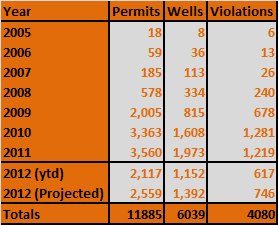
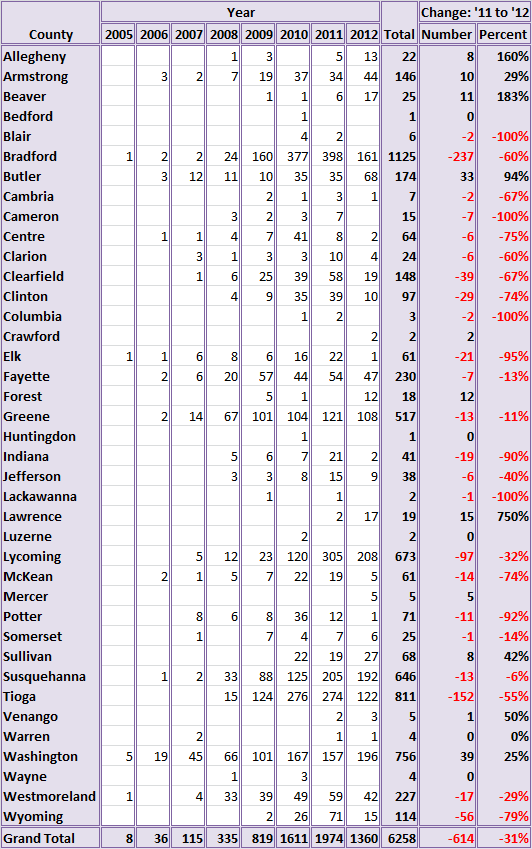
In order to look at long-term trends we need a consistent approach, so I developed a simple strategy to tackle these questions: use the summary information provided by PADEP from the dataset queries.  Results may therefore not reflect what I think to be an optimal representation of events on the ground, but they are totals produced by PADEP that have been obtained in a uniform manner. For each year, I searched for all unconventional records between New Year’s Day and New Year’s Eve, except for 2012 of course, where I used today’s date. Here are those results:


Unconventional gas activity in Pennsylvania, with 2012 year to date totals and projections

The projected totals, for those who are curious, are based on the fact that October 29th is the 302nd day of the year, and multiplying the year to date totals by the inverse of the percentage of time elapsed in the year (365/302).  The projected total for each category is down substantially from 2011 totals.  Let’s take a closer look at each one:


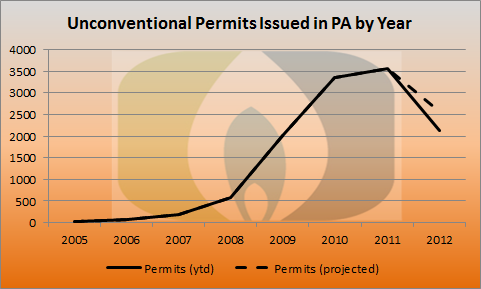
Permits issued by year
At the current rate, there will be 1001 fewer permits for unconventional oil and gas wells issued in 2012 as the year before, a reduction of 28%.  This was widely predicted due to the low price of natural gas earlier in the year.  That price has now rebounded back to $3.81. It remains to be seen whether permit counts rebound as well.


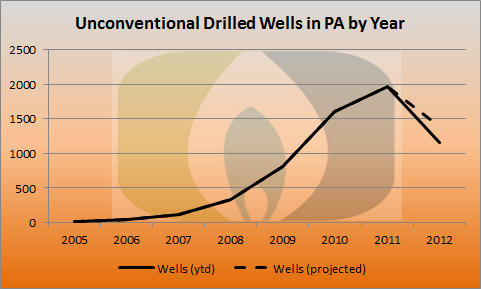
Drilled wells per year
This graph looks pretty similar to the permits, with the exception that all of the total values are lower. 2012 is on pace to have 581 fewer wells drilled statewide than 2011, a 29% reduction, presumably for much the same reason as permits.


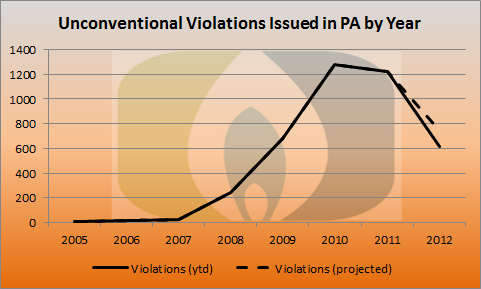
Violations issued per year
The number of violations peaked in 2010, so there may be some reason for the reduction other than the fact the industry itself is in a phase of contraction. Pennsylvania is on pace for 473 fewer violations that last year, which is a 39% drop. What these numbers cannot tell us is why. Is it a result of better performance in the field or less rigorous inspection by an administration with long-standing ties to the industry, or both?


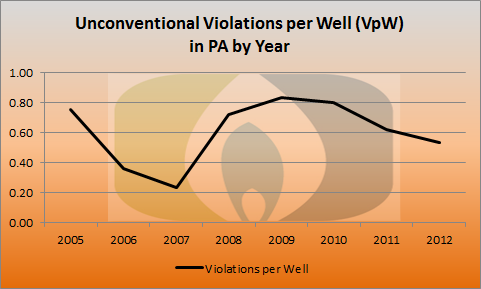
Violations per drilled well, by year
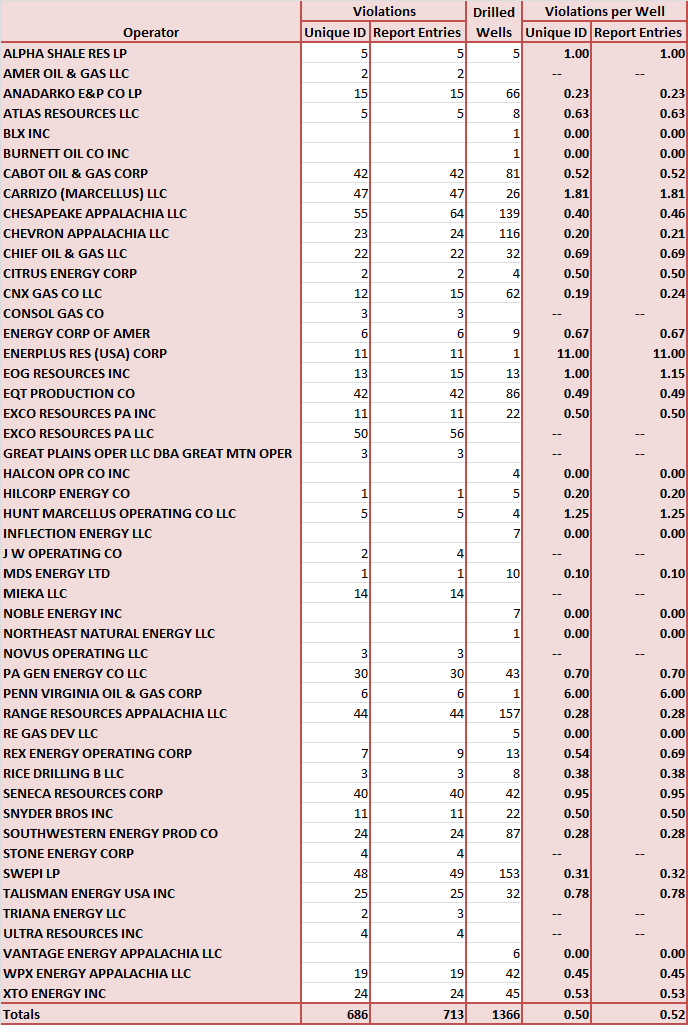
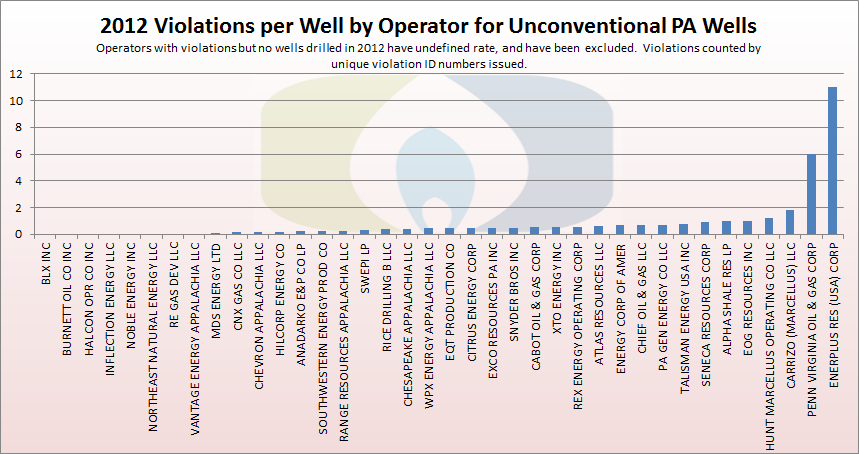
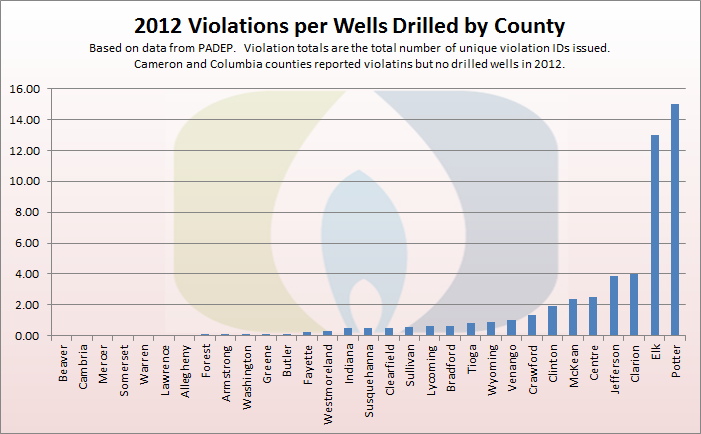
Since 2010, I’ve taken periodic looks at the number of violations issued divided by the number of wells drilled. It is a somewhat simplistic but effective way to conduct a cost-benefit analysis of impact by various operators, geographies, or in this case, time. The 2012 rate of 0.54 violations per drilled well is down 13% from last year, and 36% from the peak in 2009. This chart also has a huge dip in the years 2006 and 2007, at a time when the number of wells being drilled was small but growing rapidly.

Approaching 10K Unconventional Wells in PA

Spatial Distribution of Unconventional Production in PA

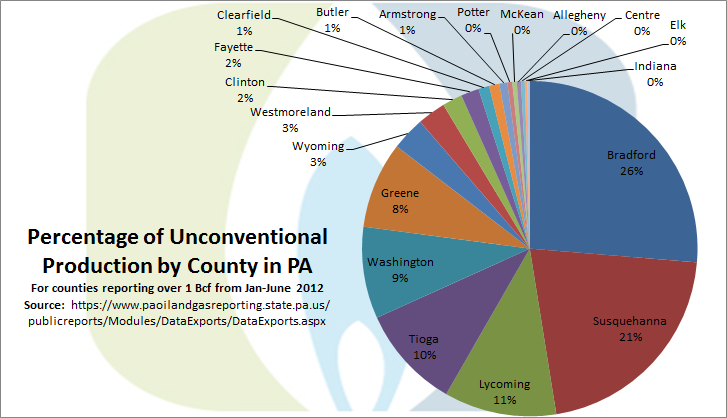
In the first half of 2012, gas production from unconventional sources such as the Marcellus Shale was reported in 30 different counties in Pennsylvania, according to data downloaded from the Pennsylvania Department of Environmental Protection (PADEP) website on September 10, 2012. Of these, 19 counties had aggregated totals of at least one billion cubic feet (Bcf), lead by Bradford (235 Bcf); Susquehanna (189 Bcf); Lycoming (97 Bcf); Tioga (89 Bcf); Washington (79 Bcf); and Greene (74 Bcf). Here are the proportions of those 19 counties presented graphically:

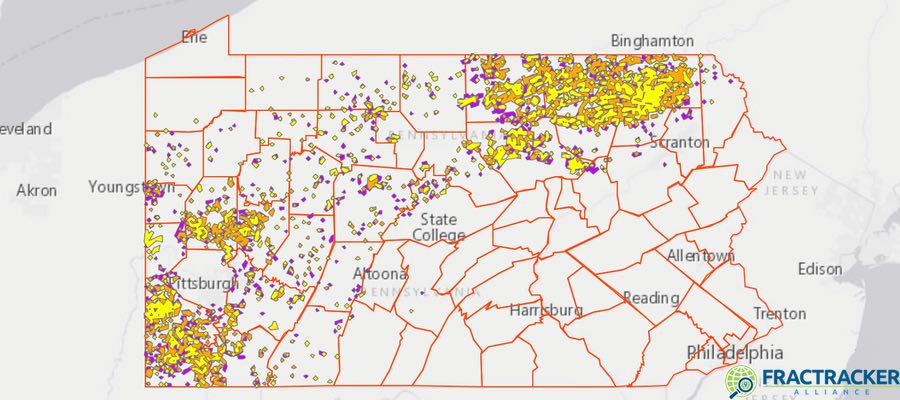
We can also view the data spatially. To find out the production value of any county, please click the blue “i” tool, then any county shown in blue. Also added is the location of the top ten wells in the state in terms of natural gas production for the six month period:

On this view, the top wells are clustered so closely together that there appear to be only four. The top two producers are both operated by Citrus Energy in Meshoppen Bourough, a small town in Wyoming County with 563 residents as of the 2010 Census, and a total surface area of 0.7 square miles. The other eight wells on the list are operated by Cabot Oil and Gas in a handful of municipalities in Susquehanna County. Here is a closer look at the wells, with an additional layer of all unconventional drilled wells:

The wells in red are the same 10 wells, all within 10 miles of one another as the crow flies. The wells in black show the other unconventional drilled wells in the area as of late August. Obviously, this part of the state has been the focus of considerable attention by the operators active in the region.

Pennsylvania Unconventional Waste Data

As we recently learned with unconventional production report, one never quite knows when Pennsylvania Department of Environmental Protection (PADEP) datasets are complete. According to the Post-Gazette, PADEP considers the reports to speak for themselves, and information is shared with the public without preamble or fanfare as it becomes available.  Therefore, we can’t know that self-reported data, in this case unconventional waste report, is ever truly complete.  Hopefully at this point, which is now several weeks after the reporting deadline, we can let the report speak what it will, expecting that further changes will be fairly minor in scope.

In addition to all of that, some oil and gas operators were apparently confused about the difference between gallons and 42 gallon barrels in the past, leading to wildly erroneous reports.  We’ll just have to hope that’s not the case.

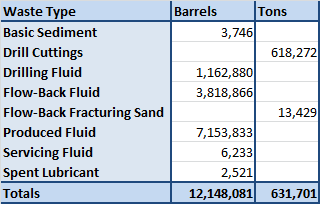
First, let’s take a look a the amount of waste produced by type for unconventional wells between January and June of 2012:

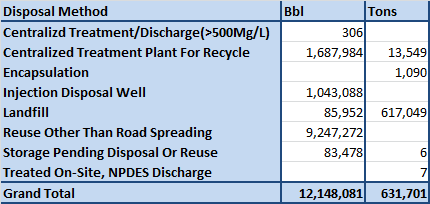
And here is the same dataset, arranged to show disposal method (with the waste types grouped together for the sake of simplicity):

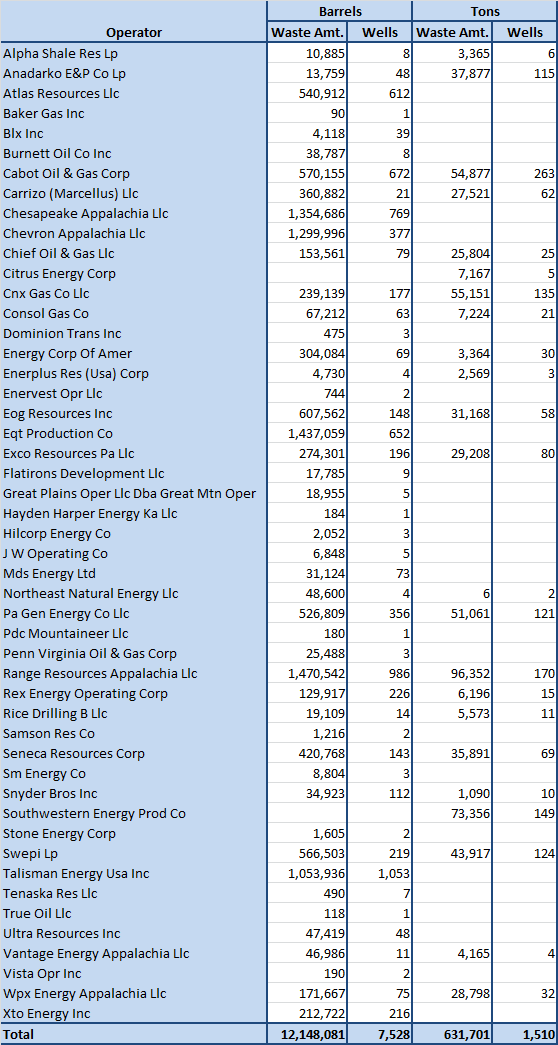
Here are the data arranged by operator:

Please note that not all wells that are present on the report are producing waste, or have even been drilled for that matter.  In fact, there is a column in the data where operators can explain why there is no waste being reported.  Here are those results, summarized:

This does not mean, however, that there are 7,994 wells producing waste.  In fact, there are only 5,651 instances of wells reporting at least some amount of one or more kinds of waste, a number roughly in line with the spud count.  This number was actually more than I had expected, since it is known that not all of the spudded (drilled) wells have been put into production, and that reported totals for drill cuttings are remarkable modest for a series of holes in the ground that are roughly between 5,000 and 8,500 feet deep.  The explanation, it turns out, is due to the architecture of the dataset, wherein each line of data is capable of handling only one type of waste, so that wells reporting multiple types of waste must appear more than once.  Therefore, there are not 9,038 wells, or even 5,651.  There are 3,922 unique wells on the report, as counted by the unique well API numbers.  For this reason, in the charts above, it is best to think of the “Wells” columns as “Instances” instead.

It is also probable that different operators report their waste in different ways.  For example, EQT and Chesapeake are both near the top of the list in the amount of barrels of liquid waste produced, but neither one reported any waste that was measured in tons (drill cuttings and flowback fracturing sand).  Without having seen their operations in the field, we must assume that the waste produced is fundamentally similar to that of other operators–perhaps they reported the waste content as a viscous fluid rather than filtering out some of the solids, as other operators seem to do.

Drilled Wells in PA by Watershed Data Available

This information is out of date. Please visit our FracMapper page for updated PA maps.


There are two new Pennsylvania watershed available for download on FracTracker’s DataTool:

  • Pennsylvania Watersheds (HUC12), which shows the boundaries of watershed boundaries within the state at relatively fine level of detail. In general, the higher the number associated with the HUC (hydrologic unit code), the smaller the size of the watershed, and the greater the accuracy and resolution of the file. For more information on HUC’s, see this US Geologic Survey page.
  • Pennsylvania Watersheds With Drilled Unconventional Wells (8-29-2012), which contains those watersheds in the above dataset with one or more drilled wells, as determined by a spatial join with PADEP drilled unconventional welldata.Included on this dataset for each watershed is the number of unconventional wells drilled within its boundary from January 1, 2005 through August 29, 2012, as well as a density of wells per square kilometer.

You can find out more information on any watershed in the maps below by clicking the blue “i” tool, then clicking on any watershed shape. Please click the gray compass rose and double carat (^) symbol to hide those menus.


Drilled unconventional wells by watershed in Pennsylvania


Density of drilled unconventional wells per square kilometer in Pennsylvania watersheds

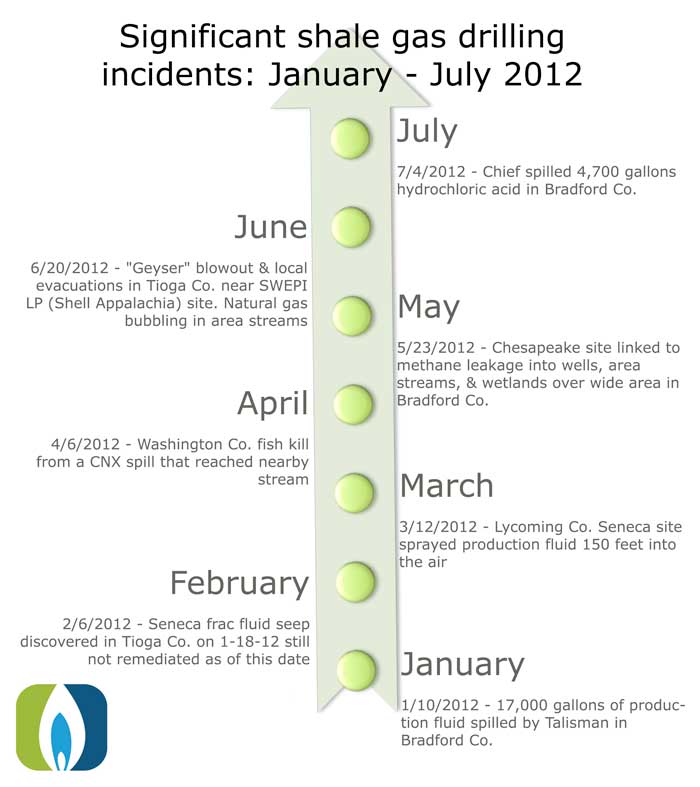
Incidents continue to make headlines during drilling slowdown

Although drilling activity in some areas of PA seems to have slowed due to the lower price of natural gas ($2.82 per MMBtu), the decline in violations cited by the PA DEP have not followed that trend as quickly as one would hope. There have still been plenty of incidents over the last few months that keep the safety of drilling at the forefront of the media and in residents’ minds. Just last night there was a confirmed report about a gas well explosion (or possibly fire) in Susquehanna County. West Virginia is not exempt from these problems, either, after three rig workers were injured in an explosion at an Antero well pad on August 17th.

Check out the timeline below of  a selection of significant gas drilling incidents in PA that have surfaced since January 2012.


Unconventional Gas Production Cut in Half in PA

The Pennsylvania Department of Environmental Protection (PADEP) has released their semi-annual unconventional production and waste reports. This data is self-reported from well operators to PADEP. While in the past, this report was limited to Marcellus Shale wells only, now it includes wells in other formations, such as the Utica, which require similar treatment to extract hydrocarbons.

Despite the expanded definition, the gas production for this period is half that of the previous six months, and barely more than one fifth of condensate production:

Here’s a look at just the gas production over the last three cycles:

In the map below, you can see production values for each well that reported for the cycle. Please click the compass rose and double carat (^) to hide those menus, then click the “i” tool and any map icon to learn about specific wells.

Unconventional Permits Declining Sharply in PA

Following shale gas trends in the media can be a confusing task. One article, entitled Shale gas boom lifts W.Va. construction industry, discusses the positive impact that the gas industry has had on the construction industry in recent years. But it also includes the following quote:

“In 2011, there was so much demand and so much work and we participated in that. Now that demand has been somewhat faded and we need to move on,” said John Strickland, president of Maynard C. Smith Construction of Charleston. “Last year it just seemed like there was a lot of work to bid … the double edge sword was the work dried up.”

That makes it seem like the headline is more appropriate for 2011 than 2012.

And in a recent AP article titled Marcellus Shale becoming top US natural gas field, the authors discuss the explosion of the Marcellus Shale in recent years in comparison to declines in other prominent shale gas plays, such as the Haynesville. They note:

For now, it looks like the Marcellus region will be in the top production spot for several years, analysts say. While drilling has slowed, there were still 288 new well permits issued in May, and over 1,200 for the first five months of the year, according to data from LCI Energy Insight, an El Paso firm that tracks national energy trends.

I found this curious for two reasons. First of all, the PADEP only issues production reports twice a year, and the report for the first half of 2012 has not yet been released, making the timing of claim for the top spot in production somewhat dubious. On the other hand, permit data is issued nightly, and yet, the August 5 article chose to cite permit data from May. Knowing that unconventional activity has declined in recent months, that got me wanting to take a closer look.  Here are the total number of permits issued for unconventional wells in Pennsylvania for the first seven months of 2012 (including permits for new wells as well as re-drills):
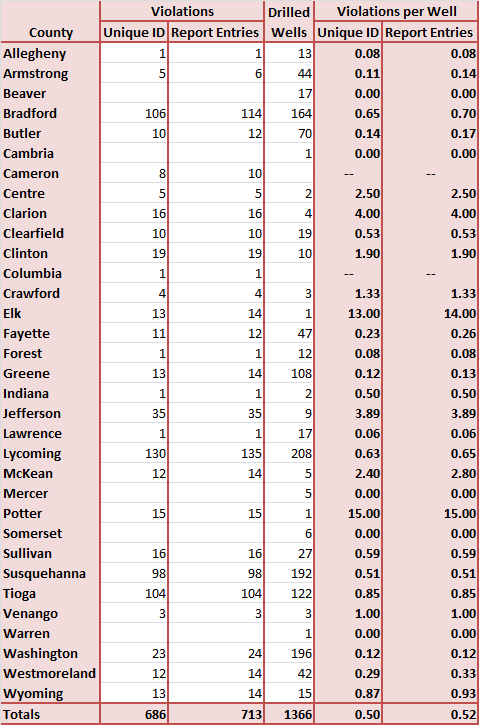
There were 229 fewer unconventional permits issued in Pennsylvania during July than there were in January, a difference of almost twice the number of July permits. In May, the month used in the quote above, there were 246 permits issued in Pennsylvania (the other 42 were presumably from West Virginia). Two months later, there were 130 fewer permits issued.

Here is what the data look like county by county. For any of the following maps, you can hide the overlaying menus by clicking on the gray compass rose and the double carat (^) tabs, and find out more information about each county by clicking on the blue “i” tool then the county of interest.

Unconventional permits issued in PA by county: January, 2012

Unconventional permits issued in PA by county: July, 2012
These first two maps are drawn with the same numeric scheme, even though no county reached either of the highest two categories in July.

Difference in unconventional permits issued in PA by county: July 2012 totals minus January 2012 totals
The color scheme here is designed to represent symmetry from zero, however the actual distribution is quite skewed. The biggest loss in permits from January to July was Bradford County with 62, while the biggest gain was 5 permits, seen in both Greene and Somerset Counties.

Unconventional Gas Activity in Pennsylvania

Recently, the Pennsylvania Department of Environmental Protection (PADEP) Office of Oil and Gas Management changed a column on a variety of their data that they distribute. Now, instead of indicating whether or not a well is permitted or drilled into the Marcellus Shale, we are given data as to whether or not it is an unconventional well. This is a move likely designed to incorporate the Utica Shale, and perhaps other formations as well. PADEP defines unconventional wells as:

An unconventional gas well is a well that is drilled into an Unconventional formation, which is defined as a geologic shale formation below the base of the Elk Sandstone or its geologic equivalent where natural gas generally cannot be produced except by horizontal or vertical well bores stimulated by hydraulic fracturing.

Historically, of course, the lion’s share of unconventional wells in Pennsylvania have been drilled into the Marcellus Shale, although I have encountered the odd report about activity in the Utica.  Interestingly, just across the state line in Ohio, the situation is more or less reversed; evidently operators in the Buckeye State find the Utica to be more enticing than the Marcellus. In Pennsylvania, these distinctions will unfortunately be lost for us moving forward because they will be lumped together as unconventional, but really, the process is the same and the associated concerns are too. We just won’t be able to effectively compare the two black shale formations to each other in Pennsylvania.

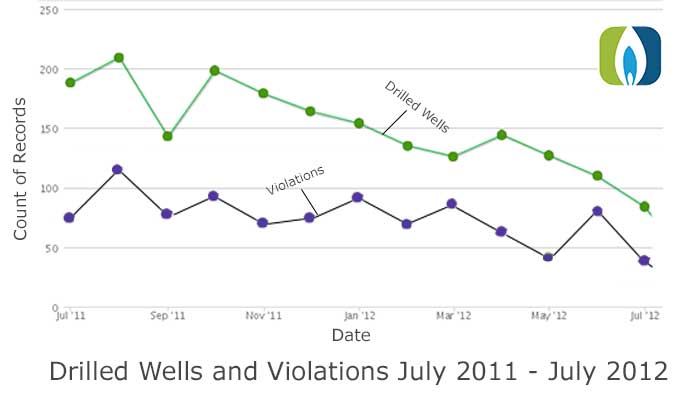
I always feel like changes in data are a good opportunity for a retrospective. Here, perhaps for the first time ever, is a single chart with permits, violations, and drilled wells, dating back to 2005:

Obviously, June 2012 is not yet over, and the data though the 25th represents only about 83% of what we would expect for month long totals.  However, the decline in recent months is notable on all three fronts.  Let’s zoom in, so to speak, and take a look at the last 12 complete months, and add some Excel generated trend lines while we are at it:

While there is obviously significant fluctuation on a month to month basis, the negative slope of the trend lines show that these three indicators of activity for unconventional wells in Pennsylvania are all well down over a one year period.
Here is the data spatially (with violations upload pending):

Unconventional Wells and Permits in PA (large)

Notes:  At the risk of being redundant from post to post, I always like to say a few a words about how I worked with the data, just in case you want to try this at home and your graph looks a little different. The permits require a bit of preparation, because there can be multiple items listed for the same well. While that data can be valuable, it’s not really what we are looking for in this analysis. I have resolved this by using the earliest permit action for any given well API number. The drilled wells are unchanged from the original, as each well appears on the downloaded dataset exactly once. The violations are also unchanged from the original in terms of the number of records used. This results in a number of actions greater than the official DEP count of violations, which are apparently tallied by the number of violation ID’s issued. As I have mentioned elsewhere there are numerous issues with the violation dataset, and my perception is that there was a period of time in which there was a lack of uniformity in how the data were entered, which is reflected in data trail left behind. So while using all records from the data download may inflate the number of of violations, to use only the unique violation ID’s will yield a number that is too small.

Tag Archive for: Pennsylvania

Nothing Found

Sorry, no posts matched your criteria